
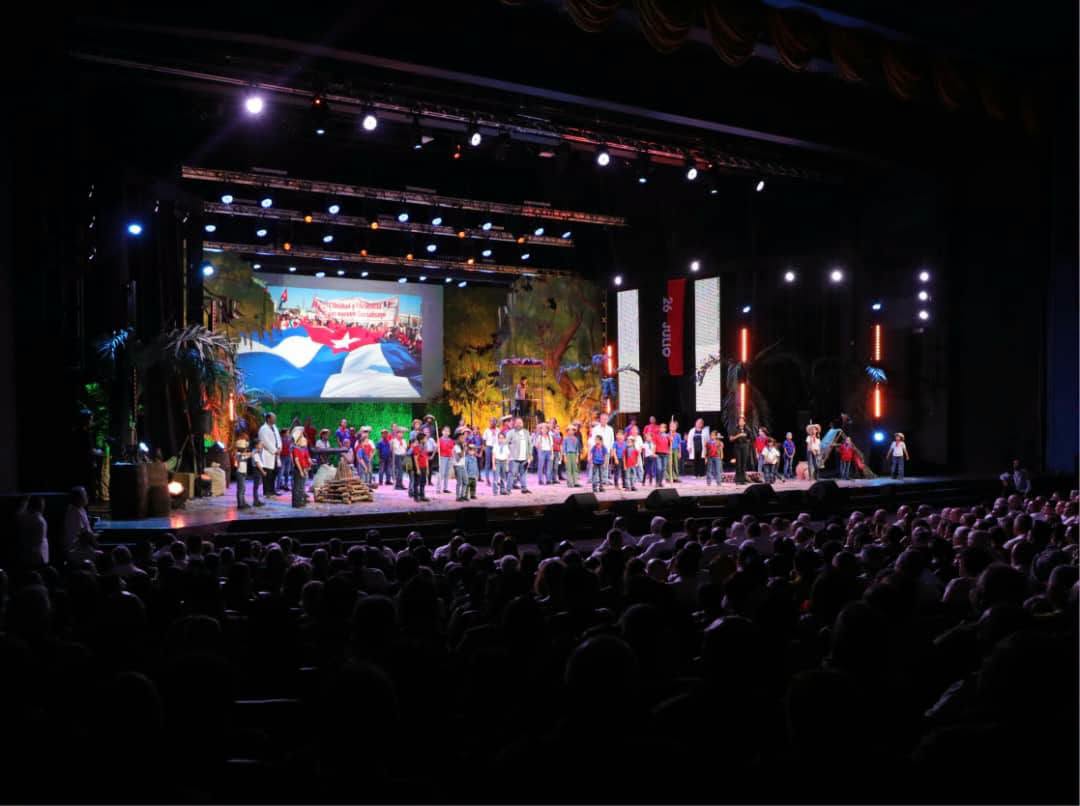
The closing activities of 100th anniversary celebrations of Fidel Castro’s birth on 13 August 2026, were held at Havana’s Karl Marx Theatre.
Colloquium for Fidel closes with a big event
The event was attended by Raúl Castro, described as the leader of the Cuban Revolution and Fidel’s closest comrade and brother, as well as President Miguel Díaz-Canel, senior Party, state and military officials, Fidel’s family and close collaborators, and representatives of Cuban society.
According to Granma, the ceremony also marked the closing of the First International Colloquium “Fidel: Legacy and Future,” which had brought together participants and friends of Cuba from 63 countries. Delegates and the audience repeatedly chanted “Fidel” and “Fidel is present,” reflecting the event’s central message that Fidel’s political ideas and revolutionary legacy remain alive.
In his keynote speech, Díaz-Canel reviewed Fidel’s life and political legacy, portraying him as a revolutionary and anti-imperialist figure whose importance extended beyond Cuba to Africa, Asia, Latin America and the wider world. He argued that being a Fidelista means maintaining a commitment to anti-imperialism and opposition to injustice. Díaz-Canel identified three principles inherited from Fidel as non-negotiable: national independence, the Revolution, and the values and achievements of socialism. He linked these principles to Cuba’s current economic and social transformations.
A major theme of the ceremony was the idea that Fidel’s legacy belongs not only to Cuba but to revolutionary movements internationally. Díaz-Canel said that future historians would see not merely one individual when looking for Fidel, but millions of people inspired by his example.
The cultural programme, performed largely by the children's theatre group La Colmenita, presented Fidel’s legacy through themes associated with his government and political project: sport as a social right, scientific development, revolutionary heroes, solidarity and internationalism. It highlighted Cuban sporting figures, scientists and political figures, as well as struggles involving personalities such as Elián González and the Cuban Five.
Cuban international solidarity was strongly emphasized, presented as one of Fidel’s defining principles. Cuba was portrayed as a small country that, despite the US blockade, continues to send medical and humanitarian assistance abroad, contrasting this with countries that supposedly bring “death.”
The ceremony also portrayed Fidel as a figure who repeatedly overcame apparently impossible challenges, comparing him to Don Quixote, while recalling his childhood in Birán and his relationship with Hugo Chávez. José Martí was repeatedly invoked as an ideological predecessor whose principles Fidel supposedly embodied.
The US blockade was another prominent theme. The cultural performance presented it as Cuba’s greatest obstacle but stressed that it could not overcome the Cuban people's determination, creativity and unity. Raúl Castro's continuing role was also emphasized, particularly his contribution alongside Fidel to the Revolution's history and his leadership in preserving Fidel's legacy.
The event concluded with Fidel’s birthday being celebrated collectively, followed by chants of “I am Fidel” and “Cuba is not alone.” Although Fidel Castro died in 2016, his political ideas, revolutionary identity and influence remain central to the Cuban Revolution and are continuing to guide the country into the future.
(Photo: Cubadebate)