
The Colombian Communist Party (Partido Comunista Colombiano, PCC) supported the nationwide strike and demonstrations held on 19 November against the government's proposed Economic Rescue Law and its wider economic and social policies.
Colombian Communist Party backs nationwide strike against government's economic measures
The mobilisation brought together trade unions, social and popular organisations, students and opposition political forces in demonstrations across the country.
The PCC had called for unity and mass mobilisation in the days preceding the strike, presenting the government's proposed legislation as an attempt to transfer the burden of fiscal adjustment onto working people and lower-income households while protecting the interests of large corporations and financial capital. Its position formed part of a broader campaign for the defence of social rights, democracy, peace and national sovereignty.
Opposition to the Economic Rescue Law
The immediate focus of the mobilisation was the government's proposed Economic Rescue Law, which the trade-union movement and the PCC consider a regressive fiscal adjustment. The proposed measures include increasing VAT on certain everyday consumer products from 5% to 19%, raising health contributions for some salaried workers from 4% to as much as 8%, and lowering the income-tax threshold so that more wage earners would become liable.
The Central Unitaria de Trabajadores (CUT), Colombia's principal trade-union confederation, also opposed proposed reductions in parafiscal contributions to family compensation funds and warned that the government's plans to reorganise, merge or abolish public institutions could result in substantial job losses and weaken essential public services.
For the PCC, these measures reflect a wider political direction that places the costs of the country's economic difficulties on workers, peasants and vulnerable sections of the population. In its 13 November article, La rebelión del pueblo (The Rebellion of the People), published by its newspaper Voz, the party argued that the proposed adjustment would deepen inequality and undermine the social responsibilities of the state.
The party called for a different approach to the fiscal deficit, based on more equitable taxation, strengthening national production, protecting employment and maintaining public investment rather than increasing the burden on working families.
A broad mobilisation across the country
The 19 November action was called by trade-union, social, popular, peasant, Indigenous, Afro-Colombian, student, women's and political organisations. The initiative emerged from the National Meeting for the Defence of Life, Dignity, Democracy, Peace, Sovereignty and Social Reforms, held in Bogotá on 11–12 September, which brought together more than 1,500 delegates from organisations across Colombia.
The Central Unitaria de Trabajadores and other trade-union organisations coordinated the call alongside the teachers' federation FECODE and a wide range of social and political organisations. The Pacto Histórico also urged its members and supporters to participate. At least 40 cities were expected to host demonstrations.
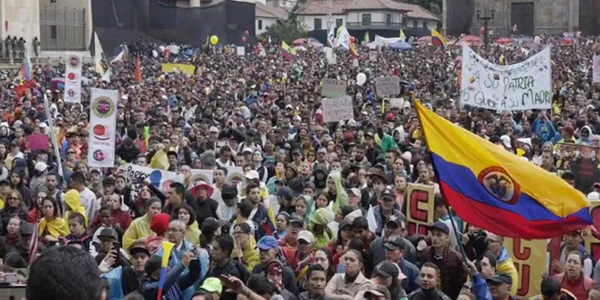
In Bogotá, several marches converged on Plaza de Bolívar. According to La Silla Vacía, the demonstrations arrived from five different starting points, and the central square was nearly full by the end of the mobilisation. Workers from the judicial sector and unions including the CUT and CGT participated. Representatives of the Pacto Histórico and trade-union leaders addressed the crowd from a platform in the square.
Among the political figures who spoke were senators María José Pizarro, Carolina Corcho and María Fernanda Carrascal. Their interventions addressed the proposed tax measures, social rights and opposition to the government's political direction. Pizarro warned that the mobilisation would continue whenever the government attempted to roll back rights and social gains.
PCC, in a report published on 19 November under the headline Sindicatos y organizaciones sociales se manifiestan en Colombia (Trade unions and social organisations demonstrate in Colombia), explained the nationwide actions and highlighted the opposition of trade unions and social organisations to the government's fiscal policies. The party also emphasised the Pacto Histórico's appeal to turn the demonstrations into a broader process of democratic organisation and popular participation.
Beyond taxation: defence of social rights and democracy
The mobilisation was not restricted to the proposed tax measures. The participating organisations connected opposition to the Economic Rescue Law with the defence of public education and healthcare, employment, women's rights, the rights of Indigenous and Afro-Colombian communities, peasant demands and the protection of public assets.
The September national meeting had also declared opposition to the government's proposed anti-terrorism statute and its approach to peace policy, which the participating organisations consider threats to democratic guarantees and the right to protest.
The PCC has sought to connect these demands with the wider struggle for popular organisation and political unity. Its 13 November article stressed that the response to the government's policies should not be limited to isolated demonstrations, but should develop into sustained mobilisation involving workers and other popular sectors.
The party's position also reflects its broader call for an alliance of trade unions, social movements, peasants, Indigenous and Afro-Colombian communities, women and youth organisations around the defence of democracy, peace and national sovereignty.
The outcome and the next steps
Reports published after the demonstrations described substantial participation in Bogotá and other cities. La Silla Vacía reported a nearly full Plaza de Bolívar after the convergence of several marches, while El País described the national action as a large mobilisation involving the established social and political base of the opposition.
The PCC's support for the strike forms part of its broader strategy of building unity among working-class and popular organisations. The party is calling for continued mobilisation and organisation to defend social rights, public services, employment, democratic freedoms and national sovereignty.