
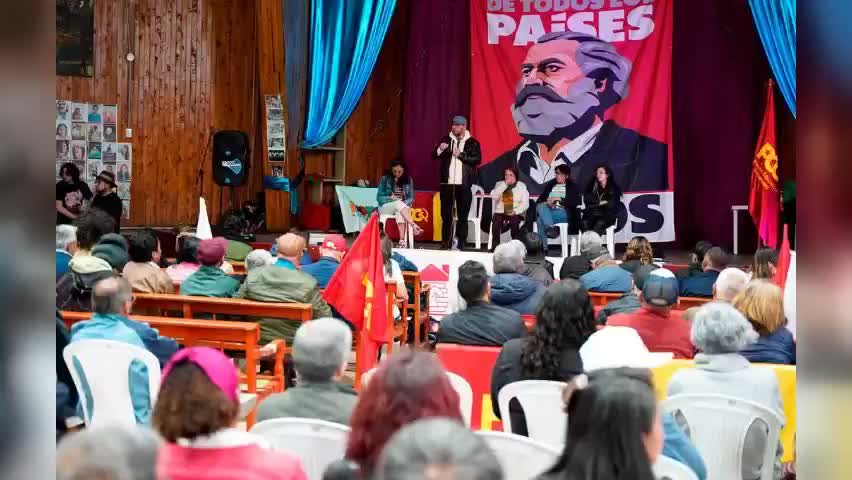
The leadership of the Communist Party, the Patriotic Union, and the JUCO (Communist Youth of Colombia) have gathered in Bogotá for a forum that was not a campaign event or a farewell, but a declaration of principles, shared their strategy for confronting the new far-right government.
Colombian Communist Party declares disobedience with allied forces
Under the banner “Let's Organize Disobedience” the community gathered to hear from Claudia Flórez, general secretary of the Colombian Communist Party; Aída Avella, president of the Patriotic Union; Gabriel Becerra, secretary of the same organization; and youth leader Viviana Marín.
The forum provided a space to reflect on the challenges and tasks of the social and political movement led by the Historical Pact. The results of the second round of elections, which gave Abelardo de la Espriella the victory by less than 1% of the vote, was discussed with careful analysis. The difference was minimal, but enough for the right wing to return to power.
Faced with this scenario, the leadership of the Historical Pact agreed on one output: unity is the most important instrument of the Colombian people and must be the priority to face what is to come.
The resistance of the CCP
In her speech, Claudia Flórez was emphatic: “We did everything humanly possible. It was our revolutionary commitment to move forward and continue the process of change that the government of Gustavo Petro and the Historical Pact have represented.”
The leader acknowledged that, although the election result was a setback, the left and progressive movement also advanced on other fronts: in representation in Congress, in territorial processes, and in grassroots organizing.
“We lost numerically by less than 1%, which means that around 13 million Colombians support this project,” Flórez noted. The difference is so narrow that the dispute remains open. “The work of building that Colombia where we can overcome obstacles and continue to win our rights continues,” she affirmed.
She also issued a warning: “The left has made progress in its representation in Congress and also in territorial and organizational processes. Perhaps we fell short, and we need to continue reflecting on how we can reach more people, how we can make our initiatives more flexible to attract more people to this vision of the country.”
Her declaration of principles: “The theme of resistance has always been part of the party’s DNA. This isn’t the first time.” And she added a key point: “This time we’re going to have a forceful opposition in Congress, coupled with social mobilization movements that we need to unite to face what’s coming.”
The complaint in the territory
The president of the Patriotic Union, Aída Avella, touched on the sensitive issue of the elections. She denounced receiving complaints in Norte de Santander from communities pressured by drug traffickers who pooled their money to support the right wing. “Yes, sir, they were there campaigning for the other guy in a region as difficult as Catatumbo,” she stated.
Avella also warned about threats to agrarian reform: “We will continue with agrarian reform every day. We've already received a report from Puerto López that some men came to evict people, but the people didn't leave. They're going to stay.”
She emphasized that, despite the limitations, the National Land Agency has received criminal complaints against drug traffickers who have tried to dispossess farmers who are receiving land for the first time.
“There is a criminal complaint against a drug trafficker who wanted to evict poor farmers who are receiving a few hectares of land for the first time,” she stressed.
Let's overcome the discourse of fear
For his part, Gabriel Becerra, the representative to the Chamber for Bogotá and a member of the political leadership of the Historical Pact, gave a stark analysis of the electoral defeat.
“The fearmongering discourse managed to penetrate the conscience and hearts of many people who, even if they were working-class, even if they received the benefit of free education for young people and even if they received the benefit for the elderly, thought that their life project was on the side of that man who represents the far right,” he reflected.
Becerra urged people not to look only inward, but to speak to the citizens outside, to the humble workers who voted for De la Espriella even though they may now lose their formal jobs and be paid by the hour: “We lost a battle, not the war. Long live the unity of the Colombian people.”
Youth as a driving force
Viviana Marín, a youth leader with the Colombian Communist Youth, spoke out to demand a place for young people in politics: “Today, Gustavo Petro’s campaign, but especially the second round, teaches us a lesson: young people need to be allowed to participate, to be allowed to do politics.” She criticized the fact that, in general, young people are almost entirely absent from political discussions and decision-making.
“I think that when we allow them and give them the material to do things, then what happened in the second round in the streets happens: I think we all saw it,” said Viviana Marín, referring to the repertoires of mobilization that the young people deployed during the campaign.
The forum concluded with a call to defend the Historical Pact as a political instrument. “We cannot allow it to be divided internally or externally,” the leaders warned. The proposal is to open spaces for participation—such as assemblies and open town hall meetings in localities and regions—so that people can express their assessment and see that the Pact is the instrument the people need to continue moving forward.
“Resistance is not an option; it is our history. We will move forward with creativity, intelligence, and organization. Because this battle is not over; it is merely changing its stage.”