
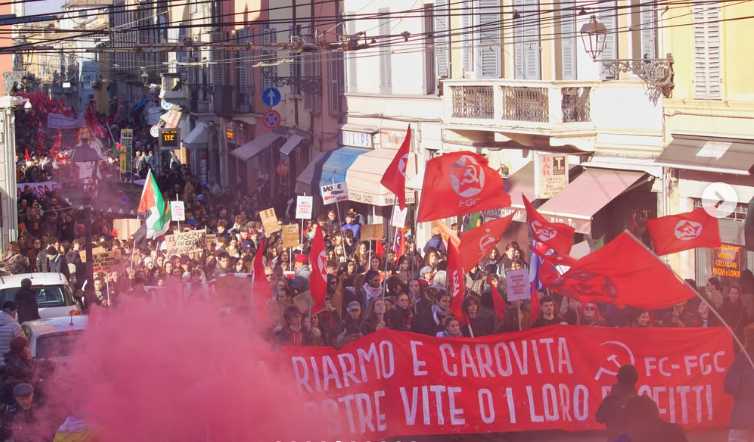

Workers and students took to the streets across Italy on 20 November as a 24-hour general strike called by the CGIL, the country’s largest trade union confederation, brought demonstrations to more than 100 cities.
Communist Front of Italy joins nationwide mobilisation against rearmament, austerity and Meloni government
Student mobilisations also took place in more than 45 cities. The actions combined demands for higher wages, better public services and improved living conditions with opposition to increased military spending and the growing cost of living. Public transport, schools and healthcare services were among the sectors affected by the strike.
The demonstrations took place in Rome, Milan, Turin, Bologna, Genoa, Perugia, Aosta and other cities. In Bologna, thousands joined the CGIL march, while thousands also took part in the Turin demonstration. Student marches were reported in Rome, Genoa and Milan, among other locations. CGIL general secretary Maurizio Landini said that more than one million people had participated in demonstrations across over 100 cities.
Fronte Comunista (FC), together with the Political Bureau of the Federation of Communist Youth (FGC), had called for participation in the strike, describing it as an opportunity to strengthen the working-class character of the mobilisations against rearmament, the rising cost of living and the government of Giorgia Meloni. In their joint statement of 14 November, the two organisations argued that the 2027 budget represented a programme of war and austerity: military expenditure was being prioritised while public education, healthcare, pensions and wages faced further pressure. They also highlighted the impact of rising energy and fuel prices on working-class households, attributing the increases to speculation and the effects of imperialist conflicts. The statement cited an October inflation rate of 5.2% and the prospect of around 7,000 job cuts in public education; these figures were presented by the organisations in support of their criticism of the budget.
Following the demonstrations, the central message expressed by Fronte Comunista was that workers and the wider population should not be made to pay for imperialist war and the rearmament plans of the EU and NATO. The party described the crowded squares across Italy as a rejection of a system that places the profits of a minority and military spending ahead of schools, healthcare, pensions and decent living conditions. Its message was summed up in the slogan: “Either our lives or their profits.”
Fronte Comunista also directed its criticism at the centre-left electoral alliance, the campo largo. According to the party, its representatives appeared in the demonstrations seeking electoral support but offered no solution to workers’ problems. FC argued that the centre-left also supports rearmament and bears responsibility for previous anti-worker policies, citing the Jobs Act among them. It rejected the prospect of simply changing the administrators of the existing system, arguing instead for a political alternative outside its framework.
This position builds on the party’s assessment of the role communists should play in the CGIL strike. In its 14 November statement, FC stressed that participation did not mean endorsing the CGIL leadership or the centre-left parties. It argued that the CGIL brings together millions of workers who do not necessarily share the positions of their union leadership or those of the campo largo. For communists, therefore, abandoning the demonstrations would leave workers open to being politically channelled by the centre-left. The party called instead for organised communist participation to advance an independent working-class perspective within the mobilisations.
The organisation also criticised the fragmentation of the strike movement, pointing to the separate general-strike dates of 30 October, 20 November and 4 December. It called for greater unity in the mobilisation of workers and students, while rejecting attempts to separate student demonstrations from the broader general strike. In its view, the struggles of students and workers need to be brought together around a common class-based response to war, austerity and the cost of living.
Fronte Comunista had previously supported the 30 October general strike called initially by USB and joined by other grassroots unions, as well as the international dockworkers’ mobilisation that took place on the same day. Its support for the 20 November CGIL strike was presented as part of the same effort to bring workers into struggle, regardless of which union had called the action, while advancing an independent political position.
The party’s message after the 20 November mobilisations reiterated that the alternative must be built through workers’ organisation and struggle, rather than through a change of government that leaves the existing economic and political framework intact. “Enough sacrifices for imperialist war” and “Either our lives or their profits” were the central slogans of its intervention.