
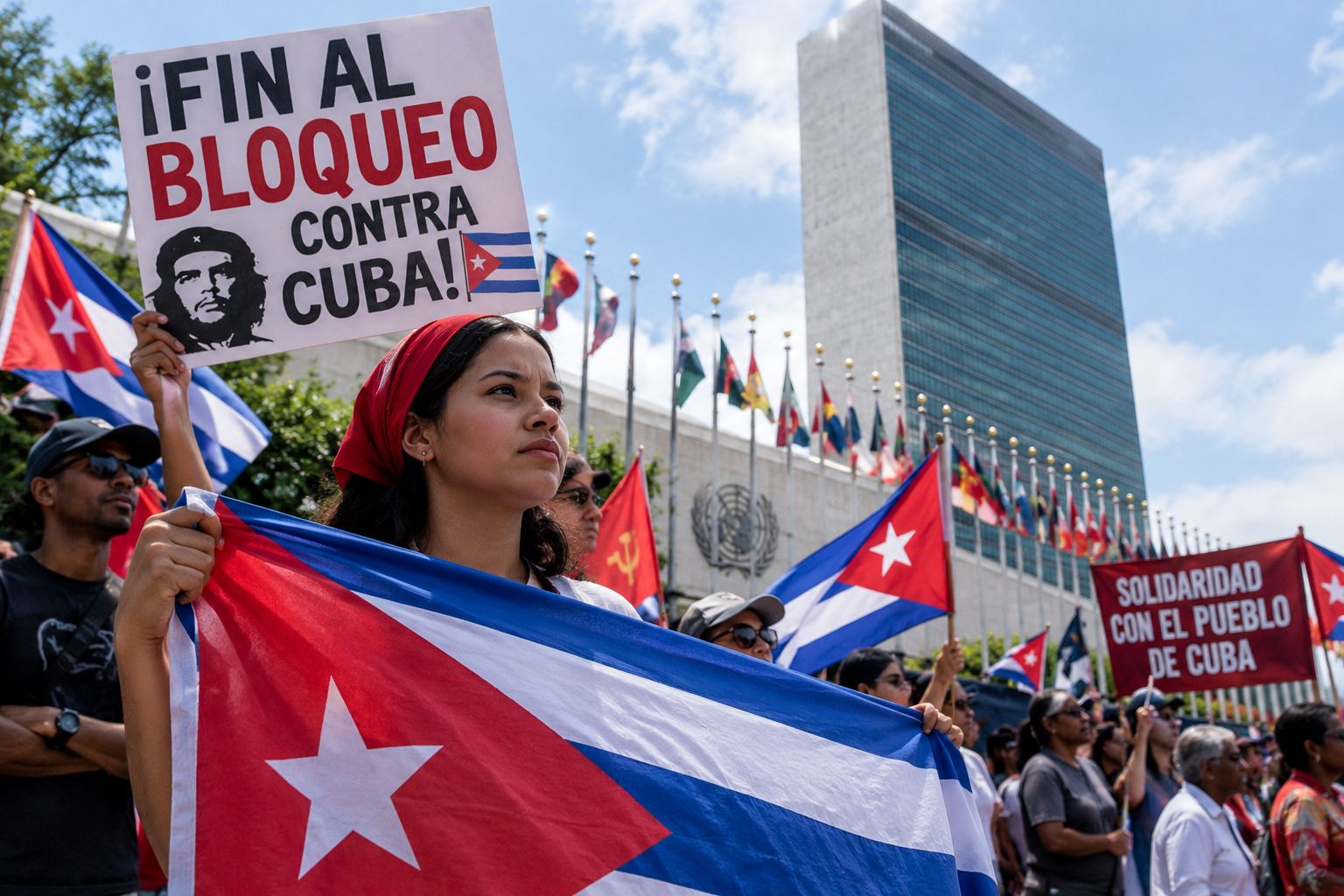
The Communist Party of Cuba (PCC) is intensifying its diplomatic and public campaign ahead of the United Nations General Assembly vote on its resolution calling for an end to the US economic, commercial and financial blockade. The vote is scheduled for 27–28 October 2026, marking the 34th time the issue has been brought before the General Assembly.
Communist parties mobilise international support for Cuba ahead of crucial UN vote
The campaign comes amid a further tightening of US measures against Cuba, including restrictions on fuel supplies, and allegations by Havana that Washington is pressuring other countries to change their votes. Communist parties across the world have issued statements urging their governments to oppose the blockade and defend Cuba’s sovereignty.
The Communist Party of Cuba mobilises diplomatic and public support
The PCC has placed the UN vote at the centre of its campaign to defend Cuba’s sovereignty and expose the economic and humanitarian consequences of the blockade. The Cuban government’s position has been articulated by President Miguel Díaz-Canel and Foreign Minister Bruno Rodríguez Parrilla, who have called on governments to uphold international law and resist external pressure.
On 21 October, Rodríguez accused the US government of conducting an unprecedented campaign to influence the vote. According to the Cuban foreign minister, Washington has threatened countries with visa restrictions, tariffs, sanctions and the suspension of cooperation if they maintain their support for the Cuban resolution. He also said that US officials had threatened to support opposition forces and interfere in other countries’ political affairs.
Cuba is presenting the vote as an issue that concerns the sovereign equality of states and the right of countries to establish economic and diplomatic relations without coercion by a major power.
The campaign has also highlighted the consequences of the restrictions for everyday life in Cuba, including difficulties obtaining fuel, medicines and medical equipment. On 23 October, a parliamentary public hearing at Havana’s National Institute of Oncology and Radiobiology examined the blockade’s effects on healthcare, medicine production and families. The hearing, titled “Cuba Is Not a Threat—the Blockade Is,” called for international solidarity ahead of the vote.
In his public address, Rodríguez expressed confidence that the General Assembly would once again support the resolution. He also thanked governments, trade unions, social movements, women’s and youth organisations, intellectuals and solidarity groups for campaigning against the blockade.
Communist parties around the world join the campaign
In a statement issued on 23 October, the South African Communist Party (SACP) condemned the blockade and called on the South African government, trade unions and civil society to ensure a decisive rejection of it at the UN. The party argued that international solidarity must continue beyond the vote, calling for practical support for the Cuban people amid the intensification of US pressure.
The SACP also recalled Cuba’s historical solidarity with African liberation movements, arguing that Africa should now stand with Cuba.
In its 23 October statement, titled “No Complicity in the Blockade!”, the Communist Party of Turkey (TKP) called on the Turkish government to maintain its longstanding support for ending the blockade. It argued that Washington was seeking to force other countries into complicity through threats and diplomatic pressure.
The TKP linked solidarity with Cuba to the relationship between the Turkish and Cuban peoples, recalling Cuba’s assistance to countries in need. It called on Türkiye to defend its position at the UN unequivocally, concluding with the slogans “Long live Cuba!” and “Down with the blockade!”
On 26 October, Fronte Comunista of Italy and the Communist Youth Front called on the Italian government to resist US pressure and maintain its vote in support of ending the blockade. They announced a solidarity gathering in Rome’s Piazza Montecitorio for 27 October.
Their statement highlighted the consequences of restrictions on fuel supplies and the role of Cuban medical personnel in Italy, including their contribution to healthcare services in Calabria. The organisations presented solidarity with Cuba as a defence of the Cuban people’s right to determine their own political and economic system.
A vote with international significance
The resolution before the General Assembly calls for an end to the US economic, commercial and financial embargo against Cuba. It is non-binding, meaning that the vote does not itself compel Washington to lift the restrictions. Nevertheless, it carries diplomatic significance as a measure of international opposition to the policy.
In the previous vote, in 2025, the resolution received 165 votes in favour, seven against and 12 abstentions. That was a marked change from the 2024 result, when 187 countries supported the resolution, two opposed it and one abstained. The decline in support in 2025 has heightened attention to Washington’s current efforts to influence the outcome.