
The statement delves into the significance of a people's independence. The May Revolution is acknowledged as the manifestation of a new historical will. However, CPA emphasizes that 1810 was incomplete, as new forms of dependence continued to emerge even after the proclamation of independence in 1816.
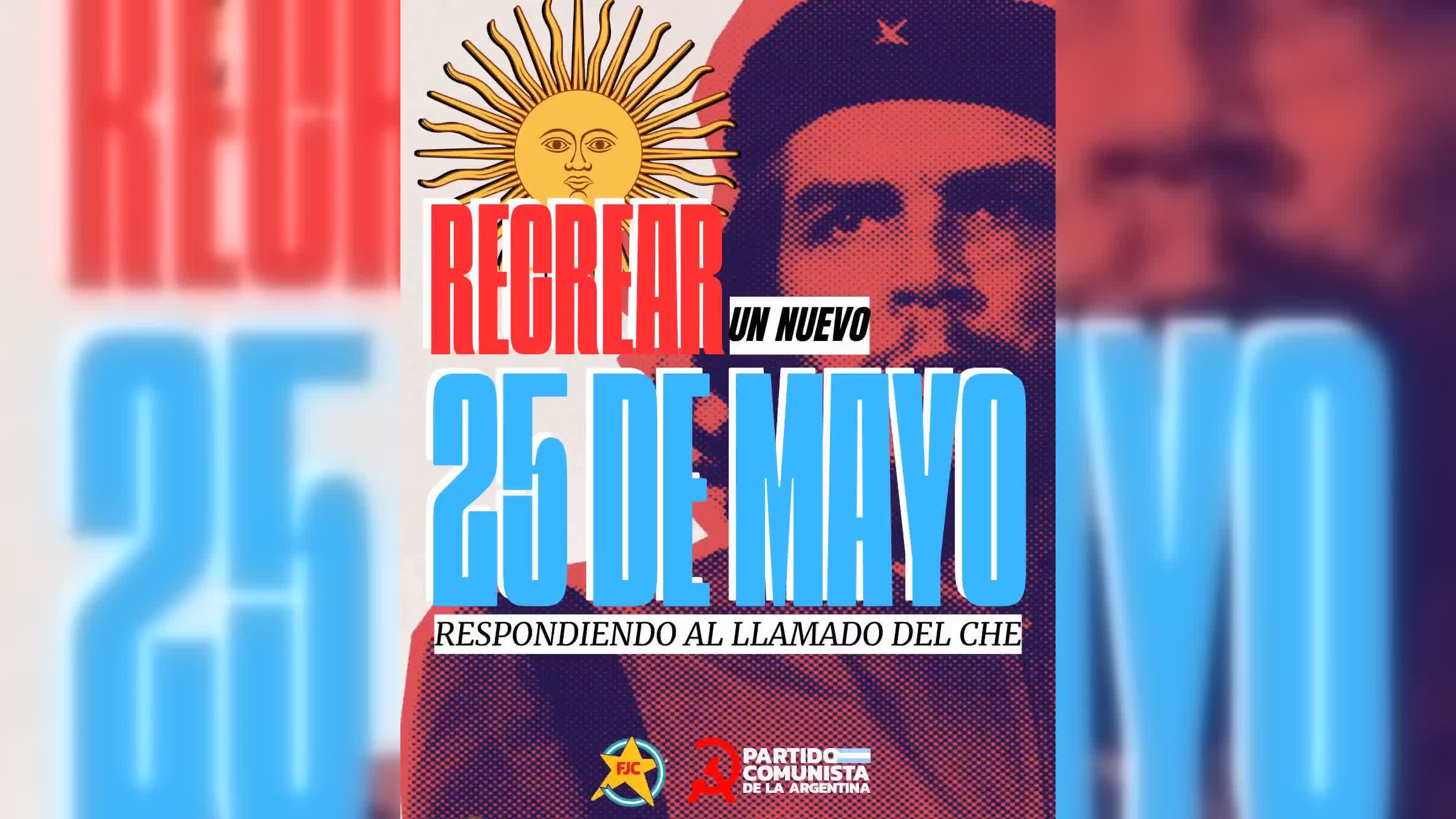
Communist Party of Argentina commemorates May Revolution: “Recreating a New May 25, Answering Che's call”
“This historical limitation, intertwined with the tension between formal independence and real dependence, is precisely what Mariano Moreno, the principal ideologue and strategist of the May Revolution, so profoundly warned against then.
Along the same lines, always valuing the steps taken on the path toward a free homeland but pointing out the urgency of the steps to follow, is the 'Message to the Argentines' of Commander Ernesto Guevara.
Che fully understood that the struggle for national liberation could not be limited to the legal borders of states, that it is essential to project this struggle at a continental level against a common enemy: imperialism and the monopolies that subjugated and subjugate Latin America.”
The relevance of Che's words is found in the balance of historical events and in the increasing aggression of imperialism. “The criminal blockade against Cuba continues to intensify as an 'exemplary' punishment against a people who dared to walk their path toward socialism and build sovereignty with their political consciousness and national dignity.”
The statement makes a big emphasis on how the struggle educates the people and creates the masses' conviction in their victory when the main enemy is confronted and action is taken accordingly.
“Imperialism needs resigned peoples; revolution needs peoples aware of their strength.”
In the “Message to the Argentinians,” a historical call addressed to the peoples of Argentina and all of Latin America is found. PCA calls out the invitation to recreate May 25th in Che's message, to achieve the real independence of the peoples by building an immense working-class, peasant, student, and popular force capable of collectively confronting imperialism.
“The task of fighting for a total transformation of society cannot be taken as a long-term plan; rather, it is an urgent necessity for survival in the face of the depredation of a dependent capitalism in our country and in Our America that leaves a trail of devastation in its wake. This daily work also demands revolutionary responsibility in the political and ideological formation of the militants, in fraternal debate stripped of formalisms for unity of program and action with all anti-imperialist sectors, and in the capacity to organize the people in new Open Assemblies. Therefore, this vocation for power must be built from the bottom up and from the top down. And it must be concretely realized in every mass front.
216 years after the May Revolution and 64 years after Che Guevara's Message to the Argentine People, emancipation will not be possible if we do not dedicate our greatest efforts to building, strengthening, and expanding anti-imperialist consciousness. In every place where a worker organizes for their rights, where a student resists the dismantling of education, where a peasant defends the land, and where a people confronts the plundering of their resources, the unfinished struggle of May lives on.
The historical possibility of our definitive liberation remains alive.”
The May Revolution was a week-long series of events that took place from 18 to 25 May 1810, in Buenos Aires, capital of the Spanish colony, Viceroyalty of the Río de la Plata. The result was the removal of Viceroy Baltasar Hidalgo de Cisneros and the establishment of a local government, the Primera Junta.