
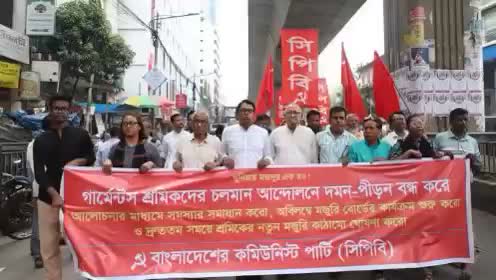
The Communist Party of Bangladesh (CPB) has expressed solidarity with garment workers demanding higher wages, organising a rally in Dhaka on 2 November as protests and work stoppages spread across the country’s major industrial areas.
Communist Party of Bangladesh Supports Garment Workers’ Wage Struggle and Condemns Police Repression
The Communist Party of Bangladesh (CPB) called for an end to police repression, the release of detained workers and a negotiated solution to the dispute with the effective participation of workers’ representatives.
The rally was organised by CPB at Paltan Mor in the capital in support of garment workers’ struggle for a substantial increase in wages. It was chaired by CPB General Secretary Abdullah Al Kafi Ratan and addressed by Presidium member Mujahidul Islam Selim, Control Commission Chairman Mahbub Alam and garment workers’ leader Montu Ghosh.
The speakers condemned police attacks on protesting workers, arrests, intimidation and the filing of what they described as harassment cases. They demanded the immediate release of detained workers, an end to dismissals and threats against those participating in the movement, and the prompt completion of the wage board’s work. CPB also stressed that workers’ representatives must have an effective role in negotiations to determine a fair and realistic wage.
Montu Ghosh stressed that demanding a living wage was not a crime and that workers had a democratic and constitutional right to organise and protest peacefully. Abdullah Al Kafi Ratan called on the authorities to stop using force against workers and resolve the dispute through negotiations.
Protests spread across industrial areas
CPB’s intervention came amid several days of unrest in the garment industry. Workers in Dhaka, Gazipur, Savar, Ashulia and Narayanganj staged demonstrations, blocked roads and stopped production at numerous factories. Their central demand was to raise the minimum monthly wage from Tk 12,500 to Tk 30,000, alongside demands concerning dismissed workers and blacklisting.
The protests were met with police intervention, including the use of tear gas, and clashes occurred in several industrial areas. On 4 November, the newly formed wage board agreed to introduce a revised pay structure from December. However, the amount of the increase remained unclear, and workers continued to express uncertainty about whether the agreement would meet their demands.
By 6 November, production had resumed in most industrial areas, although tensions and demonstrations persisted in parts of Ashulia and Savar, where some factories remained closed.