
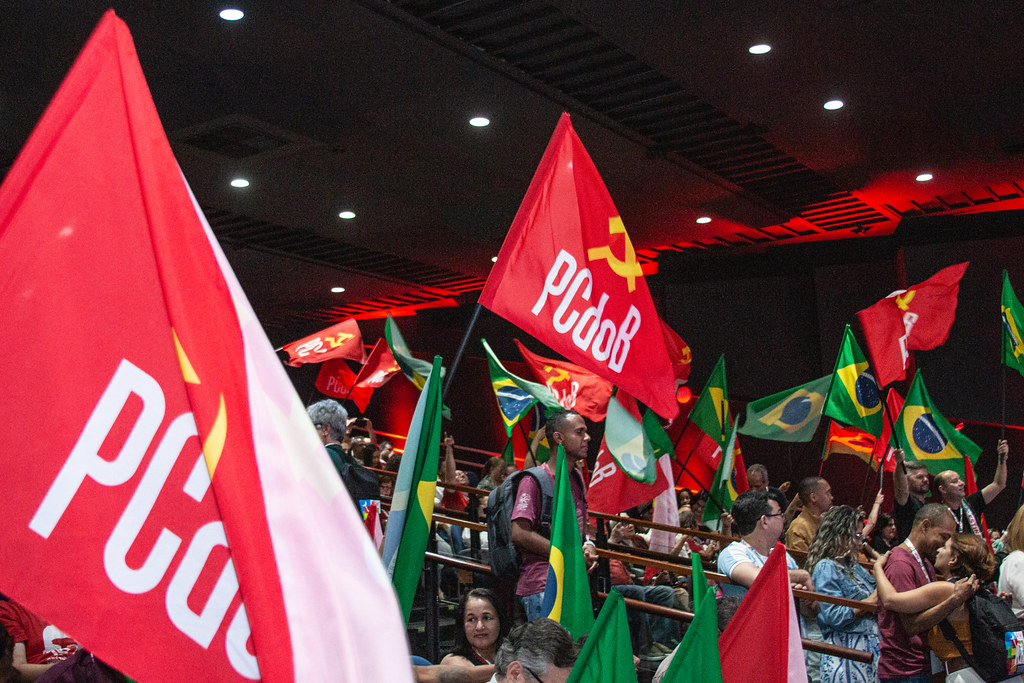
The Communist Party of Brazil (PCdoB) launches a reform program to break away from neoliberalism. The document proposes four axes of structural transformation, from the central bank to agrarian reform, as a path to sovereign development and socialism.
Communist Party of Brazil launches reform program
The Communist Party of Brazil (PCdoB) has shared the document titled “Subsidies for the elaboration of democratic structural reforms,” a detailed program that points the way to break away from the neoliberal and neocolonial shackles that have hindered Brazil's development for decades. The result of the collective work of more than 50 leaders, activists, and scholars, the text was approved by the party's Permanent Commission at the end of 2025.
According to the Party's diagnosis, Brazil accumulates structural deformities that block development and push the country towards regression: its condition as a dependent and semi-peripheral nation, subjected to the pressure of US imperialism; the dominance of financial capital and rent-seeking, which drains resources that should finance production; a weakened state captured by the financial oligarchy; accelerated deindustrialization—the share of manufacturing in GDP has plummeted from 36% in 1985 to only 11% today—and the increasing precariousness of labor. Added to these obstacles are enormous social and regional inequality, the rise of racism, sexism, misogyny, and LGBTphobia, and the permanent threat of the far-right to democracy. The document names the culprits as the financial oligarchy, the pro-imperialist sectors of the ruling classes, and US imperialism.
The program organizes democratic structural reforms into four major axes. The first deals with the reconstruction and democratization of the national state, with proposals ranging from political reform to national defense, including the financial system, foreign policy, and the regulation of digital platforms. The second axis focuses on economic development with productive sovereignty: reindustrialization on new technological bases, progressive tax reform, agrarian reform linked to agro-industrialization, and sustainable development. The third axis demands the universalization of social rights—social security, education, public safety, and urban reform. And the fourth fundamental axis deals with the contents that determine a humanist society: the rights of women, the Black population, Indigenous peoples, the LGBTQIA+ community, and religious freedom. No serious national project can ignore any of these axes.
The program advocates that the exchange rate cease to float in favor of speculation and instead be managed by the state, in coordination with the presidency of the republic and the ministry of finance. It also advocates the creation of a National Public Financing System for Productive Transformation, strengthening the BNDES (Brazilian Development Bank) and regional public banks to direct credit to priority areas. Regarding taxation, the party proposes to definitively end the privileges of the wealthiest: regulating the tax on large fortunes—provided for in the Constitution since 1988 and never implemented—increasing tax rates for incomes above R$ 50,000 per month, and reviewing tax breaks that benefit financial conglomerates.
In the field of production, the document bets on reindustrialization as a central pillar of the new national project, endorsing the New Industry Brazil (NIB), a policy of the Lula government that organizes six mobilizing missions: health, digital transformation, bioeconomy and energy transition, defense, sustainable agro-industrial chains, and urban infrastructure. In political reform, the PCdoB defends the end of the barrier clause—“a remnant of the authoritarian debris of the dictatorship,” in the document's own definition—the adoption of the pre-ordered list with gender parity, and the maintenance of the proportional system against the district vote that favors the elites. In the field of rights, the proposal states that social security should be considered a national investment, with stable and progressive financing, democratic and participatory management, and the reversal of reforms that penalize the most vulnerable.
Furthermore, the document is acknowledges that the reforms will not be granted by the goodwill of the dominant classes— path to victory is described to be through social mobilization, the construction of a political majority in Congress, and the struggle for hegemony in society. In this sense, the text argues that a new victory for Lula in the 2026 elections will create more favorable conditions for progress. But it also stresses that the journey for reforms cannot wait.