
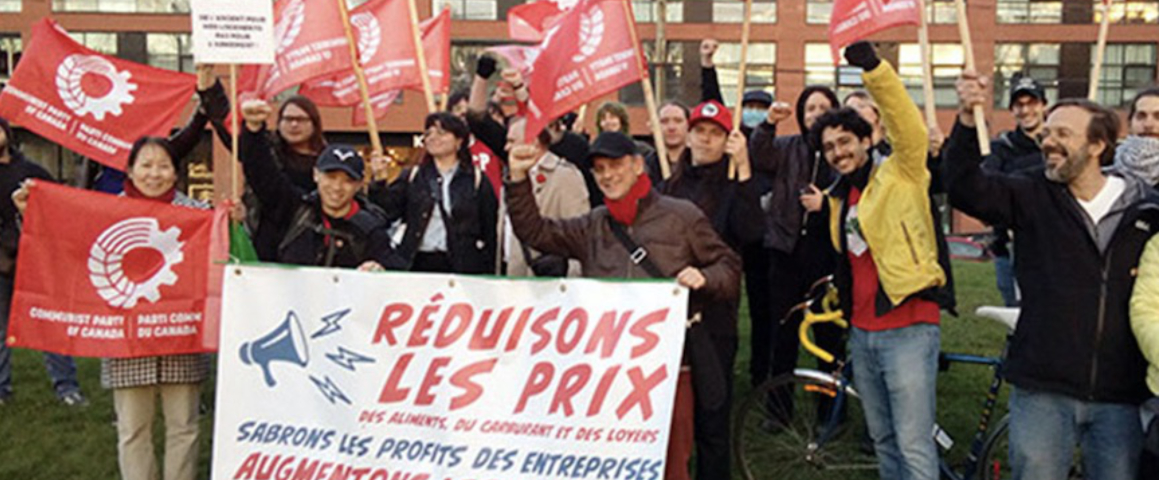
For the first time since 1998, the Parti Communiste du Québec (PCQ, the Quebec national section of the Communist Party of Canada) is running 10 candidates for the October 5 vote. The PCQ is fielding 9 candidates in Montreal ridings and one in Sherbrooke, the first time since 1989 that there has been a Communist Party candidate outside Montreal.
Communist Party of Canada back on ballot in Quebec
PCQ leader Adrien Welsh spoke with People’s Voice about what this “comeback” means.
“Until 2017, we supported Québec solidaire, which our Party was a key component in creating in 2002. However, in its 2017 Congress, Québec solidaire decided to merge with Option nationale – a small nationalist outfit that was smaller than QS itself – under the pretext of “unity.” It was clear that the goal was to unite the “sovereigntist” forces rather than the progressive forces and, as a corollary, get rid of the communists in order to insert itself further into bourgeois politics.
“History has proven us right QS is a party of the educated middle-strata, neither of nor for the working class, and consequently it sees its base shrinking.
“In waiting until this election to run candidates, it wasn’t so much because we wanted to spare QS or give them a chance. We evaluated the possibility of running an independent candidate in the 2018 elections, but came to the conclusion that it would be premature for us, so we then focused on building the Party.
“Québec communist candidates did run in federal elections, and during that time we initiated a long and arduous process to reclaim our name and registration as an official Québec party. I should note that this is a particularly anti-democratic process that requires us to provide a list of not less than 100 members every year and run at least two candidates in any general elections – so no room for coalitions. We registered as a Québec party In March 2023.
“In 2022, we stated clearly that this election would be the last one in which the working class wouldn’t have any forces in the battle. This year, they will see their interests defended by the Parti communiste du Québec.”
PCQ is campaigning on a five-point platform centred on challenging capitalist power and strengthening the position of workers. Its first priority is to put labour before capital, arguing that Quebec's wealth is concentrated in the hands of a small number of billionaire families while many workers face poverty, unemployment and inadequate access to essential services. The party calls for higher wages and pensions, full employment and expanded trade-union rights, including the right to strike.
Second, the PCQ advocates an economy planned according to workers' needs, including the nationalisation of banks, major retail chains and large manufacturing companies. It also proposes taking banking, savings and insurance outside the market logic, introducing price controls on essential goods and reforming taxation so that monopolies and the wealthiest bear a greater share of the burden rather than workers and small businesses.
Third, the party calls for a public monopoly over public services and infrastructure. It attributes Quebec's deteriorating public infrastructure and services to chronic underfunding, privatisation and competition from the private sector. The PCQ therefore wants healthcare, education, public transport and other essential services expanded and placed firmly under public control rather than governed by capitalist-market principles.
On the national question, the PCQ rejects the conventional choice between Quebec independence and Canadian federalism, as well as the CAQ's “autonomist” alternative. It supports Quebec sovereignty but does not equate this with secession. Instead, it proposes a Constituent Assembly that would produce a new constitution for Canada and its constituent peoples and nations, allowing Quebec to exist as an associated state within a renewed Canadian Confederation. The party also links this approach to an internationalist foreign policy centred on peace and solidarity.
Finally, the PCQ seeks to expand democratic and minority rights, arguing that the ruling class uses nationalism, immigration and minority issues to divide working people and divert attention from economic inequalities. It calls for stronger protection against hate speech, greater democratisation of local institutions and mixed-member proportional representation. The party explicitly presents these five demands as part of a broader struggle to overthrow capitalism and establish socialism, arguing that its immediate programme can unite workers' social, economic and political struggles and build a force capable of confronting big business.