
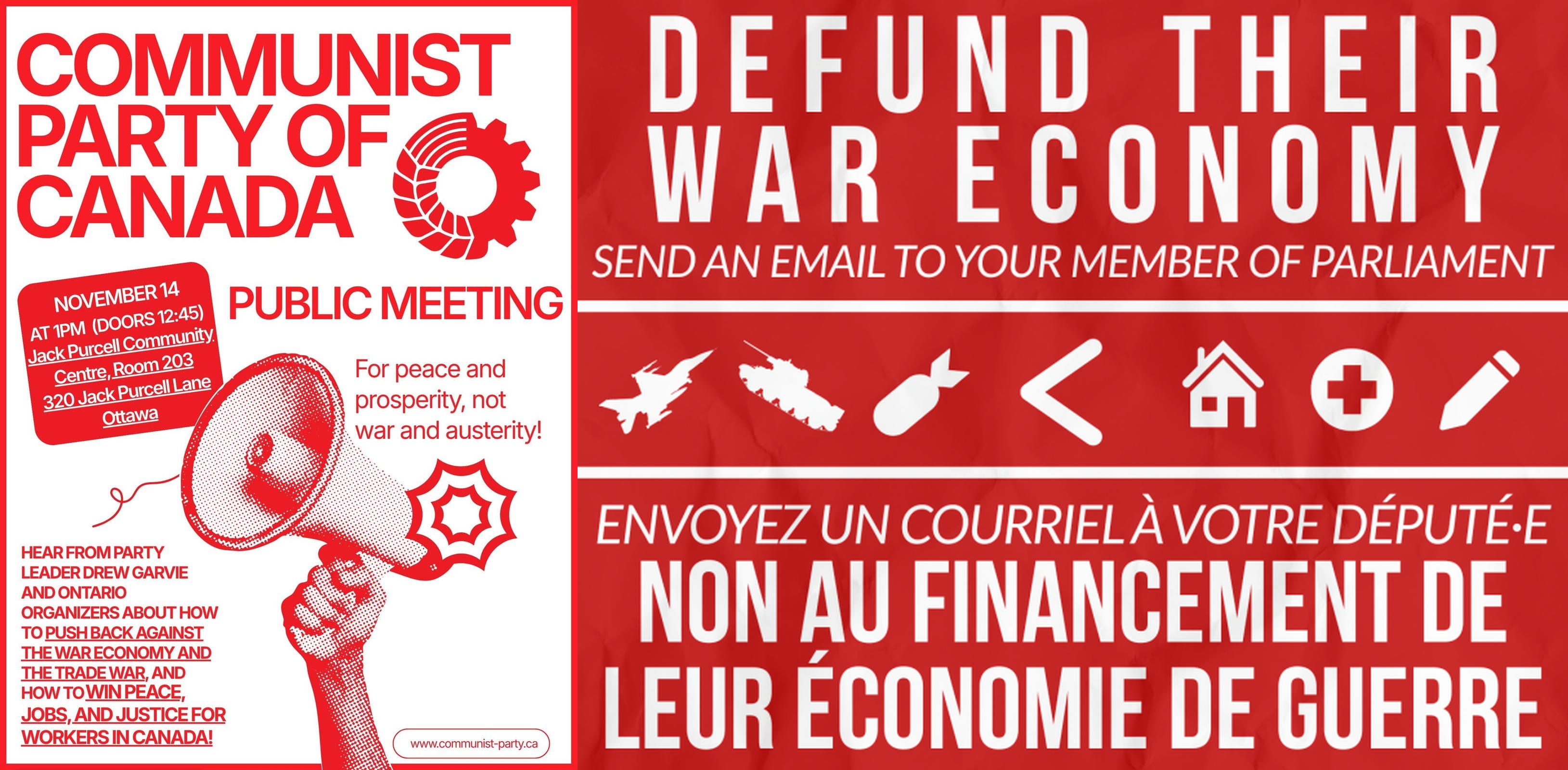
The Communist Party of Canada (CPC) has stepped up its campaign against the federal government’s planned expansion of military spending, organising public meetings in Barrie and Ottawa in November under the slogan “Defund the War Economy – Fund Jobs, Wages and Canada’s Sovereignty.”
Communist Party of Canada takes “Defund the War Economy” campaign to Barrie and Ottawa
The party argues that the proposed military build-up will divert public resources from urgent social needs, strengthen Canada’s dependence on the United States and NATO, and serve the interests of arms manufacturers rather than working people.
The campaign centres on the federal government’s commitment to raise military expenditure to 5% of GDP. The CPC rejects the argument that such an increase is necessary to protect Canada or defend its sovereignty. It argues instead that the demand for higher military spending is being driven by Washington and NATO, and that the resulting expansion of the defence industry will orient Canada’s economy more closely towards the US-led military alliance.
Public meeting in Barrie
On 12 November, CPC leader Drew Garvie addressed a public meeting entitled “Defund the War Economy” at Grace United Church in Barrie, Ontario. The meeting was also promoted by former federal Communist Party candidate Michael Speers.
The choice of Barrie gave the campaign a local dimension. Mayor Alex Nuttall has been promoting the city as a potential centre for defence manufacturing, presenting military production as an opportunity for investment and job creation. The Communist Party challenged this approach, arguing that municipalities are increasingly being encouraged to compete for defence contracts and to shape their economic development around the priorities of the arms industry.
In the party’s announcement of the meeting, Speers questioned why governments repeatedly claim that there is insufficient funding for affordable housing, public transport, healthcare, education, environmental protection and poverty reduction, while substantial resources can be made available for military procurement. He argued that Barrie’s economic future should not be tied to the expansion of the arms industry.
The CPC also challenged the claim that military expenditure is an especially effective way to create employment. Citing research it attributes to a 2025 Brown University study, the party stated that every million dollars spent on military activity generates approximately five jobs, compared with nine in healthcare, eight in infrastructure and thirteen in education. It used these figures to argue that investment in social needs would create more employment while improving living conditions.
“Peace, Jobs and Justice” in Ottawa
The campaign continued in the national capital on 14 November with a public meeting entitled “Peace, Jobs and Justice”, organised by the Communist Party of Canada’s Ottawa Region at the Jack Purcell Community Centre.
Drew Garvie was announced as the principal speaker. According to the event notice, he was to explain how opposing the war economy could contribute to peace, employment and social justice. The meeting brought the campaign directly to Ottawa, where the federal government’s military spending plans and defence policy are being debated.
Beyond military spending: the Defence Industrial Strategy
The CPC’s campaign is directed not only against the proposed increase in military expenditure but also against the federal government’s Defence Industrial Strategy. The party argues that this strategy will reorganise and subsidise Canadian industry around the requirements of the US-NATO military system.
CPC emphasises that militarisation is an economic and political project extending beyond the defence budget. It warns that public resources, industrial capacity and employment policy are increasingly being directed towards military production, while social investment and public services remain underfunded.
The party has established an online parliamentary lobbying initiative as part of the campaign. Through its website, people can send a prepared message to their federal MPs urging them to oppose the military-spending increase and the Defence Industrial Strategy, and to redirect public resources towards jobs, wages and public services.
An alternative economic and foreign-policy programme
The CPC proposes redirecting public resources towards measures intended to improve living standards and strengthen economic independence.
Its demands include expanding social housing and employment insurance, raising wages, controlling prices, and increasing public investment in healthcare, education and childcare. It also calls for bringing key industries—including automobile manufacturing, steel, aerospace and shipbuilding—under public ownership, as well as placing energy and natural resources under public control to support a just ecological transition.
On foreign policy, the party calls for Canada's withdrawal from NATO and NORAD, an end to participation in corporate trade agreements such as the USMCA, and the development of an independent policy based on peace, disarmament and international solidarity.
The party's central argument is that genuine security cannot be achieved through an arms build-up. It must be based on decent employment, affordable housing, accessible public services and an independent foreign policy.