
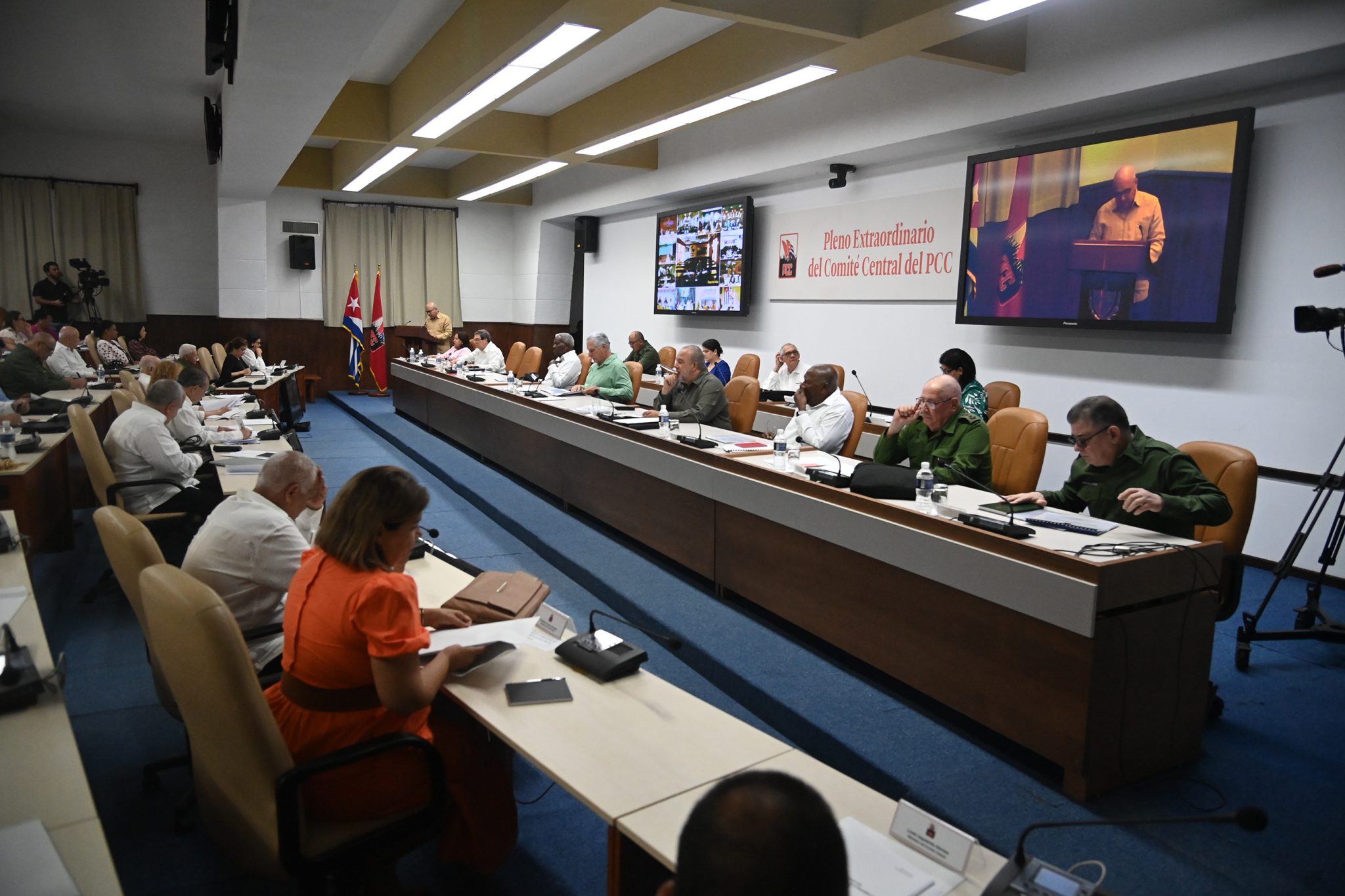

The Central Committee of the Communist Party of Cuba convened for a plenary session to discuss and adopt economic transformations. These were later presented to the National Assembly of Cuba.
Communist Party of Cuba holds important central committee meeting
At the beginning of the session, member of the Political Bureau and Prime Minister Manuel Marrero Cruz presented the proposals for economic and social transformations initiatives articulated along several axes (lines of work).
Organisational Secretary of the Central Committee, Roberto Morales Ojeda stated that despite the severe U.S. blockade, Cuba continues to resist and seek alternative paths for development while remaining committed to preserving the Revolution and the principal achievements of socialism.
According to www.cubadebate.cu, Morales Ojeda recalled several important historical anniversaries, including the 121st anniversary of the death of Maximo Gomez, the upcoming centenary of Fidel Castro, and the 73rd anniversary of the attacks on the Moncada and Carlos Manuel de Céspedes barracks. He emphasized the Communist Party's commitment to renewal, principled leadership, debate, and necessary reforms.
During the session, Raul Castro, participating via videoconference, sent a message that was read by Jose Amado Ricardo Guerra, a member of the Political Bureau. Raúl Castro expressed his full agreement with the proposed transformations under discussion and stressed the importance of collective analysis and open debate, arguing that the best ideas emerge from discussion and even disagreement.
Raúl Castro called for broad participation in refining the proposed measures and building the consensus needed to implement reforms at what he described as a crucial moment for the Revolution. He also warned that approving reform proposals would be less important than their effective implementation. According to his message, success will require clearly defined priorities, the conscious participation of the population, and close attention to the concerns and opinions of ordinary citizens.
The meeting therefore highlighted the Cuban leadership's intention to pursue reforms and adaptations in response to current economic challenges while maintaining its commitment to socialism and the political legacy of the Cuban Revolution.
Proposals presented to the National Assembly
The Prime Minister, Manuel Marrero Cruz, presented to the National Assembly a set of proposed economic and social transformations, explaining that Cuba’s current difficulties are largely driven by disruptions in fuel supply, reduced foreign currency inflows, and the resulting deterioration of the country’s energy infrastructure. These conditions have significantly affected living standards.
He acknowledged the existence of internal inefficiencies but emphasized that external pressures—particularly the intensification of U.S. sanctions since 2019—have strongly hindered the implementation of economic reforms initiated in 2011. Despite this, the government continues to pursue corrective measures aimed at stabilizing and reactivating the economy.
The proposed reforms are framed as consistent with the preservation of the socialist system, guided by the principle of “doing what is necessary to preserve what is essential.” They are rooted in the ideas of Fidel Castro and aligned with the broader strategic direction set by Cuba’s leadership, including Raúl Castro and President Miguel Díaz-Canel. A consultative process reviewed 390 proposals, of which 66.7% were accepted.
The Prime Minister introduced 176 transformation proposals structured around 23 thematic areas. The reforms focus on modernizing the economic model while maintaining state ownership in strategic sectors and expanding economic flexibility.
A major focus is the restructuring of the state enterprise system:
- Expansion of autonomy for state-owned enterprises, including freedom to engage in any legal activity.
- Greater decentralization in pricing decisions and use of profits after taxes.
- Reform of OSDE (Higher Business Management Organizations), granting them authority to create or restructure companies and subsidiaries.
- Redesign of financial relations between enterprises and the state budget, including new financing tools and asset monetization mechanisms.
- Empowerment of provincial and municipal governments to create or dissolve state companies.
- Reduction of performance indicators used to evaluate enterprises.
A significant proposed change is the elimination of standardized wage scales in the state sector, replaced by a minimum wage adjusted for inflation and negotiated between employers, workers, and unions.
Additional measures include establishing legal frameworks for bankruptcy and restructuring, and allowing state enterprises to convert into joint-stock or mixed-ownership companies, while the state retains majority control in strategic sectors.
The reforms expand the role of private and non-state actors:
- Approval of pending applications for non-state enterprises, including thousands of micro, small, and medium-sized enterprises (MSMEs).
- Faster approval processes and removal of the 100-employee limit, beyond which firms would be classified as private enterprises.
- Allowing individuals to own multiple private companies.
- Expansion of legal business structures, including shareholding models.
- Granting property rights such as usufruct and surface rights.
- Access to foreign bank accounts and expanded operational flexibility.
- Reduction of prohibited activities for non-state actors and improved administrative systems using artificial intelligence.
In agriculture, MSMEs would be authorized for the first time, alongside cooperatives. A national supply market and a production-chain platform would be developed to link enterprises and improve coordination.
A separate reform axis focuses on digital modernization:
- Creation of a national technological hub integrating hardware, software, and artificial intelligence.
- Expansion of AI use in public administration under human supervision.
- Competitive salary systems for technology professionals.
- Opening selected digital infrastructure sectors (such as data centers and mobile networks) to foreign investment, excluding areas linked to national security.
The proposed reforms represent a restructuring of Cuba’s economic model aimed at increasing efficiency, expanding non-state participation, and modernizing governance and digital infrastructure. The plan maintains the commitment to socialism and state control in strategic sectors.
Photo: Estudios Revolución