
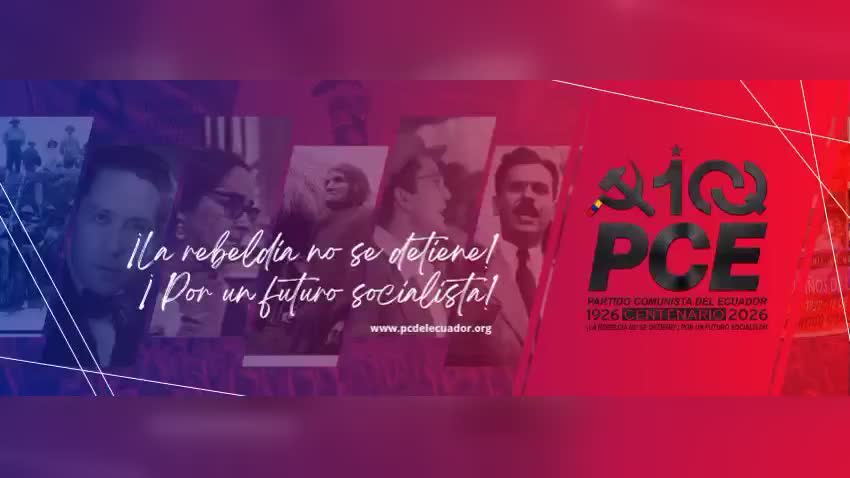
Communist Party of Ecuador looks back on the 100 years of struggle with articles that are titled, "A century alongside the working class marks the centenary of the Communist Party of Ecuador" and "100 years of the Communist Party of Ecuador: Unity of the left and lessons of struggle."
Communist Party of Ecuador reflects upon last 100 years of working class struggle
The article, A century alongside the working class marks the centenary of the Communist Party of Ecuador, looks at the roots of the party and its founding cadres:
“Our natural and indispensable stronghold remains within the working class. In commemorating the 100th anniversary of the Communist Party of Ecuador, our organization draws upon its accumulated historical experience, forged in the heat of the first general strikes. The first bloodbath of the Ecuadorian working class, perpetrated on November 15, 1922, unleashed brutal repression against the first workers' organizations.
This harsh historical lesson accelerated the political maturation of the masses. It resulted in an organized working class which, four years later, in May 1926, founded our party under the name of the former Ecuadorian Socialist Party. At its second congress in 1931, our party definitively adopted the name Communist Party of Ecuador. With this legacy, our natural and indispensable stronghold remains within the working class. In this endeavour, the theoretical and practical legacy of Pedro Saad Niayim is irreplaceable.
Saad rejected the conception of the communist cadre as a desk bureaucrat, demanding that he be a vanguard organizer who fused Marxist-Leninist theory with the daily life of the factories, workshops, and fields of the homeland.”
During this retrospective, Communist Party of Ecuador lays out the responsibilities of the present:
“We acknowledge with rigorous self-criticism that, during the last decade, due to various political circumstances and organizational deviations, the communist presence suffered a retreat within the workers' movement. However, recently, we have reversed this trend. Following the resolutions of the XVI Congress of the Communist Party of Ecuador, we have gradually recovered our integration within the grassroots of the workers' movement.
Today, the primary task requires systematically strengthening and expanding organic work within the trade union movement and among the retirees sector, who suffer particularly harshly from the dismantling of public services and the systematic assault on the funds of the Ecuadorian Social Security Institute (IESS).
Faced with a State that criminalizes protest and legalizes exploitation, the Communist Party of Ecuador maintains its battle cry: the only way out of the current barbarity is through strikes, street protests, community organizing, and the unity of the popular bloc to demolish dependent institutions and build a process of social and national liberation.”
In the article, 100 years of the Communist Party of Ecuador: Unity of the left and lessons of struggle, CPE shares the path which contributes to their current strategies:
“In the first months of 2026, the PCE, along with other forces, formed the People's United Front (FUP) (comprised of the Communist Party of Ecuador, the Ecuadorian Socialist Party, and the National Integration Front).
The trajectory of Ecuadorian communism demonstrates that the unity of progressive forces is a strategic necessity, far removed from any short-term opportunism. As we commemorate the centenary of the Communist Party of Ecuador, the accumulated historical experience of our organization demands that we develop tools for convergence in the face of oligarchic aggression.
The historical path towards unity is evidenced in firm mass political tools built over the decades: the National Anti-Conservative Democratic Unity (UDNA) in 1960, the Broad Left Front (FADi) in 1978, the experience of the United Left Front in 1988 and the United Front coalition in 2014. In the current context, characterized by social depoliticization and the politicization of the judiciary, organic unity has acquired an unprecedented urgency. However, this convergence must overcome the narrow electoral margin of the last election in 2025, which consisted of a pragmatic pact incapable of responding to the demands of the popular movement.”