
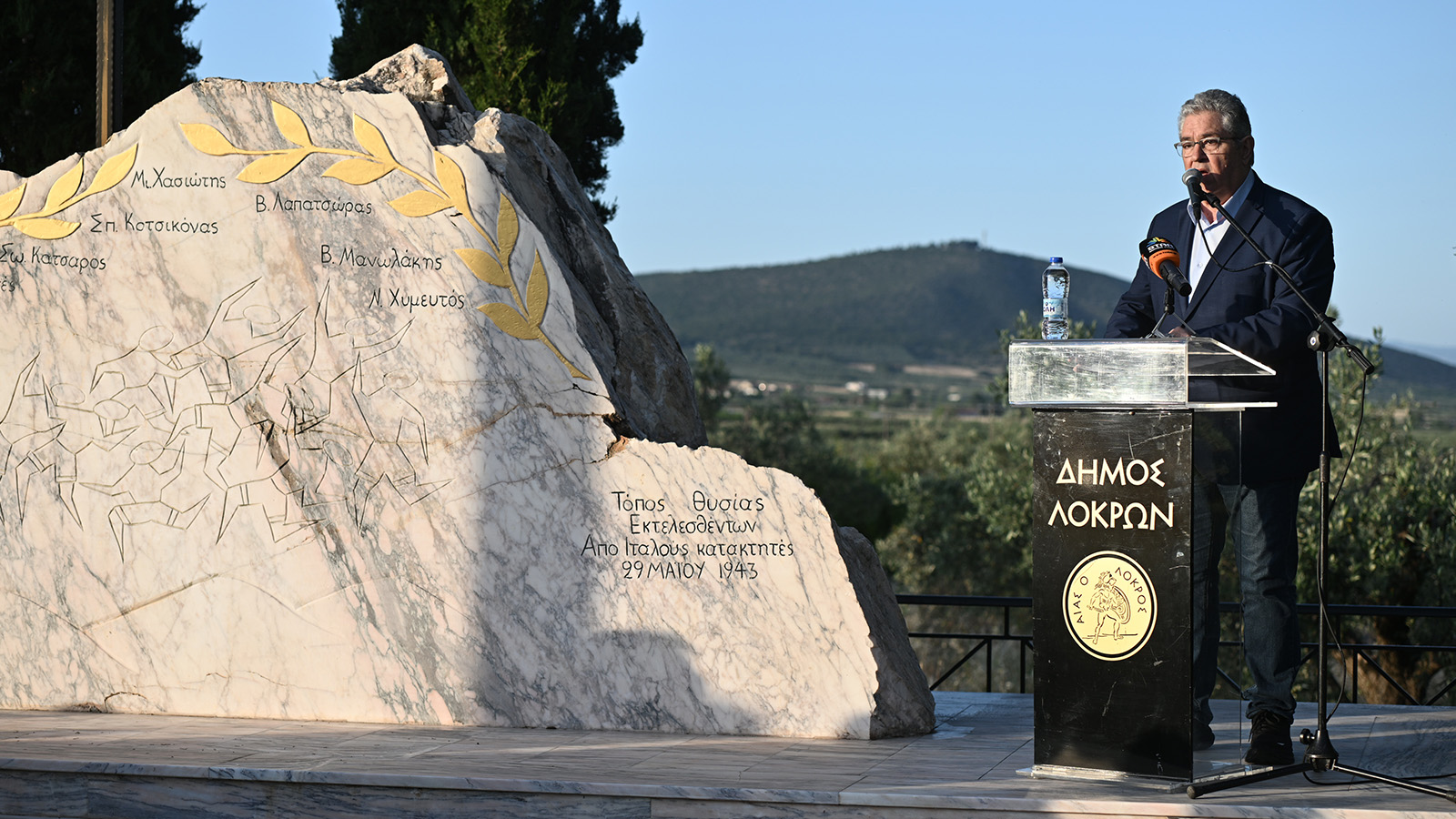
An event was organised by the municipality of Lokros in Greece, about the people of Atalanta who were executed by the Italian occupation troops on 29 May 1943. At the event, Dimitris Koutsoumbas, the General Secretary of KKE made a speech.
Communist Party of Greece commemorates those executed in WW2
He praised the sacrifices made by EAM and ELAS fighters who resisted fascism and Nazism and described Lokris as a region deeply connected to the history of the National Resistance. He stressed the importance of preserving historical memory, combating what he called attempts to revise or distort history, and continuing the demand for German reparations and compensation for wartime destruction.
He argued that the sacrifices of resistance fighters refute attempts to equate communism with fascism, criticizing what he described as the European Union’s promotion of the “theory of the two extremes.” According to him, the history of the resistance reveals a fundamental divide between those who fought for liberation and social justice and the occupation forces, fascists, and domestic political forces that collaborated with them.
Drawing parallels with the present, he claimed that the same social divide persists today, contrasting workers, farmers, and ordinary people with large economic interests and political elites. He pointed to rising living costs, low wages, pressures on small businesses, and the OPEKEPE scandal as evidence of growing inequalities, while criticizing subsidies and privileges granted to major corporations.
Particular emphasis was placed on the future of LARCO, the state-owned nickel producer with operations in the region. The KKE leader expressed support for workers demanding stable employment, higher wages, improved conditions, and guarantees regarding the company’s future, arguing that local communities should not bear the costs of economic policies or international conflicts.
The speech also criticised successive Greek governments and political forces that, in KKE’s view, have invoked the legacy of the resistance while implementing austerity measures, maintaining close relations with the United States, and supporting strategic cooperation with Israel. Koutsoumbas specifically condemned ties with the government of Israeli Prime Minister Benjamin Netanyahu and denounced Israel’s actions in Gaza.
Concluding his remarks, he presented the history of EAM and ELAS as proof that ordinary people can transform society through collective struggle. He called on workers, farmers, and other social groups to organize politically and socially, arguing that only a mass popular movement can challenge existing inequalities and open the way to what he described as a future of prosperity, peace, freedom, and social justice.