
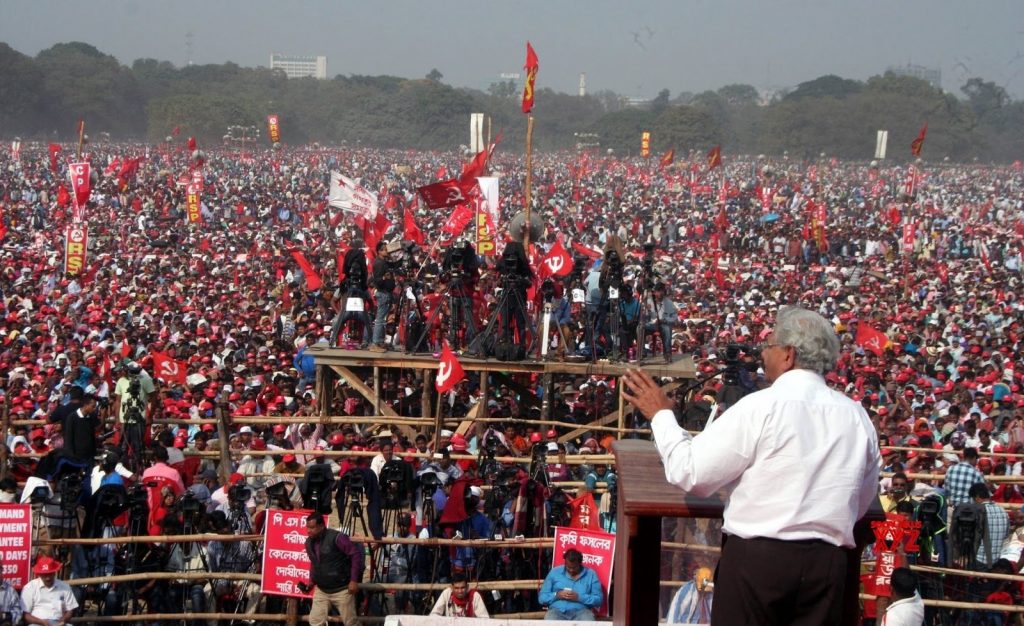

Communist Party of India (CPI) General Secretary D. Raja has criticised recent remarks by RSS chief Mohan Bhagwat questioning the Western origins of secularism and contrasting it with the Indian principle of sarva-pantha-samabhava, or equal respect for different faiths.
Communist Party of India GS on secularism
RSS (Rashtriya Swayamsevak Sangh) is widely regarded as the ideological and organisational parent of the broader Sangh Parivar, the family of Hindu-nationalist organisations that includes the Bharatiya Janata Party (BJP). Bhagwat has recently argued that India’s understanding of dharma and secularism differs from the Western conception.
In a statement Raja emphasises that this is not simply a terminological dispute but has direct political implications because the RSS has long promoted the concept of a Hindu Rashtra. He questions the consequences of defining all Indians as “Hindus” in a broad civilisational sense, arguing that citizens should not have to accept a religious or cultural definition imposed by another political organisation in order to enjoy equal citizenship.
Raja contrasts the RSS position with the views of major figures of India’s freedom movement and Constitution-making process. He cites Mahatma Gandhi’s insistence that the State should be wholly secular and that citizens should enjoy equality before the law and freedom of religion. He also recalls Gandhi’s explicit rejection of a theocratic Hindu State.
He similarly highlights Jawaharlal Nehru’s commitment to a secular, non-communal and democratic State in which citizens of all religions would have equal rights. Raja argues that these positions emerged directly from the experience of Partition and communal violence, when the dangers of organising political life around religious identity had become evident.
Raja places particular emphasis on B. R. Ambedkar’s constitutional position. Citing Ambedkar’s rejection of theocracy, he states that secularism does not mean abolishing religion but preventing Parliament and the State from imposing any particular religion on the population; and that this demonstrates that secularism was a response to India’s own religious diversity rather than a foreign concept imposed on the country.
He also invokes Bhagat Singh, particularly his criticism of religious authority and his advocacy of independent thinking. Raja connects this with his broader argument that the issue is not respect for Hinduism or other religions, but whether a particular interpretation of Hindu civilisation should become the organising principle of the Indian State.
The CPI general secretary further links the Hindu Rashtra project to questions of caste and gender inequality. He argues that the constitutional Republic is based on equality, liberty and equal citizenship, whereas inherited social hierarchies based on caste or gender cannot be allowed to determine citizens’ rights and status. He cites Ambedkar’s struggle for social reform, including the Hindu Code Bill, in this context.
Raja concludes that sarva-pantha-samabhava, despite its value as an ethical principle, does not resolve the constitutional question of whether the State can privilege a religious conception of national identity. He argues that Gandhi, Nehru and Ambedkar all rejected such a conception, while insisting that Muslims, Christians, Sikhs, Buddhists, Jains and atheists should not have to accept a common religious identity to establish their equal place in India.
He finally argues that the debate over secularism has practical social and economic consequences. Raja states that focusing political life on religious identity diverts attention from unemployment, inflation, education, healthcare and insecurity, which affect citizens across religious communities. He therefore presents the central issue as whether the Indian State will belong equally to all citizens or require citizens to accept a religious definition of the nation.