
Mexico has seen an increase in civil unrest and popular movements. The most recent being the education workers of Mexico and with the National Coordinator of Education Workers (CNTE), who are fighting for the right to a dignified retirement, for stable working conditions, and for the defence of public education.
Communist Party of Mexico organises 4th meeting of popular struggle
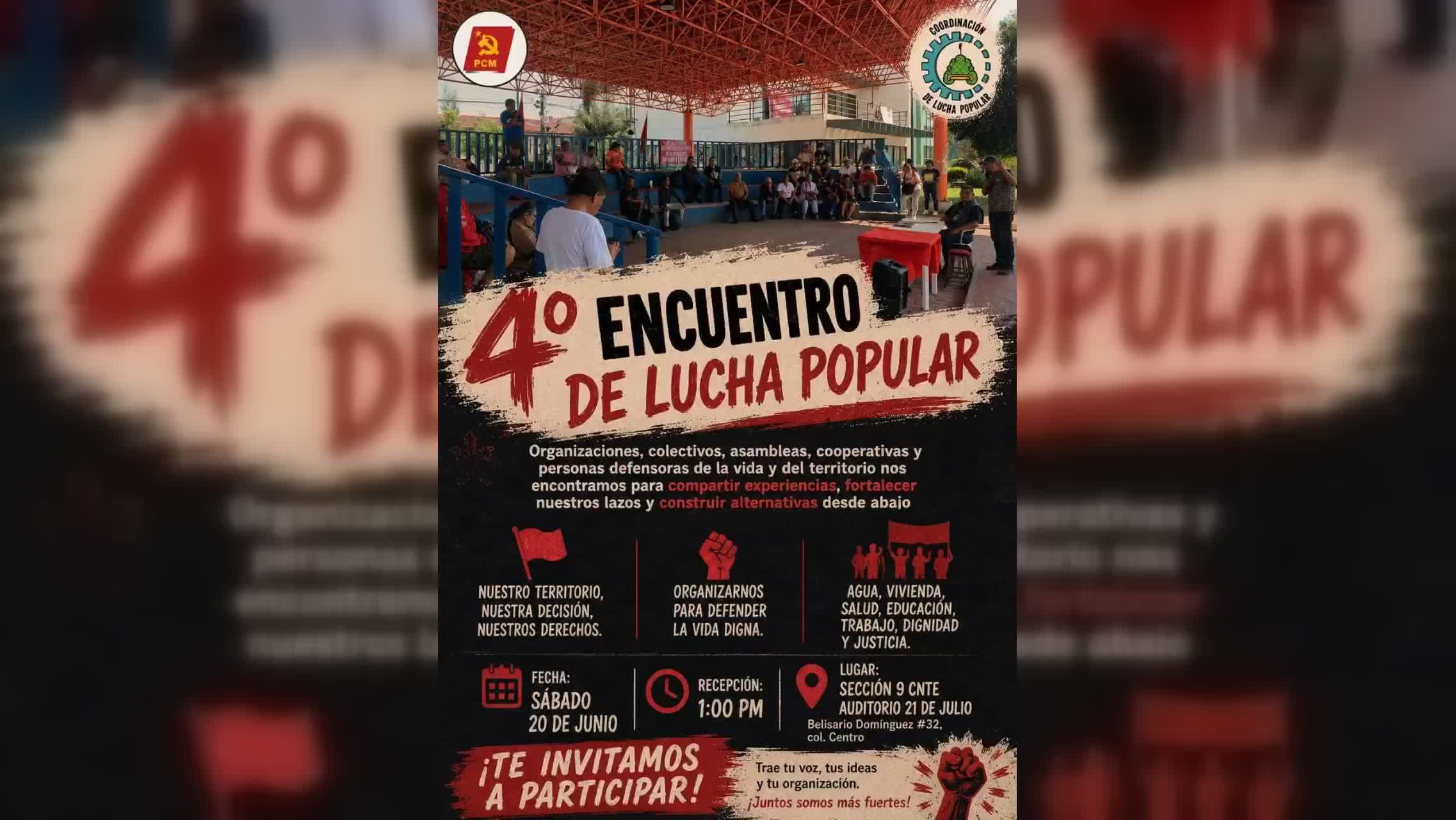
Communist Party of Mexico is organising a meeting of coordination of the popular struggle. The meeting is described as organizations, collectives, assemblies, cooperatives, and people defending life and territory coming together to share experiences, strengthen our bonds, and build alternatives from below.
Communist Party of Mexico has also shared the following statement titled “Our policy with the popular sectors”:
In any political community divided by social classes, the clash of interests and the conflict arising from the imposition of one group over another are inherent. In Mexico City, this conflict manifests itself in many ways: neighbourhood blockades due to lack of water, marches by indigenous communities demanding respect for their rights, shouting and shoving public officials at neighbourhood assemblies, residents of a district gathering signatures to demand a service or report a problem, and in many other ways.
The question that should concern us is why all these expressions of discontent are occurring. We say the first reason is that the discontent exists. This obvious point is necessary because the current government of Clara Brugada, like that of Sheinbaum at the national level, maintains a narrative that no social issues exist in our capital, that the people here are happy, and that justice and well-being reign. All the blockades and popular demonstrations expose this false narrative.
The second reason for these expressions of discontent is that popular consciousness is beginning to shake off the political culture of depoliticization, replacing it with an awareness of the undeniable need to organise and demand solutions from those who control the entire state apparatus and have the political obligation to do so. This awareness is growing throughout the city. Displays of discontent are becoming increasingly frequent, and new, legitimate organizations are emerging that the morena government has been unable to co-opt.
The growing trend of civil disobedience in Mexico City is a reality that, in addition to the reasons already mentioned, stems from the conflict between the private interests of the bourgeoisie and the popular interests of the majority of the population. Because, let's be clear, working-class neighbourhoods are left without water because it's being siphoned off by industry, real estate developers, and enormous shopping malls. Working families will never be able to buy a house because banks hoard them and profit from them. We workers don't have a decent pension or good wages because that would reduce the profits of the monopolies.
In the case of Indigenous peoples, who is violating their rights? It is the State itself that feigns consultation; it is politicians from all bourgeois parties who interfere in the internal affairs of these communities; it is the Brugada administration and the local governments that seek to divide and usurp representation. And what is the purpose of all this? To ensure that capitalism has free rein for its business dealings in their territories.
The preceding examples are sufficient to show that the logic guiding this city's development is incompatible with meeting the needs of the majority of its population. As long as water, housing, transportation, land, education, culture, and everything else continue to be conceived as commodities, they will remain scarce for the people and a source of enrichment for the monopolies that hoard them. As Marx and Engels denounced in the Communist Manifesto, the property of a few exists only at the expense of millions.
The explanations cannot end there. Why do minority interests guide the development of Mexico City? Why are housing, water, transportation, culture, and everything else we need to live well commodities owned by a minority? Because in the clash between the interests of the bourgeoisie and those of the people, the former has a fundamental instrument: the State. It is the State that ensures that minority private interests prevail over all the society.
The imposition of minority interests is not always achieved through open repression. The Brugada government does so in various ways: deception, corruption, division, coaptation, usurpation… a wide range of tactics well learned from the PRI. Despite all this, they have been unable to stem the growing trend of insubordination that we are witnessing today.
With this upward trend, it is essential to emphasize the need for a united struggle to shake off the external interests that have been imposed upon us. Popular movements and struggles must actively participate in politics in all its forms, as a single front against minority interests. This front must alter the balance of power to sweep away the commodification of our needs and transform them into inalienable rights.
The popular struggle of our time compels us to discuss political trends, programs, and organizational forms. Those who seek to maintain oppression over the popular sectors aim to drag us, once again, into the shadow of MORENA. Others tend toward the fragmentation of struggles, unionism, and localism. We communists seek the unity of struggles because it is the political task of our time. Faced with our common enemy, who concentrates wealth and political power, we must wield our most effective weapon: the vast, organised social mass.