
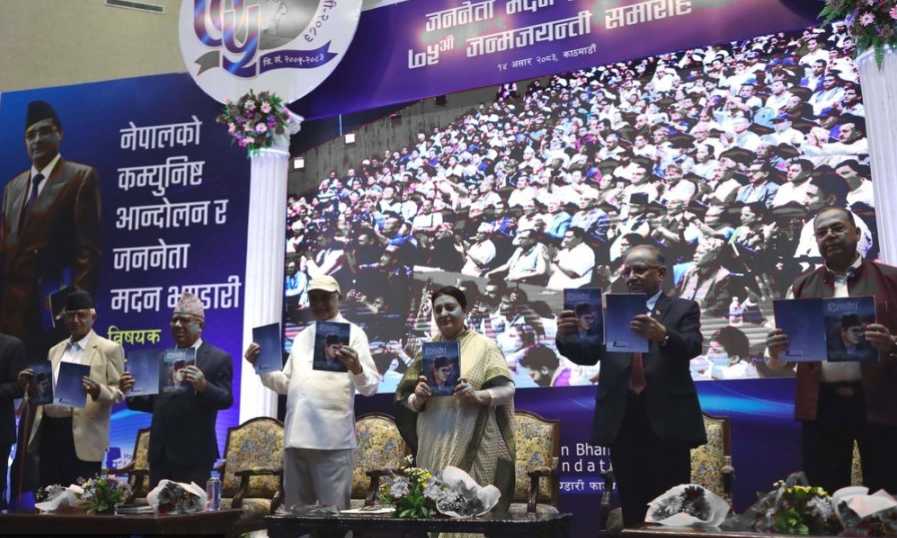
The Communist Party of Nepal (Unified Marxist-Leninist) (CPN-UML), led by KP Sharma Oli, is pursuing closer cooperation with other left-wing and democratic forces in Nepal, amid preparations for the local and provincial elections scheduled for 2027.
Communist Party of Nepal(UML) calls for unity of left and democratic forces to defend constitution
The initiative aims to strengthen the position of the left, defend the country's constitutional framework and prevent further fragmentation of its electoral support.
Oli has repeatedly called for unity among left-wing and democratic forces. Speaking in late June, he warned that efforts were being made to weaken the left and argued that these forces must unite to prevent political regression. The UML's position is that cooperation should be built around common political objectives and practical action, rather than being made conditional on an immediate merger of parties.
This approach has increasingly taken shape through cooperation between the UML and the Nepali Communist Party (NCP), coordinated by Pushpa Kamal Dahal. Following the March 2026 parliamentary elections, in which both parties suffered a significant decline compared with their previous electoral strength, they joined forces in five provincial governments. Their leaders have since discussed extending this cooperation to the next local and provincial elections.
In October, UML leaders confirmed that preparations were under way to establish a framework for electoral cooperation. UML Secretary Bhanu Bhakta Dhakal stressed that trust between the two parties needed to be strengthened and that agreements should be developed through their local and district organisations, rather than imposed exclusively through decisions at the top. The parties have also been preparing common programmes on national sovereignty, constitutional protection and the rising cost of living.
On 23 November, Dahal announced that a policy-level decision had been reached to contest the forthcoming local and provincial elections jointly with the UML. He also said that the two parties, together with another communist organisation, CPN Mashal, had agreed to cooperate in Parliament and through street mobilisation. Dahal described the discussions with the UML as progressing positively.
The UML's broader political objective is to bring together left-wing and democratic forces in defence of the Constitution and the federal republican system. According to Dahal's latest remarks, discussions are also continuing with the Nepali Congress and Madhesh-based parties to establish a wider common front. This would extend beyond the communist movement and include forces involved in the Constituent Assembly process and the peace agreement.
The defence of constitutional provisions is also at the centre of the current dispute over the timetable for the 2027 elections. The government and the ruling Rastriya Swatantra Party have favoured holding local and provincial elections simultaneously, citing the costs and disruption caused by separate election campaigns. The UML and NCP oppose this approach, insisting that the elections must be held separately in accordance with constitutional and legal provisions. UML Vice-Chair Guru Baral has argued that there is no legal basis for postponing local elections or bringing provincial elections forward simply to hold the two votes together.
The cooperation between Oli and Dahal marks a significant development in Nepal's left-wing politics. Their parties previously formed an electoral alliance in 2017 and merged in 2018 to establish the Nepal Communist Party, which commanded a near two-thirds parliamentary majority. That unity collapsed in 2021. With the current initiative, both sides are seeking practical cooperation and electoral coordination without committing to an immediate organisational merger.
For the CPN-UML, the challenge is to turn this renewed cooperation into a durable political alternative. By strengthening coordination among left-wing forces and reaching out to other democratic parties, the UML is seeking to defend the constitutional achievements of the republican period, protect national sovereignty and rebuild the political influence of the left ahead of the 2027 elections.
(Photo: The Kathmandu Post)