
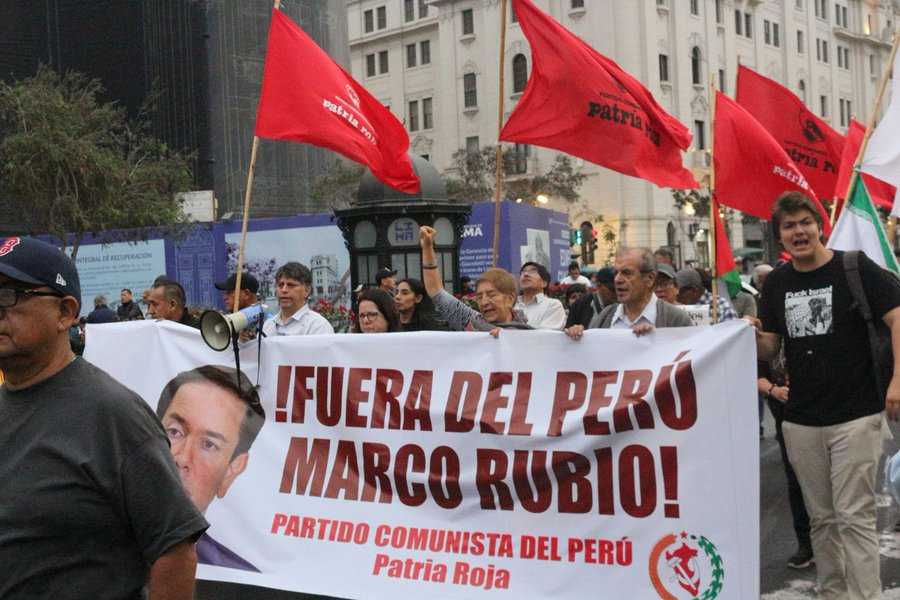
The Communist Party of Peru – Patria Roja mobilised in Lima on 9 September against the visit of U.S. Secretary of State Marco Rubio, denouncing the growing U.S. political, military and economic interference in Peru and opposing the country’s incorporation into the U.S.-led “Shield of the Americas” security initiative.
Communist Party of Peru - Patria Roja mobilises against Rubio
Patria Roja had called on workers, students, intellectuals and the wider population to take part in the mobilisation, which began at 4 p.m. at Dos de Mayo Square. The party urged the population to reject Rubio’s visit, portraying him as a representative of the Trump administration and as a leading figure in U.S. interventionist policies in Latin America.
The mobilisation subsequently moved through central Lima and reached Plaza San Martín, where demonstrators displayed banners and chanted slogans including “Fuera Marco Rubio” (Marco Rubio out of Peru), “Fuera yanquis” (Yankees out) and “No al Escudo de las Américas.” Patria Roja participated alongside other left-wing, progressive and democratic organisations. Patria Roja was one of the organisations that had called for the protest.
Patria Roja: opposition to the “Shield of the Americas”
The central political issue for Patria Roja was not simply Rubio’s presence in Peru but the broader realignment of the Peruvian government under President Keiko Fujimori towards Washington.
In a statement issued ahead of the visit, the Political Bureau of Patria Roja’s Central Committee categorically rejected Peru’s incorporation into the “Shield of the Americas.” The party argued that national security and the fight against drug trafficking and organised crime should be addressed through a sovereign Peruvian strategy and cooperation among equals, rather than through a hemispheric security architecture designed according to U.S. strategic interests.
Patria Roja characterised the language of “hemispheric security”, “narcoterrorism” and “transnational threats” as a continuation of a historic policy of U.S. tutelage and interference in Latin America and the Caribbean.
The party also rejected the argument that maintaining diplomatic relations with Washington requires accepting U.S. policies. It called instead for an independent and non-aligned foreign policy based on dialogue with all countries, peaceful resolution of disputes and respect for international law.
Patria Roja argued that Peru should respond to the emergence of a more multipolar international order by strengthening its sovereignty and maintaining relations with all countries rather than aligning itself with what the party described as the declining interests of a hegemonic power. It called on the Fujimori government to reverse its decision and appealed to democratic, patriotic and popular organisations and to the working class to oppose what it called the “colonial subordination” of Peruvian diplomacy.
Protest linked Rubio’s visit to wider U.S. policy
The mobilisation also expressed opposition to the wider foreign policy of the Trump administration. Patria Roja’s call described Rubio as an architect of the U.S. blockade against Cuba and accused him of complicity with Israel in the war in Palestine and with U.S. military aggression against Iran. The party therefore presented the protest as part of a broader struggle against U.S. imperialism rather than as opposition to a single diplomatic visit.
During the demonstration, participants also carried Palestinian flags and expressed solidarity with Palestine, while condemning what they saw as Washington’s attempts to reassert its political and strategic dominance over Latin America. Other demonstrators argued that Peru should decide independently with which countries it develops alliances and agreements.
Rubio’s visit and Peru’s closer alignment with Washington
The protest took place as Rubio concluded a three-country Latin American tour that also included Colombia and Ecuador. His Peru visit focused on security cooperation, drug trafficking, trade, migration and regional geopolitical issues. During the visit, the Fujimori government formally announced Peru’s participation in the “Shield of the Americas,” a U.S.-led initiative intended to coordinate regional efforts against transnational organised crime.
Peru had already been designated a major non-NATO ally by the United States, while the two countries are discussing further military and defence cooperation. Washington is also seeking to counter China's expanding economic influence in Peru, particularly in strategic sectors such as mining and infrastructure.
Rubio's visit therefore formed part of a wider U.S. effort to consolidate relations with right-wing governments in South America and strengthen Washington's regional influence amid increasing competition with China. Peru's entry into the “Shield of the Americas” was one of the principal outcomes of the visit.