
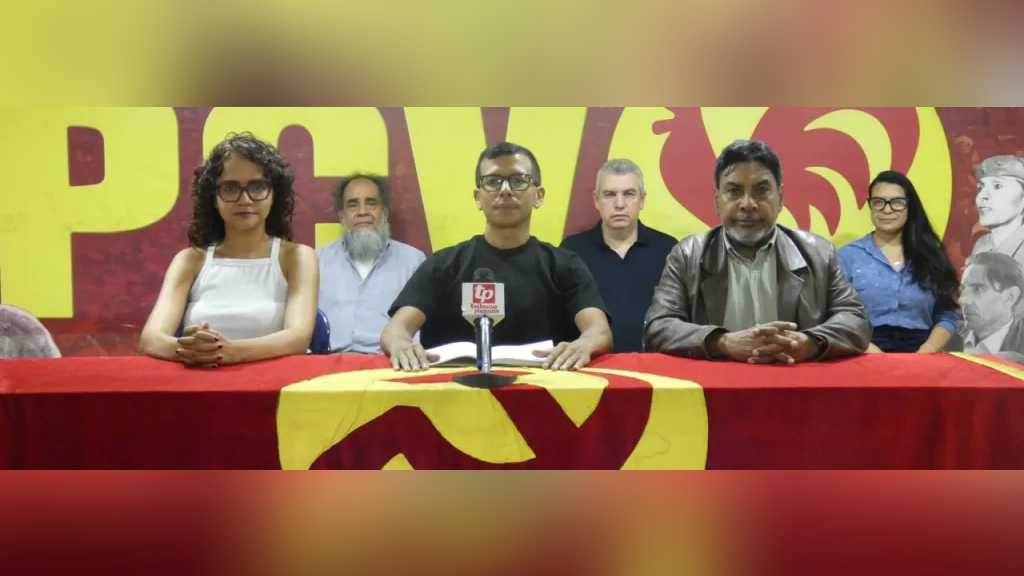
The Communist Party of Venezuela (PCV) warned that Venezuela's inclusion in the credit guarantee program of the Foreign Agricultural Service of the United States Department of Agriculture will deepen the country's agri-food dependence and affect small and medium-sized producers.
Communist Party of Venezuela warns against US agricultural program
According to Tribuna Popular, Ali Jiménez, a member of the Political Bureau of the Central Committee of the PCV, stated that the US initiative is not aimed at strengthening national production, but at facilitating the purchase of agricultural raw materials from the United States by the Venezuelan agro-industrial sector.
"We want to express our concern to the Venezuelan people, especially to small and medium-sized producers and farmers, about this tool of the United States government that seeks to turn Venezuela into a market for its agricultural products," Jiménez said during the Political Bureau's press statement.
The communist leader argued that the credit guarantee program does not directly benefit the farmers, but rather favors the agro-industrial sector to finance the acquisition of American agricultural products.
"This is a program that seeks to provide credit not to farmers, not to producers, but to the country's agro-industrial sector so that it can buy agricultural raw materials in the United States," he stated.
For the PCV, this policy will deepen the problems already facing Venezuelan agricultural production, particularly in sectors such as rice and corn.
"This is detrimental to national production," insisted Jiménez, who considered that the measure will not contribute to guaranteeing food sovereignty in Venezuela.
"This measure announced by the United States government does not seek to increase the country's food sovereignty and independence," he stated.
Against agri-food dependency
Jiménez warned that the initiative could increase food imports and limit the possibilities of developing crops and livestock production in the country.
"We want to warn against this action that seeks to put the country in a situation where there is an even greater level of dependence on American imperialism," he stated.
The communist leader stated that US influence over the Venezuelan economy would not be limited to the oil and mining sectors, but would also extend to food supplies.
"We can see that it has not only been the control of oil fields and mining in our country, but now the United States government is also seeking to control imports, especially of food, that our country has," he said.
Given this scenario, the PCV called on the peasantry and producers to discuss the measure and mobilize in defense of national production.
"We cannot allow agricultural products from other countries to be prioritized when they can be perfectly produced in our country," Jiménez said.
The leader argued that agricultural policy should be geared towards producing in Venezuela the food consumed by the population, as a way to achieve food sovereignty and halt the deterioration of the living conditions of the peasantry.
"That should be the agricultural, farming and production policy in our country: that these items, that the production of these items, be here in Venezuela," he stated.
Jiménez also denounced the precarious economic conditions of the farmers and questioned the prices they receive for their crops.
In his opinion, the situation contributes to the "impoverishment of our peasantry," which, he stated, has been subjected to "extremely poor" conditions for "a very long time."
PCV supports teachers' mobilization
During the statement, the PCV also expressed its support for the mobilizations of the education sector and questioned the start of the school year.
Jiménez accused the government of "trampling on Venezuelan teachers" by bringing forward the start of classes and argued that this decision violates agreements and legal provisions regarding teachers' vacation period.
The leader also pointed out that low salaries add to the adverse conditions facing the sector and described the 12 bolivar vacation bonus that education workers recently received as "a mockery of their efforts".
The PCV expressed its support for the teachers' unions that have called for a return to classrooms on September 16 and for the mobilizations called in front of the Ministry of Education and the educational zones.
Rejection of Rubio's tour in the region
Likewise, the PCV rejected the recent tour of US Secretary of State Marco Rubio through countries in the region, considering it to be part of a strategy to strengthen Washington's influence in Latin America and the Caribbean.
The leader described the tour as part of the so-called "Trump corollary to the Monroe doctrine" and argued that it seeks to "strengthen the subordination of the hemisphere to the geopolitical, geostrategic interests of the United States."
"From the Communist Party of Venezuela, we call upon the peoples of Latin America to organize ourselves, to rise up against a new attempt at domination," he stated.
Jiménez recalled that Rubio's tour coincided with another anniversary of the fascist coup against Salvador Allende in Chile.
"This event led to the establishment in Latin America of one of the cruelest and most bloodthirsty dictatorships our continent has ever seen. Thousands were murdered, thousands disappeared, and there was total persecution of democratic, revolutionary, and communist sectors in Chile," he said.
Crisis in the Middle East
Finally, the PCV condemned the intervention of the United States and Israel in Yemen and supported the resistance actions against the aggression.
"Nearly 20% of the world's goods and 10% of its oil production pass through the Bab el-Mandeb Strait. There, imperialism, through Zionism and its satellites in the region, is trying to take control," Jiménez denounced.