
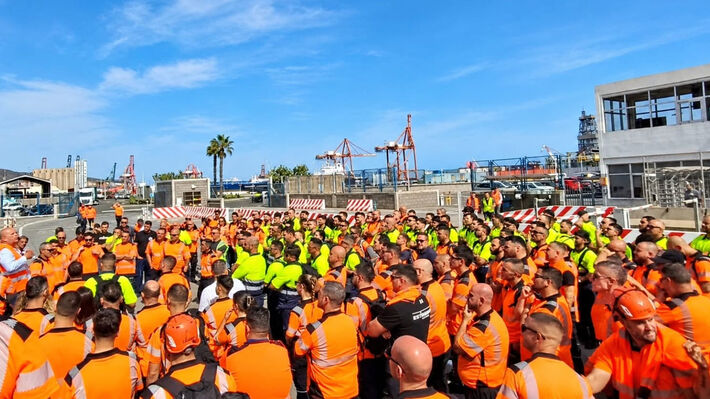

At the Dockworkers International Day of Action against War on 30 October, strikes were reported in around 115 ports across 22 countries. Reports by communist parties, unions and other organisations show a clear picture that the strike was effective.
Communists hail international dockworkers' strike as its affects are assessed
KKE: “The strike made history”
The Communist Party of Greece's (KKE) newspaper Rizospastis, in its edition dated 31 October–1 November, devoted prominent coverage to the outcome of the international action. Its headline described the strike in 113 ports across five continents as an historic event. The coverage highlighted that the port of Piraeus was brought to a standstill, with strike rallies and mobilisations taking place across Greece. The newspaper emphasised the international reach of the action, using the phrase “Images of hope from Australia to the USA.” It argued that workers, when united and organised at the points where profits are produced and military cargoes transported, can influence the future of their countries. It called for the mobilisation to be extended to other sectors, with stronger joint initiatives and international coordination against involvement in war.
The newspaper also carried the message from KKE General Secretary Dimitris Koutsoumbas: “All the people stand with the dockworkers – Workers of all countries, unite!” The KKE’s official website had also published Koutsoumbas’s statement at the Piraeus strike rally on 30 October. He expressed solidarity with dockworkers in 113 ports across 22 countries and five continents, declaring: “We do not work for their war! We demand ports of peace, belonging to the peoples, not bases and launching pads for the imperialists.”
A solidarity gathering and a concert was held in Ilion, in western Athens, on the evening of 30 October. It was organised by the local Peace Committee together with trade unions, associations and other organisations.
Apostolis Kypraios, president of the seafarers’ union PEMEN and a member of the Piraeus Labour Centre administration, addressed the gathering and reported on the atmosphere at the morning strike rally and the problems faced by port workers. The main speech, delivered by Petros Karabas, president of the Ilion Peace Committee, connected the dockworkers’ mobilisation with wider struggles against war, rising prices and the deterioration of public services. It described the international strike as the largest of its kind in recent decades.
Communist Front, Italy: “An extraordinary day of struggle”
The party said that more than one million workers, students and unemployed people had filled squares across Italy. It linked the mobilisation to opposition to rising living costs, the deterioration of healthcare and education, poverty wages and what it called “criminal, warmongering policies”.
PAME: post-strike assessment
There is also a particularly relevant post-action statement from PAME, the All-Workers Militant Front in Greece, published on 31 October. Its headline says that the media blackout cannot conceal the historic dockworkers’ strike.
USB: Largest stoppages in the Mediterranean
A statement issued by Italy’s Unione Sindacale di Base (USB) on 31 October provided a more detailed account of the international dockworkers’ mobilisation held the previous day. According to USB, approximately 115 ports in 22 countries across five continents were involved, with reports of strikes and demonstrations arriving throughout the day, from the first action in Melbourne, Australia, to the final rally in Oakland and San Francisco on the US West Coast.
The largest stoppages took place in the Mediterranean. USB reported 24-hour strikes in 24 French ports, nine Italian ports, ten Greek ports and three Turkish ports. In Italy, the action was organised by USB and ORSA Porti. Shorter stoppages and other forms of mobilisation took place in Morocco, the Basque Country, Spain and Cyprus. The planned strike by the WTWFI federation in 11 Indian ports, however, was suspended because of adverse weather conditions.
In Livorno, Italy, dockworkers refused to service the Sunaid X, a container ship identified by local unions as supplying the NATO military base at Sigonella. Workers on both the night and morning shifts refused to handle the vessel, while USB, the dockworkers’ collective GAP and activists from the Global Sumud Flotilla organised pickets and action around the port.
The scale of the mobilisation was also recognised by the International Transport Workers’ Federation (ITF), which expressed solidarity with the participating unions and reiterated its support for Palestinian rights and opposition to the use of civilian ports for military cargo.
The expectation before the strike was that in the ports striking for 24 hours, 52,000 containers would be halted and $2.8 billion worth of cargo would not move. This delay would cost $57,000,000, and that was before taking into account the cascading delays the following day, the general strike in Italy, and the greater number of ports striking for two hours.
These figures have not been confirmed, yet. But overall, the international strike has been very successful.