
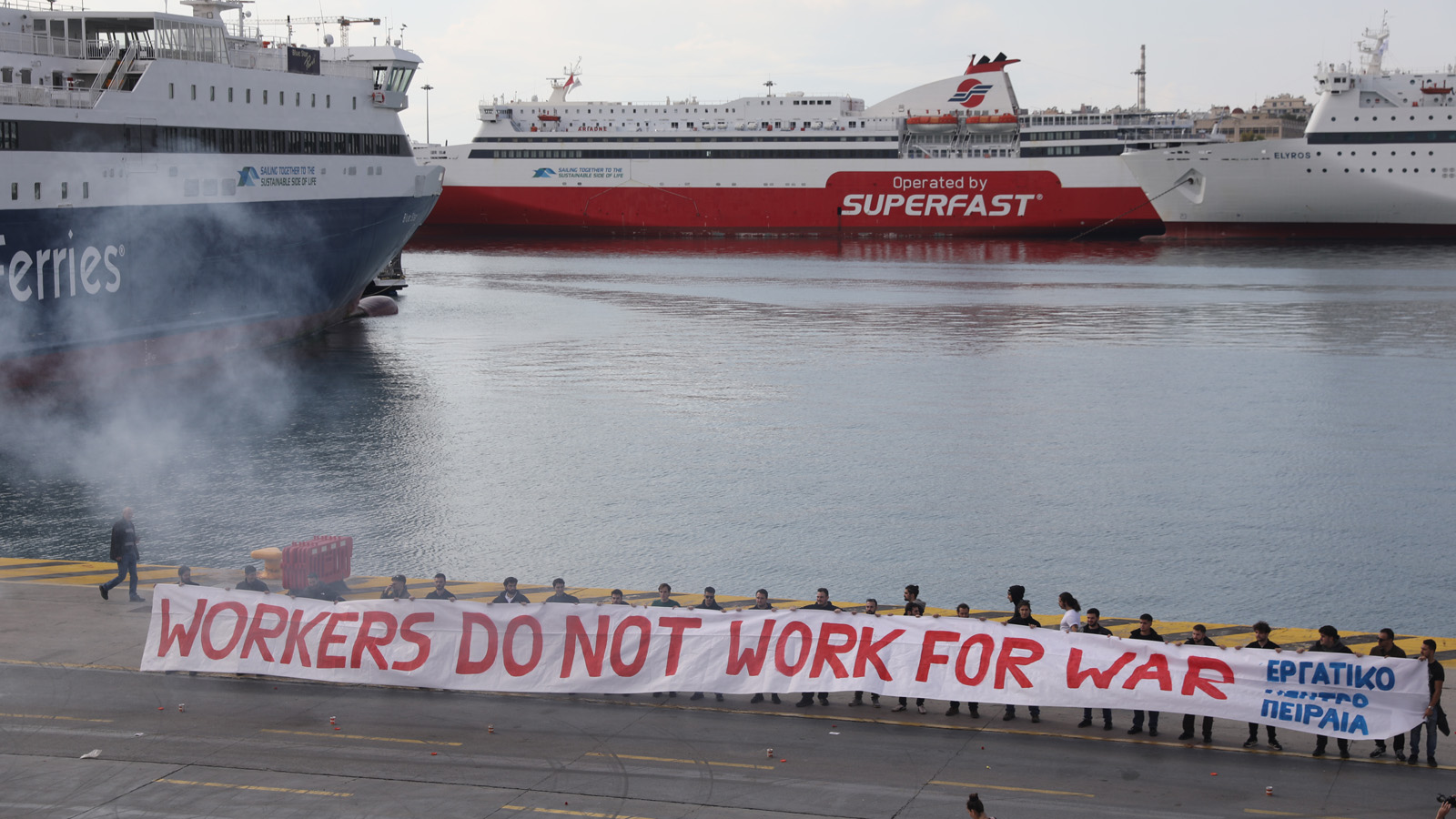

Dockworkers and port workers in 113 ports across 22 countries and five continents took part on Friday, 30 October, in an international day of action against war and the militarisation of ports.
Communists rally as dockworkers mobilise at 113 ports in 22 countries against war and imperialist militarisation
Under the slogan “We don't work for war”, workers organised strikes, work stoppages, demonstrations and pickets, demanding that commercial ports not be used to transport weapons, ammunition, military equipment and troops to conflict zones, particularly Israel.
The mobilisation was coordinated by more than 25 trade unions and brought together workers from Europe, the Mediterranean, Asia, Africa and the Americas. It followed an international meeting of dockworkers' unions held in İstanbul in May 2026. Among the organisations behind the initiative were CGT Ports and Docks in France, ENEDEP in Greece, LAB in the Basque Country, Liman-İş in Turkey, ODT in Morocco and USB in Italy. The World Federation of Trade Unions (WFTU) and its International Trade Union of Transport, Ports, Fishery and Communications Workers also called for participation.
Greece: A major strike and broad working-class mobilisation
The largest reported mobilisation took place in Piraeus, where around 3,000 workers participated in the strike and demonstration. Cargo operations were halted, while ferry services were disrupted. The action extended beyond dockworkers: seafarers, ship-repair workers, metalworkers, railway workers, teachers, students and other sections of the working class joined the mobilisation.
The ENEDEP union, representing workers at the COSCO-operated Piers II and III, was at the centre of the strike. The Piraeus Labour Centre called a 24-hour strike, while the Federation of Greek Port Employees and other unions organised work stoppages and solidarity actions. Seafarers' unions also called a nationwide 24-hour strike, demanding wage increases, improved working conditions, stronger safety measures and the presence of doctors aboard ships. Railway workers joined with their own 24-hour strike, raising demands for safer railway transport.
The mobilisation was not confined to Piraeus. Workers took action in Thessaloniki, Patras and other ports, while demonstrations and solidarity gatherings were organised in several Greek cities. In Thessaloniki, more than 200 containers and trucks were reportedly brought to a standstill during a three-hour work stoppage. A large banner reading “Workers do not work for war” was unfurled inside the port of Piraeus at the conclusion of the demonstration.
The Communist Party of Greece (KKE) played an active political role in supporting the mobilisation. Its Attica Party Organisation had campaigned for the strike, calling on workers, young people and the wider population to participate under the slogans “Dockworkers do not work for war” and “Ports of the peoples and peace—not bases and launching pads for the imperialists”.
KKE General Secretary Dimitris Koutsoumbas attended the strike rally in Piraeus. He declared that dockworkers in 113 ports, 22 countries and five continents were sending a common message: “We don't work for their war! We demand ports of peace, of the peoples, and not bases and launching pads for the imperialists.” He expressed the solidarity of the Greek people and youth with the workers taking action internationally, concluding with the call: “Workers of all countries, unite!”
The Communist Youth of Greece (KNE) also campaigned for participation, seeking to mobilise students and young people. The KKE linked the struggle against war with workers' demands for collective agreements, wage increases, secure employment and improved health and safety conditions. It argued that workers should not be exposed to the dangers of transporting military cargo or made to bear the economic consequences of military escalation and increased military expenditure.
Mexico: Veracruz dockworkers denounce privatisation and militarisation
The Communist Party of Mexico publicised a declaration by the Union of Dockworkers and Day Labourers of the Port of Veracruz, which expressed its support for the international action and highlighted the specific conditions faced by Mexican port workers.
The union recalled that in 1991, as part of the process of privatising the Port of Veracruz under President Carlos Salinas de Gortari, dockworkers were stripped of their collective labour agreement, their established area of operation and their source of employment. The declaration linked these measures to the commitments made by the Mexican government in connection with the North American Free Trade Agreement (NAFTA).
According to the union, privatisation fragmented dockworkers into smaller company-based unions and contributed to the loss of labour rights won through decades of organisation and trade union struggle. It stated that workers have continued fighting to recover those rights and their livelihoods.
The declaration also denounced the militarisation of port administration. It said that legal reforms introduced from 2019 onwards had displaced civilian personnel and transferred administrative authority to military commanders from the Mexican Navy. The union argued that military surveillance in the port had made independent trade union activity more difficult and exposed workers' protests in defence of their rights to pressure and persecution.
The Veracruz dockworkers further connected their precarious living conditions with the economic consequences of war, particularly rising prices of basic consumer goods. They expressed solidarity with workers and peoples affected by imperialist conflicts, naming Russia and Ukraine, Iran, Cuba and Palestine. They condemned the genocide committed by Israel against the Palestinian people and warned that military equipment and weapons were being transported through ports in the Mediterranean and across Europe, Africa, Asia, Oceania and the Americas.
The union called on Mexican port workers to examine the conditions in which they work and live and to heed the international appeal of dockworkers. Its declaration concluded with the slogans: “Dockworkers do not work for war!”, “Stop the genocide in Palestine!” and “Down with the criminal blockade against Cuba!”
The statement gave the international action a concrete labour dimension, showing how opposition to the use of ports for war is connected, in the experience of Veracruz workers, to struggles against privatisation, the erosion of collective rights and militarisation.
International actions
In Italy, the Unione Sindacale di Base (USB) organised actions in several ports, including Genoa, Trieste and Gioia Tauro. Workers in Reggio Calabria received support from young people and other sections of the population. USB connected the opposition to war and rearmament with demands for higher wages, better pensions and resistance to the rising cost of living.
The Communist Front and other Italian communist and left organisations supported the mobilisation. Communist Front said, "This general strike was an extraordinary day of struggle. More than one million workers, students and unemployed people filled squares across Italy, sending a very clear message: the rising cost of living, the collapse of the healthcare and education systems, and poverty wages are the result of criminal, warmongering policies."
In France, hundreds of workers at Fos-sur-Mer, near Marseille, joined the mobilisation organised by the CGT Ports and Docks federation. The action also involved workers in other major ports, including Le Havre, Dunkirk and Rouen, opposing the militarisation of port infrastructure and the use of commercial facilities for military purposes. The French Communist Party (PCF) had publicised and supported the initiative.
In Germany, young dockworkers and apprentices held a solidarity demonstration at the port of Hamburg. The participation of port workers represented by ver.di had been announced during the preparations. In India, dockworkers and seafarers joined the action under the slogan “Ports of peace and jobs with dignity”. Their representatives highlighted the deaths of Indian seafarers in the Iran war and the situation of others stranded in conflict zones.
Actions and demonstrations were also reported in Turkey, Morocco, Spain, Denmark and Sweden, as well as in countries in the Americas and other regions. In Istanbul, demonstrators gathered outside Haydarpaşa port under a banner reading “No to war, no to armament”. The international network included workers represented by ILWU Local 10 in the ports of San Francisco and Oakland and dockworkers in Veracruz, Mexico.
Dockworkers and seafarers in India joined the international action as well, calling for “ports of peace and jobs with dignity”. Indian union representatives also raised the deaths of approximately 15 Indian seafarers in the Iran war and the situation of others stranded at sea.
Against the use of ports for war
The international action was based on the İstanbul Declaration adopted by participating unions in May. It calls for an end to the genocide of the Palestinian people and recognition of an independent Palestinian state within the 1967 borders, with East Jerusalem as its capital. It also demands an end to US-Israeli military aggression in West Asia and against Iran, and opposes the use of commercial ports for transporting weapons, ammunition, military equipment and troops to war zones.
The declaration further rejects the transformation of ports and other strategic infrastructure into military bases and facilities serving NATO, the United States and the European Union. It expresses solidarity with peoples resisting imperialist intervention and with countries including Cuba, Venezuela and Sudan.
The unions also stressed the connection between military escalation and the deterioration of workers' living conditions. Their demands include higher wages, secure employment, shorter working hours, improved pensions and stronger occupational safety protections. They oppose the use of automation and artificial intelligence to eliminate jobs and weaken workers' rights.
The dangers facing seafarers were another central issue. Greek unions cited attacks on commercial vessels in the Gulf and the Black Sea, reporting deaths and injuries among crews. Indian union representatives raised the deaths of approximately 15 Indian seafarers in the Iran war and the situation of others stranded at sea. The unions demanded better protection for crews operating in conflict zones, including the provision of doctors aboard vessels.
The international campaign No Harbour for Genocide reported that it had tracked 315 shipments of components for Israel's arms manufacturer Elbit Systems through 56 commercial ports in 29 countries between August 2025 and September 2026. It estimated that the mobilisation could affect approximately 52,000 containers and cargo worth $2.8 billion, although this estimate has not been independently verified.
A coordinated expression of international working-class solidarity
The 30 October mobilisation demonstrated the capacity of dockworkers and their trade unions to coordinate industrial action across national borders against the use of civilian infrastructure for military purposes. Its significance lay not only in the disruption of port operations but also in the political intervention of workers who refused to separate their working conditions and social demands from the consequences of war.
The active involvement of communist parties and organisations, particularly the KKE and KNE in Greece, helped connect the industrial action with a broader struggle against imperialist wars, militarisation and the diversion of public resources towards military expenditure. By bringing dockworkers, seafarers, students and other workers together, the mobilisation gave practical expression to the internationalist principle that workers should not be made instruments of wars pursued in the interests of governments and capital.
(Photo: 902.gr)