
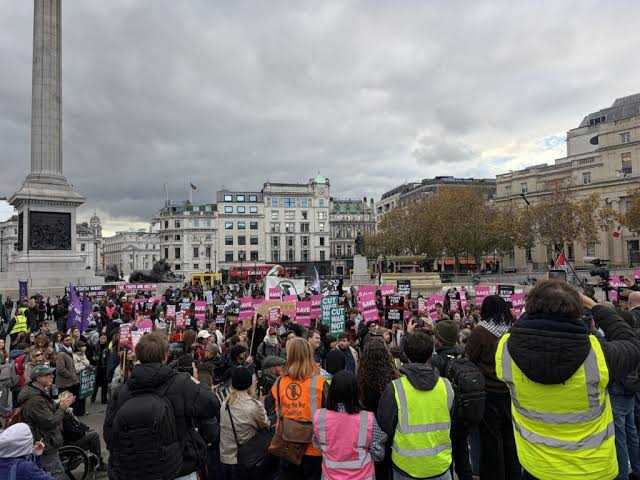

Students and young workers mobilised across Europe and Israel on 20 November in an international day of action under the slogan “Fight for Our Future, Not Their Wars”. The demonstrations and school and university walkouts brought together demands for better-funded education, affordable housing, decent living conditions and climate action with opposition to militarisation, rearmament and conscription.
Communists support European and Israeli youth mobilisations that challenge militarisation, austerity and destruction of their future
According to various sources there were mobilisations in more than 20 countries and around 400 cities. The scale and character of the mobilisations varied considerably between countries. Germany's school strikes against conscription, Italy's demonstrations alongside a general strike, and actions in Belgium, Switzerland and Austria were among the most significant developments. Communist and workers' parties participated in the preparations and political mobilisation in several countries.
Israel: Youth of the Communist Party of Israel took to the streets
Israel was among the countries where young people joined the international mobilisation on 20 November under the slogan “Fight for Our Future, Not Their Wars”. In Tel Aviv, around 100 young people demonstrated along Rothschild Boulevard, according to Zo HaDerekh, the newspaper of the Communist Party of Israel (CPI). Participants included members of the Israeli Communist Youth (Banki), the Refusers movement, the Anti-Occupation Bloc and Hadash Students. The demonstration was part of a coordinated international day of action reported by the organisers to have taken place in more than 600 cities across 25 countries.
The demonstrators opposed growing militarism and what they described as endless wars, demanding more accessible education and the transfer of public funds from military spending to social welfare. They also raised issues of housing, living standards, anti-fascism and opposition to the capitalist system. In common with mobilisations elsewhere, the protest linked the struggle against militarisation with demands for a future in which young people can determine their own lives rather than bear the costs of policies serving the interests of the wealthy.
The Tel Aviv demonstration also highlighted the internationalist and anti-war dimension of the mobilisation. Participants called for an end to the killing in Gaza and opposed what they described as imperialist intervention in Iran, Lebanon and the wider Middle East. The organisers stressed the significance of Israeli youth joining an international protest while opposing the occupation and Israel’s system of apartheid from within. The demonstration was led by young people refusing military service; Zo HaDerekh also reported that a right-wing activist attempted to disrupt the protest and physically attacked several demonstrators, including minors.
Germany: DKP supports the school strike against conscription
The German Communist Party (DKP) actively supported preparations for the fifth nationwide school strike against conscription. The party called on students, parents, grandparents, teachers and workers to join the mobilisation, seeking to connect the struggle against compulsory military service with opposition to militarisation and cuts to public services.
DKP chairman Patrik Köbele had publicly endorsed the strike in a statement published on 5 November. Local party organisations, including those in Flensburg and Gießen, publicised the action and encouraged participation. The Flensburg organisation also called for supporters to gather and collect signatures for an appeal demanding an end to conscription, an immediate halt to military examinations and withdrawal of the Military Service Modernisation Act.
The Socialist German Workers' Youth (SDAJ), the DKP's youth organisation, was also part of the broader anti-conscription mobilisation.
The demonstrations took place in 73 cities and towns. The mobilisation opposed the German government's plans to expand military recruitment and introduce a new military-service system. The protesters demanded an end to conscription and compulsory service, an immediate halt to military examinations and withdrawal of the new military-service legislation.
Belgium: PTB backs youth mobilisation against militarisation
The Workers' Party of Belgium (PTB) reported that young people took action in Ghent, Mons, Brussels, Leuven, Liège, Antwerp and Tournai.
The party had already called for participation in the 20 November youth mobilisation through its campaign “Our Future, Not Their Wars”. Its subsequent report welcomed the demonstrations across Europe and emphasised the connection between military expenditure, cuts to education and public services, and the deterioration of living conditions.
The PTB argued that young people were increasingly unwilling to accept a future shaped by austerity and military recruitment. It highlighted the contrast between the billions allocated to rearmament and the resources withheld from education, healthcare, pensions and other public services.
The party also pointed to the mobilisation's international character, describing it as evidence of a generation increasingly prepared to organise against militarisation and the social consequences of government policies.
The next mobilisation announced by the PTB is the demonstration organised by the Stop Militarisation platform in Brussels on Sunday, 22 November, at 15:00, starting at Gare du Nord.
Austria: KPÖ calls for participation in protests against rearmament
Demonstrations took place in 14 Austrian cities on 20 November under the slogan “Our Future Instead of Their Wars”. Participants called for public money to be directed towards social needs, education and climate protection rather than military spending. Palestinian flags were also visible.
The Communist Party of Austria (KPÖ), through its Carinthian organisation, had explicitly called for participation in the Stop ReArm Europe protests on 20 November. In an article published on 18 November, KPÖ member Anselm Schindler connected European rearmament with the deterioration of climate policy and cuts to environmental programmes. He argued that military expenditure was being expanded while resources needed for climate protection and social needs were being reduced.
The KPÖ's intervention linked the anti-militarist movement to the climate crisis and the danger of young people being drawn into future wars.
France: student and education-sector organisations continue mobilisation
France remained an important reference point for the European youth movement. The international mobilisation drew inspiration from the protests that had taken place in France over the preceding weeks.
On 20 November, high-school student organisations, university students and education-sector workers marched together against education cuts, academic selection and increased military expenditure. Communist parties and their youth organisations supported the nationwide maobilisations.
Overall, the central political question remains whether the mobilisation can develop beyond a one-day protest and build lasting links between students, workers and organisations opposing rearmament, austerity and the diversion of public resources from social needs.