
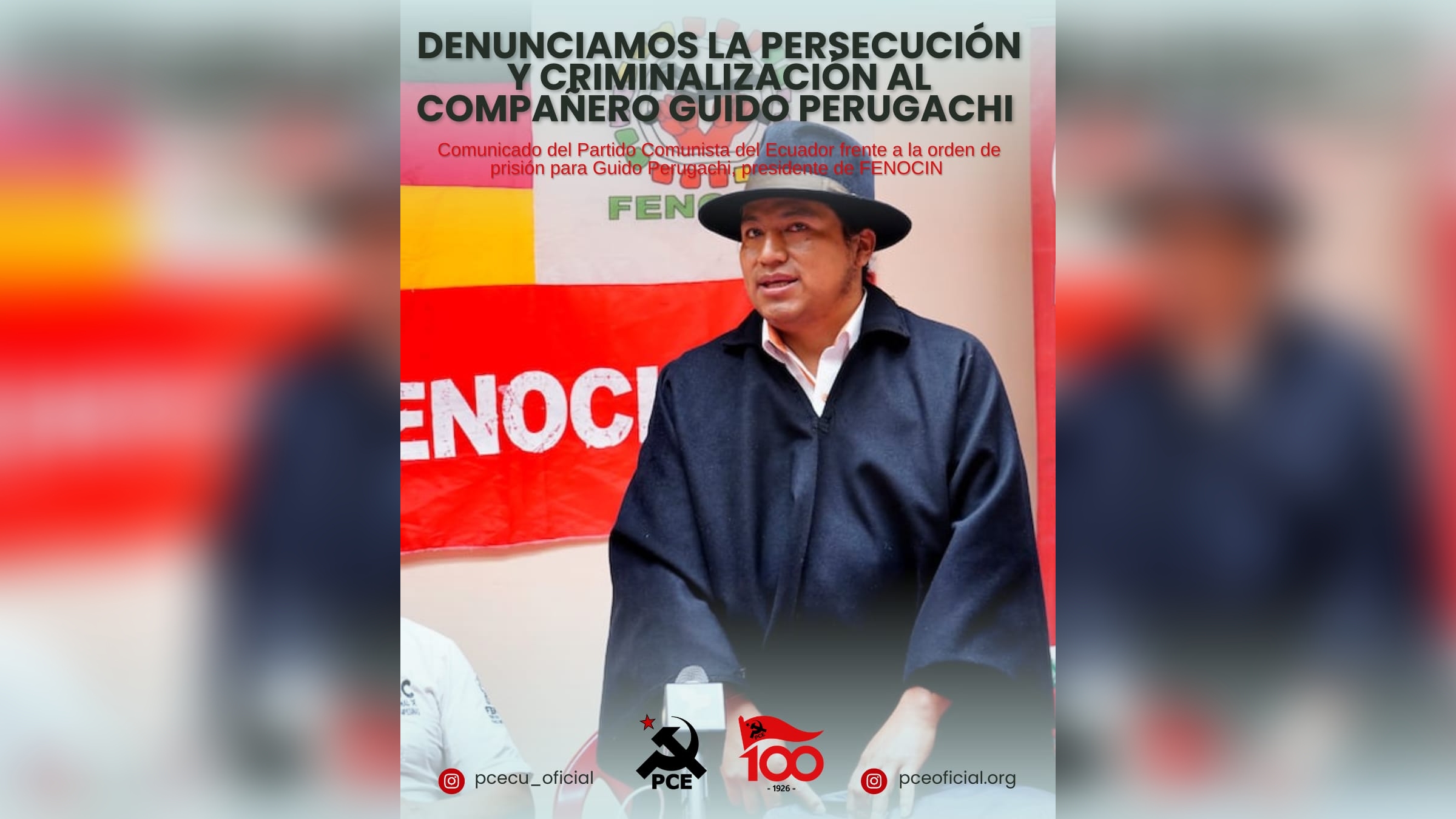
The Communist Party of Ecuador (PCE) has denounced the judicial persecution of Guido Perugachi, president of the National Confederation of Peasant, Indigenous and Black Organisations (FENOCIN), following the confirmation of a preventive detention order against the prominent social-movement leader.
CP of Ecuador denounces persecution of FENOCIN President Perugachi
The party has expressed solidarity with Perugachi, his family and FENOCIN, warning that the judiciary is being used to criminalise popular struggles and silence opposition to the government of President Daniel Noboa.
In a statement published on 7 November, the PCE condemned the decision to place Perugachi under preventive detention, describing it as an attempt by the Noboa government to criminalise social-movement leaders. The party declared its solidarity with the FENOCIN president and called for resistance against the persecution of those fighting for social rights.
The detention order was originally issued on 14 August 2026 by Judge Mery Raquel Maza Puma of the Criminal Court of Imbabura. Perugachi is being investigated over the alleged disruption of public services during the September–October 2025 protests in the province of Imbabura. These demonstrations were part of the nationwide mobilisation against the government's elimination of fuel subsidies, which had increased the cost of living for broad sections of the population.
The prosecution accuses Perugachi of instigating actions that disrupted public services during the protests. It has invoked Article 346 of Ecuador's Comprehensive Organic Criminal Code, which establishes penalties for obstructing or paralysing the normal provision of public services. The defence has rejected the accusations and challenged the preventive detention measure.
The case has acquired particular political significance because Perugachi has been one of the principal promoters of the popular initiative seeking the revocation of Noboa's presidential mandate. In its 14 August statement, the PCE specifically drew attention to this connection, questioning the timing and political context of the judicial proceedings.
The party also criticised the use of preventive detention, arguing that it should be an exceptional measure and that the proceedings risk violating fundamental guarantees, including the presumption of innocence, due process and the rights of indigenous peoples. It invoked the protections established under Ecuador's Constitution and ILO Convention 169 concerning Indigenous and Tribal Peoples.
Solidarity from popular organisations
The case has provoked a broader response from Ecuador's popular and indigenous organisations. FENOCIN's constituent organisations and regional structures rejected the detention order and described the proceedings as an attempt to instrumentalise the judicial system against the organisation's leadership.
The Union of Peasant and Indigenous Organisations of Cotacachi (UNORCAC), which is affiliated with FENOCIN, stated that Perugachi was being protected by indigenous communities. The organisation also questioned the legitimacy of enforcing the detention order without respecting indigenous jurisdiction and the autonomy of indigenous territories.
The National Union of Educators (UNE), the Popular Front, the Indigenous Movement of Cotopaxi (MICC), ECUARUNARI and the Confederation of Indigenous Nationalities of Ecuador (CONAIE) were among the organisations expressing solidarity with Perugachi.
FENOCIN's affiliated organisations declared themselves in permanent assembly in their regional and provincial structures, calling for the coordination of popular organisations and possible mobilisation in defence of collective rights and the country's constitutional guarantees. FENOCIN also announced its intention to take the case to the Inter-American Commission on Human Rights.
The detention order upheld on appeal
Perugachi's defence appealed the August decision. The appeal hearing was initially scheduled for 29 September. According to information published by UNE on 22 October, the preventive detention order was upheld following the appeal proceedings. The union described the development as part of a wider escalation of judicial and administrative pressure against social organisations and opposition figures.
The PCE's 7 November statement renewed its denunciation of the case, presenting it as part of the government's efforts to intimidate and criminalise those opposing its policies.