
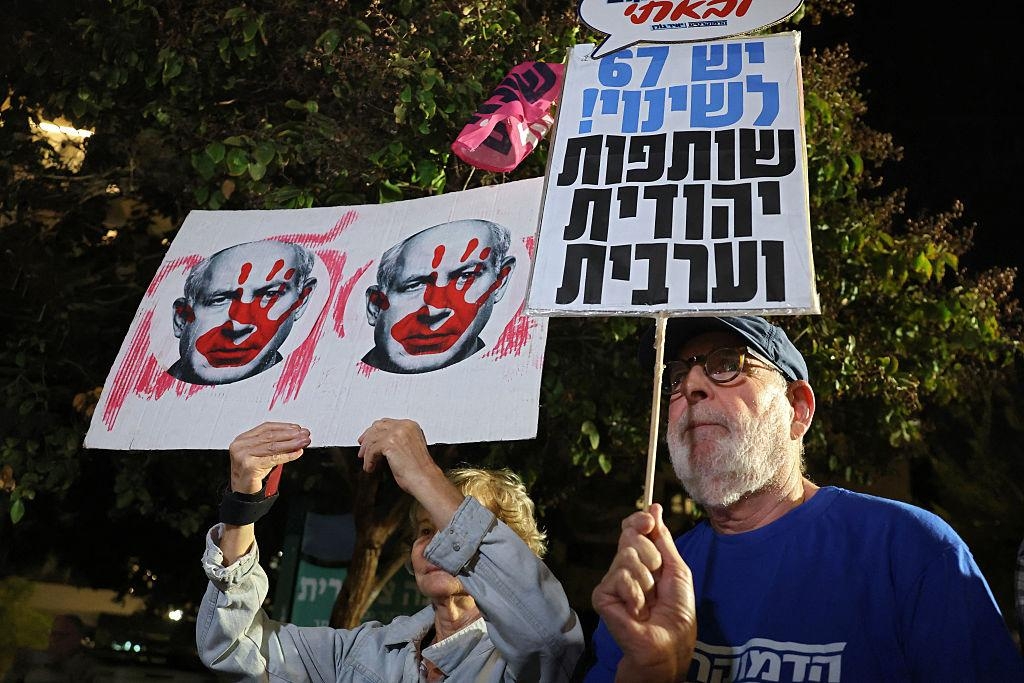
The results of Israel’s 27 October parliamentary elections have placed the Joint List, led by Hadash chairman Yousef Jabareen, and the separate United Arab List (Ra’am) in a potentially decisive position in the formation of the next government. Demonstrations are held with the demand for a Jewish-Arab government.
CP of Israel-backed Joint List and Ra'am emerge as kingmakers after election
With neither the bloc supporting Prime Minister Benjamin Netanyahu nor the Jewish-led opposition securing a majority, the two lists have won a combined 19 seats in the 120-member Knesset.
The final count gives Netanyahu’s bloc 53 seats, while the opposition parties led by Gadi Eisenkot hold 48. The Joint List secured 11 seats and Ra’am eight. Together, the two lists could provide the parliamentary support needed to replace Netanyahu, provided the opposition is prepared to cooperate with them. However, several opposition leaders have continued to reject such cooperation.
The Communist Party of Israel (CPI) highlighted these results in a report published on 30 October, while stressing the continuing struggle against attempts to exclude Arab parties from a future government.
The Joint List’s position as the fourth-largest faction gives it considerable parliamentary weight in the negotiations over the next government.
The CPI report also highlighted remarks by Joint List MK Ahmad Tibi, who said that representatives of the Change Bloc had approached him with a proposal to replace the Knesset speaker. Tibi described replacing the speaker as a normal step for an opposition following an election, adding that names had already been suggested. He declined to identify the party that had contacted him, but said it was not the Democrats.
Tibi criticised the political exclusion of Arab citizens, pointing to what he described as the absurdity of treating the 53 seats of Netanyahu’s bloc as greater than the opposition’s 67. He said Arab voters had turned out in large numbers because they wanted to change the situation marked by crime, killings and house demolitions.
In a statement quoted by the CPI, the Joint List declared that it had finished apologising and defending itself against what it called baseless accusations from right-wing politicians unwilling to accept the election results. “Without us, victory is impossible. But together with us, it is entirely possible,” the statement said, calling on the opposition to demonstrate political courage through concrete action.
Growing public pressure for Jewish-Arab partnership
The CPI also reported renewed protests against excluding the Joint List and Ra’am from a future coalition. On 29 October, hundreds of people gathered outside the home of opposition leader Gadi Eisenkot in Herzliya, calling on him to form a government with representatives of the Arab public. Protesters chanted: “The people have decided – Jewish-Arab partnership” and “Jews and Arabs refuse to be enemies.”
Further demonstrations took place at Paris Square in Jerusalem and UNESCO Square in Haifa. The Peace Partnership and other protest organisations announced plans for further demonstrations
31 October demonstration
On the evening of 31 October, thousands of people demonstrated in several Israeli cities calling for the formation of a government involving Jewish and Arab parties, following the 27 October Knesset elections. The main demonstration took place at Habima Square in Tel Aviv, where participants later marched to Rabin Square. Further rallies were held in Jerusalem, Haifa, Beersheba and near Tira and Tayibe.
The demonstrations were organised by activists from the Jewish-Arab grassroots movement Standing Together. Protesters called on the opposition parties to recognise the combined 67-seat majority won by parties opposed to Benjamin Netanyahu and to form a government with the participation or support of the Joint List and Ra’am. Slogans included “Jews and Arabs refuse to be enemies”, “No to racism, yes to partnership” and “With partnership and equality, we are changing the government”.
The demonstrations follow earlier protests in Tel Aviv, where activists called on opposition leader Gadi Eisenkot to form an alternative government with the support of the Arab parties. Protesters have argued that excluding Arab representatives would effectively disregard a substantial part of the parliamentary majority opposing Netanyahu.
Further support
The campaign has also gained support from former ministers and members of parliament. Dozens of former public officials signed an appeal urging opposition leaders to include both the Joint List and Ra’am in the future coalition. Among the signatories were former Hadash MK Dov Khenin, former Meretz leaders Zehava Galon and Nitzan Horowitz, former MKs Tamar Gozansky and Mossi Raz, and former minister Yuli Tamir.
Another appeal, issued by the group “Fortress of Democracy,” proposed appointing Ra’am MK Yoav Segalovitz as the next Knesset speaker. The signatories argued that such an appointment would recognise the role of Arab representatives and help advance the legislative changes they consider necessary following the previous government's judicial overhaul.
Joint List calls for political change
The Joint List has made clear that it is prepared to cooperate politically with the Change Bloc to bring Netanyahu’s rule to an end. Its statement calls for an alternative government that would commit itself to a substantial change in the existing government's racist policies and to recognising the rights of Arab citizens and ending their exclusion from political life.
The developments indicate that the struggle over the composition of the next government is not simply a matter of parliamentary arithmetic. The Joint List and its supporters are demanding that the 67-seat opposition majority be translated into a government that recognises Arab citizens as equal political partners. Whether the opposition leadership is prepared to accept this demand remains a central question in the post-election negotiations.
Joint List and Ra’am discuss closer coordination
A significant development came on Friday, when Ra’am chairman Mansour Abbas contacted the leaders of the Joint List: Yousef Jabareen of Hadash, Ahmad Tibi of Ta’al and Sami Abu Shehadeh of Balad. According to reports, Abbas congratulated them on their election result and stressed the responsibility facing Arab representatives in the next Knesset.
He proposed strengthening cooperation and coordination between the two lists, including a closer integration of their parliamentary roles. The Joint List leaders reciprocated with congratulations to Ra’am and its elected representatives.
The contacts indicate an effort to strengthen the collective influence of the Arab parliamentary representatives following the election. However, they do not yet amount to a formal agreement on a common parliamentary strategy or government negotiations.
Opposition divisions remain a major obstacle
Despite these initiatives, the prospect of forming a government with Arab-party support remains uncertain. Avigdor Lieberman, leader of Yisrael Beiteinu, has again ruled out joining a government that relies on the Joint List or Ra’am, accusing their representatives of supporting terrorism. His position makes the arithmetic of an alternative government considerably more difficult.
Other opposition figures have taken a different approach. Yair Golan, leader of the Democrats, has expressed support for establishing a government without Netanyahu and has held discussions with Arab-party representatives. Former defence minister Moshe Ya’alon has also called on the Jewish-led opposition to cooperate with Ra’am, arguing that its leader, Mansour Abbas, should not be excluded from political negotiations.
The Joint List has offered to support an alternative government from outside the coalition in order to remove Netanyahu. Its leaders have presented the election result as an opportunity to challenge the government’s policies and advance equality, peace and political partnership. The question now is whether the Jewish-led opposition will accept the parliamentary support of the two lists or continue to impose political conditions that could prevent an alternative majority from taking shape.