

Around 250 people, including students and lecturers from the Hebrew University of Jerusalem, demonstrated outside the Jerusalem District Court on 19 November, demanding the release of Mehdi Tounsi, a Palestinian student, peace activist and resident of Silwan.
Image
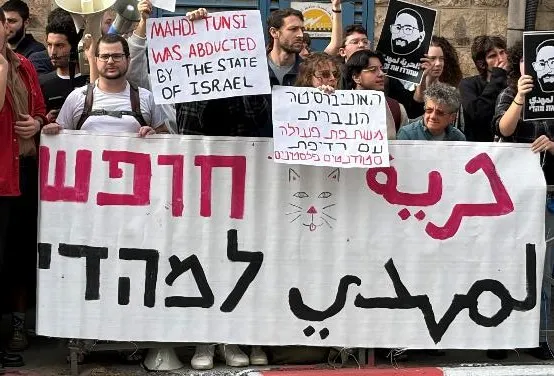
Students and lecturers from Hebrew University of Jerusalem demonstrated for release of student
CP of Israel joins protest in Jerusalem demanding release of student Mehdi Tounsi
Hadash student activists from the university took part in the protest, alongside Communist Party of Israel (CPI) member and Hadash MK Ofer Cassif, who publicly condemned the circumstances of Tounsi’s arrest and called for his immediate release.
According to Zo Khaderek, demonstrators chanted in Hebrew and Arabic against Tounsi’s detention, the occupation and Israeli fascism. Tounsi was arrested approximately a week and a half earlier in his room in the Hebrew University student dormitories. His lawyer, Nasser Odeh, said that Tounsi had reported being subjected to violence by police officers in the dormitory, in the police vehicle and at the police station.
Following his arrest by the police, the case was transferred to the Shin Bet security service. Authorities are seeking to place Tounsi under six months of administrative detention, without a public criminal trial. At the 19 November hearing, the Shin Bet did not appear, and the judge declined, at this stage, to approve the administrative detention order. Tounsi nevertheless remained in custody pending the next hearing, scheduled for Tuesday, 24 November. The judge also ordered the police to return his glasses, which had been taken from him.
Cassif criticised the Hebrew University administration for allowing police to enter the student dormitories and arrest Tounsi on campus. He argued that the university had a responsibility to protect its students and should take immediate steps to secure Tounsi’s release and prevent similar incidents. He also referred to other reported cases of students being taken from university accommodation.
Hadash student activists at the university described Tounsi as a friend and political partner. They accused the police and Shin Bet of using violence during his arrest and criticised the university for failing to inform his family and associates, while distancing itself from responsibility for what happened on its premises. They called for continued public pressure, both within Israel and internationally, on the university to acknowledge its responsibility and act to protect its students.
The protest has also drawn support from academic and professional organisations. Academia for Equality, which represents more than 1,000 lecturers in higher education institutions, demanded Tounsi’s immediate release and insisted that the university must ensure the safety of students in their dormitories. Lecturers who had taught Tounsi described him as a committed student involved in social and community activities and in initiatives promoting Jewish-Arab partnership. They expressed concern that his detention might be politically motivated and called for any evidence against him to be made public.
The Israeli Sociological Society also opposed the detention and urged university leaders to resist the request for administrative detention and defend campuses as spaces free from persecution and arbitrary state action. Marco Tesei, a national executive member of the UK's University and College Union (UCU), which represents 120,000 members, separately appealed to the Hebrew University administration to intervene. He said he would raise the case within the union to encourage wider mobilisation by student, academic and workers' organisations.
A further demonstration is planned for 24 November, coinciding with his next court hearing, as campaigners continue to demand his immediate release and oppose the use of administrative detention against a student and peace activist.
(Photo: Zo Khaderek)