The events of 3 January marked a new stage in imperialism's aggression worldwide. What does the 3 January attack mean to you?
3 January represents a turning point in the prolonged and profound political crisis Venezuela has been experiencing. In 2024, Nicolás Maduro declared himself the winner of the presidential election without publishing results demonstrating that he had won. This not only confirmed the authoritarian course the PSUV—the United Socialist Party of Venezuela, the ruling party—had been pursuing, but also eliminated the last remnants of legitimacy it still possessed.
At the same time, the most reactionary sections of the opposition, led by María Corina Machado, managed to exploit popular discontent to their advantage, but did not become strong enough to constitute a new centre of power.
Venezuela was thus pushed into what Gramsci described as a “catastrophic equilibrium”: none of the principal forces was capable of establishing its hegemony. At that point, a “third force”—the United States—entered the scene and broke this “catastrophic equilibrium” by bringing both sides under its domination.
That is what 3 January means: the arrival of the foreign gendarme.
This intervention certainly did not resolve the political crisis; rather, it shifted it to another level. We are now talking about a country that has lost its independence and is increasingly becoming a state under tutelage.
This new situation creates a new field of struggle for revolutionary, anti-imperialist and popular political forces. The struggle to restore the political, economic and social rights guaranteed by the Constitution must now be joined by the struggle against imperialist intervention and for the recovery of national sovereignty.
“This isn't a change of policy; it's a change of masters”
How do you assess the government's, and particularly Delcy Rodríguez's, rapid alignment with Washington despite the brutal abduction of their leader? How did this happen so easily?
3 January shattered some of the myths that the PSUV had cultivated for years. One was the party's supposed anti-imperialist character. For months, the PSUV government had constantly portrayed itself as confronting the United States. Nicolás Maduro repeatedly spoke of war scenarios, a possible invasion and the need to turn Venezuela into a “new Vietnam,” while the government displayed air-defence systems, drones, militias and military exercises as demonstrations of its deterrent capacity.
3 January exposed the gap between this rhetoric and the actual capacity to respond. The inability to mount an effective defence against the US operation cannot be explained simply by military weakness against a vastly superior force. It also raises questions about the political will to resist the attack and about the actual function Venezuela's military apparatus had come to serve.
In recent years, the constitutional role of the armed forces as guarantors of national sovereignty has increasingly been hollowed out. The military apparatus has increasingly been used for internal control, suppressing protests and protecting the power of the ruling elite, while sections of the officer corps have accumulated economic power through involvement in state-linked commercial activities.
We also need to compare the PSUV government's anti-imperialist rhetoric with its concrete choices. Maduro exploited contradictions among the imperialist powers by maintaining economic relations with China, Russia, Iran and Türkiye. This allowed him to partially circumvent the effects of sanctions and retain a certain degree of room for manoeuvre.
But exploiting contradictions among great powers is not the same thing as building an anti-imperialist policy. Relations with different centres of international capital remained subordinated to the government's objective of ensuring its own survival.
What we are witnessing is not a change of policy, but a change of masters.
“There is no contrast between an ‘anti-imperialist Maduro’ and a ‘capitulationist Delcy’”
Another narrative being promoted is that Venezuela underwent a fundamental change of direction after 3 January: according to this argument, Maduro represented an anti-imperialist policy, while the Delcy Rodríguez government represents a policy of capitulation to Washington.
But the economic and oil reforms implemented after 3 January do not represent a break with the model constructed under Maduro. They deepen and institutionalise that model.
Maduro had already taken steps towards opening the oil sector, particularly through secret agreements with Chevron. The new legislation transforms the mechanisms of opening that had previously been implemented through private agreements under opaque conditions into a general legal framework.
Therefore, there is no contrast between an “anti-imperialist Maduro” and a “capitulationist Delcy.” Although the interlocutors and international centres of power with which negotiations are conducted have changed, there is continuity in the policy of granting concessions to big capital.
“The United States has become directly involved in the country's present and future”
There appears to be significant US dominance in Venezuela politically, militarily and economically. What is your assessment?
The political situation in Venezuela can be summarised as a process in which the country is rapidly losing its political, economic and military sovereignty to Washington.
We are not witnessing cooperation between two governments. The United States has become directly involved in fundamental decisions concerning Venezuela's present and future.
The United States has established a three-stage roadmap: “stability, recovery and transition.” The supposed purpose of the first stage is to prevent chaos, and the PSUV has demonstrated that it can serve as the gendarme capable of carrying out this role. The second stage aims directly at securing foreign capital's access to Venezuelan oil. The third envisages a political transition.
In other words, even the supposedly democratic transition has been placed under foreign supervision.
Today, the triumvirate led by Delcy Rodríguez, her brother and National Assembly President Jorge Rodríguez, and Interior Minister Diosdado Cabello is illegally maintaining control inside the country. Under the Constitution, Maduro's abduction should have been followed by the government calling elections. Instead, this group consolidated its position and became the direct executors of the White House's policy.
Trump's attitude towards this governing group is revealing. He has repeatedly said that Delcy Rodríguez is doing a “great job,” while simultaneously saying that Venezuela is not yet ready for elections. This shows that Washington's priority is not, as it tries to persuade the public, restoring popular sovereignty or democratic freedoms.
The real objective is to secure favourable conditions for the country's plunder, and the PSUV has become the guarantor of this objective.
“An unprecedented US military force is deployed on Venezuelan territory”
The tutelage is also evident militarily. Representatives of US Southern Command and the CIA are not merely being received at the government palace by the Rodríguez brothers and Cabello; an unprecedented US military presence has also been deployed on Venezuelan territory.
This military presence was further strengthened following the earthquakes in June, under the pretext of humanitarian aid and reconstruction.
The PSUV's propaganda apparatus presents this tutelage as unavoidable and resorts to a discourse of “pragmatism” to legitimise this dependence. Yet this supposed pragmatism entails direct intervention in political decisions and the establishment of control over strategic resources.
For this reason, the PCV maintains that Venezuela is experiencing a loss of sovereignty that cannot be confused with a democratic transition. The Venezuelan people have the right to resolve their own political and social crisis without Washington deciding when elections should be held, who may participate in them or how oil should be managed.
This does not mean that we defend the former Maduro government or ignore the profound political crisis that existed previously. On the contrary, precisely because we criticised authoritarianism, corruption and the elimination of democratic rights under PSUV rule, we also reject replacing one form of dependency with another.
Venezuela's choice cannot be between its own executioners. The way forward must be democratic, popular and based on sovereignty.
“They are drafting legislation with the business organisations that led the coup against Chávez”
What can you say about the situation of the working class after 3 January? Are workers' rights won through years of struggle under attack?
Revenue from oil sales is being managed through mechanisms controlled by the United States. Donald Trump has said that the United States has already received more than $13 billion from the sale of Venezuelan oil. Michael Kozak, a senior US State Department official, recently told the US Congress that although this money belongs to Venezuela, the Venezuelan government must obtain permission from the White House to use these resources.
This directly affects the living conditions of working families. The recovery of the oil sector referred to by the triumvirate and Washington has not translated into any improvement in wages or workers' rights.
The austerity policies implemented under Maduro continue: wages and pensions remain frozen, while poverty remains extremely high. Around 68% of households live in poverty and 32% in extreme poverty. There is also a severe crisis in basic services: only a small proportion of households have access to water every day, while a significant part of the population frequently experiences electricity blackouts.
Meanwhile, the PSUV government is preparing a reform of the Labour Law. And it is doing so together with the business organisations that led the 2002 coup against Hugo Chávez.
According to the statements made so far, they plan to dismantle the social rights system they describe as “unsustainable” and eliminate the minimum wage, which has already effectively been completely eroded.
“Thousands are still missing, and no official data have been released”
The earthquake disaster occurred amid all this chaos. What impact has it had on the population and the political situation?
The earthquakes that occurred on 24 June were undoubtedly among the largest natural disasters in Venezuela's modern history.
The disaster struck a country in the midst of a profound political, economic and social crisis. That crisis had severely limited the state's ability to respond to an emergency of this scale.
A largely dismantled healthcare system, thousands of specialists who had been forced to leave the country in search of better living conditions, and public search-and-rescue institutions reduced to a minimal capacity because of the loss of qualified personnel and shortages of equipment and resources were the main factors determining the state's capacity to respond.
The state of the institutions can be understood simply by looking at the seismic monitoring network. Venezuela had 250–300 active seismological stations in the 1990s; by 2026, only four active stations remained.
Independent research indicates that during the first 24 hours, the state deployed 4,000 civilian and military personnel—only 12.6% of the total personnel mobilised during the emergency. The state did not reach its maximum deployment, 31,837 personnel, until the 18th day. By then, however, the critical 72-hour “rescue window” had long since passed.
Regardless of the speed of the state's response, there is broad agreement among the population that during the first hours, most of the search-and-rescue work was carried out by neighbourhood residents and volunteers.
Even now, almost two months after the earthquakes, thousands of people remain missing, and no official data have been released on the subject. This lack of information has left the country in a state of profound grief and helplessness.
“We are witnessing a textbook example of ‘disaster capitalism’”
The earthquakes have also brought a new dimension to the political struggle: the reconstruction of destroyed infrastructure.
Delcy Rodríguez announced that negotiations were taking place with the United States and the IMF to secure resources for reconstruction. She also said that the World Bank and Inter-American Development Bank (IDB) had offered cooperation and lending opportunities.
We are witnessing a textbook example of “disaster capitalism”: the triumvirate is using the social catastrophe to accelerate economic reforms, incur new debt and open strategic sectors to private capital.
“Israel is back in Venezuela”: “Netanyahu himself exposed the group's real objective”
Following the earthquake, we saw Israeli military officials arrive in Venezuela. Is the government opening a new chapter on an issue it had long described as a red line?
Venezuela broke diplomatic relations with Israel in 2009. But an important change has occurred following the earthquakes: a delegation led by officers from the Israeli Defence Forces' Home Front Command entered the country to participate in damage assessment and reconstruction efforts.
The delegation was incorporated into the commission responsible for preparing the national reconstruction plan.
Delcy Rodríguez attempted to conceal the presence of these Zionist military personnel in the country, presenting it as a civilian initiative by Jewish organisations in Venezuela seeking to provide assistance following the earthquake disaster.
But Benjamin Netanyahu himself revealed the group's real purpose. In a public statement, Netanyahu said that this was not merely about humanitarian assistance but also represented an opportunity to “rebuild relations” between Israel and Venezuela.
Earlier, Nicolás Maduro's son had also raised the possibility of restoring diplomatic relations with Israel, presenting this as a decision that a “sovereign government” would make of its own accord.
However, notable anti-Zionist protests were recently held in several Venezuelan cities. Although small in number, the protests were organised by sections of the party's grassroots base opposed to the new direction being pursued by the PSUV government.
“Building a political way out of the crisis cannot be postponed”
Finally, what can you say about the struggle being conducted by the Venezuelan Communist Party against this entire process? What are the main issues in the struggle?
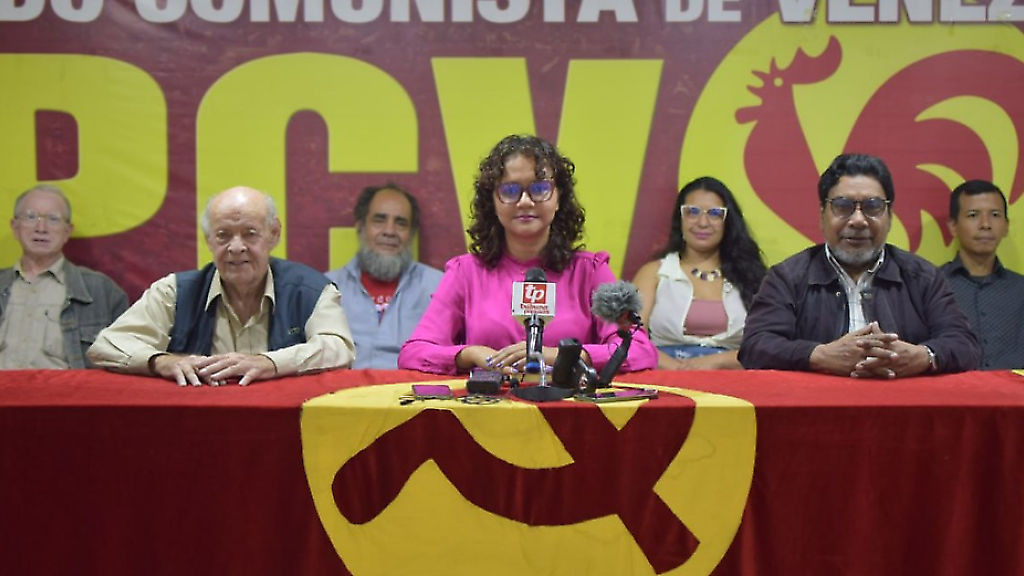
The Venezuelan Communist Party insists that building a political way out of the crisis has become an urgent necessity.
Neither occupation and imperialist tutelage nor the continuation of the authoritarian regime can constitute a solution in the interests of the working people.
In this context, it is vital to restore the constitutional order through the restoration of democratic freedoms and the holding of presidential elections in which full guarantees are provided to citizens and political organisations. To achieve this, the current electoral authorities must resign, and political parties—including the PCV—must regain their legal status.
Another fundamental issue is the recovery of workers' rights. Wages and pensions must be lifted out of the pit into which the PSUV's neoliberal programme has driven them. The ability of Venezuelan working families to live with dignity depends on this.
The Venezuelan Communist Party is working together with political and social organisations to build a democratic, popular and sovereign alternative.
With this objective, the Party has decided to convene its 17th National Congress in March 2027, in order to deepen the discussions and determine the tactical orientations needed to move forward in this direction.