
Two major mobilisations in India on 22–23 October highlighted demands for relief to drought-affected farmers and opposition to the revision of electoral rolls.
Image
CPI(M) and CPI continue to mobilise against Gyanesh Kumar and SIR and for farmers' demands
CPI(M) and CPI join farmers’ protest in Maharashtra and nationwide campaign for electoral rights
The Communist Party of India (Marxist) (CPI(M)) and the Communist Party of India (CPI) have presented both struggles as part of a wider defence of the livelihoods and democratic rights of working people.
Maharashtra: Farmers and workers demand adequate drought relief
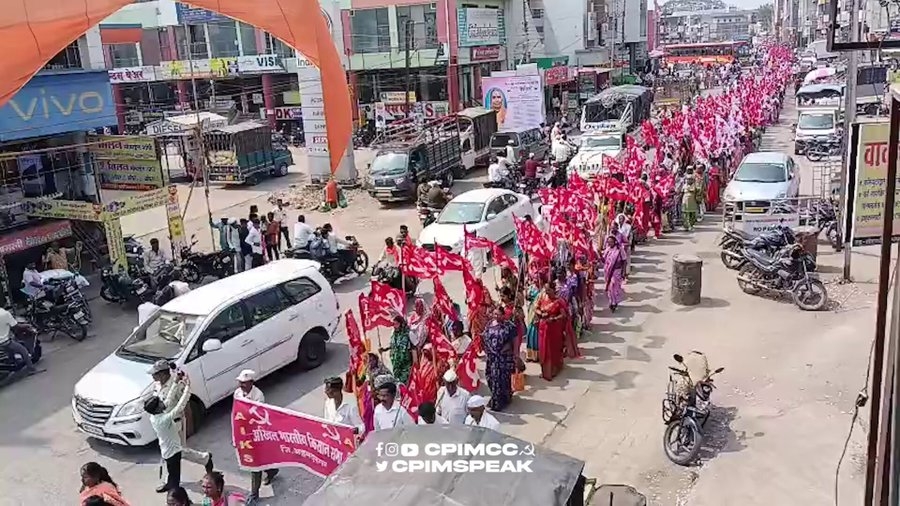
An indefinite sit-in by drought-affected farmers and workers began on 22 October in Akole, in Maharashtra’s Ahilyanagar district. Organised by the All India Kisan Sabha (AIKS), together with the Centre of Indian Trade Unions (CITU), the All India Democratic Women’s Association (AIDWA) and the Democratic Youth Federation of India (DYFI), the mobilisation brought together an estimated 7,000 farmers and workers, according to AIKS national president Ashok Dhawale.
The protesters rejected the Maharashtra government’s announcement of ₹5,000 in interim drought assistance, arguing that the amount was inadequate in the face of crop losses and existing financial obligations. Dhawale also said that payments under the state’s Namo Shetkari Mahasanman Nidhi scheme had fallen into arrears, making the new announcement insufficient to address farmers’ losses.
The movement’s demands include compensation based on official assessments of crop damage, immediate payment of crop-insurance claims, a ₹2 lakh loan waiver for farmers who have regularly repaid their loans, and land rights for cultivators. Protesters also demanded the restoration of financial assistance under the Ladki Bahin scheme for women who had been excluded.
Memoranda and thousands of individual applications were submitted to the local administration. The sit-in was due to continue until 26 October. AIKS warned that, if the government failed to take concrete action, it would organise a statewide vehicle march to Mumbai, with a proposed mobilisation of around 15,000 farmers travelling in approximately 1,000 vehicles.
From the CPI(M)’s perspective, the protest reflects the need for relief based on actual agricultural losses rather than limited advance payments. The participation of trade-union, women’s and youth organisations also underlines the party’s approach of linking farmers’ demands with the wider interests of working people.
Delhi: Demonstration demands Gyanesh Kumar’s resignation
On 23 October, a broad mobilisation in New Delhi demanded the resignation of Chief Election Commissioner Gyanesh Kumar and the suspension of the Special Intensive Revision (SIR) of electoral rolls. Organised under the banner of People Against SIR, the march brought together farmers, workers, students, women’s organisations and civil-society groups.
The campaign argues that the revision process risks excluding eligible voters and that the Election Commission must act independently and impartially. Participants demanded an end to SIR and called for accountability over the handling of electoral rolls.
CPI(M) leader Brinda Karat joined the march, while CPI representative P. Sandosh also participated. Students’ organisations, including the CPI(M)-linked Students’ Federation of India (SFI) and the CPI-linked All India Students’ Federation (AISF), have supported the wider mobilisation against SIR.
Police barricades prevented protesters from reaching the Election Commission’s headquarters. Participants subsequently gathered near Bangla Sahib and held a sit-in described as a “People’s Parliament”. Delhi Police detained more than 150 protesters, according to The Indian Express. Brinda Karat criticised the police response, arguing that demonstrators were peaceful and accusing the authorities of using force against them.
The CPI(M) and CPI have consistently demanded Kumar’s removal and an immediate halt to SIR. Both parties argue that the controversy concerns more than the conduct of an individual official: it raises questions about the independence of the Election Commission, the transparency of electoral procedures and the protection of citizens’ voting rights.
The wider campaign has also spread beyond Delhi. People Against SIR announced plans for further protests across the country, with 145 organisations expected to mobilise in 88 cities.