
The 36th National Conference of the All India Kisan Sabha (AIKS), the farmers' organisation closely associated with the Communist Party of India (Marxist), concluded on 18 November in Nalgonda, Telangana. Bringing together more than 1,200 delegates from 28 states and Union Territories, the four-day conference reviewed the agrarian crisis, assessed the organisation's work and discussed the next phase of the nationwide farmers' movement.
Image
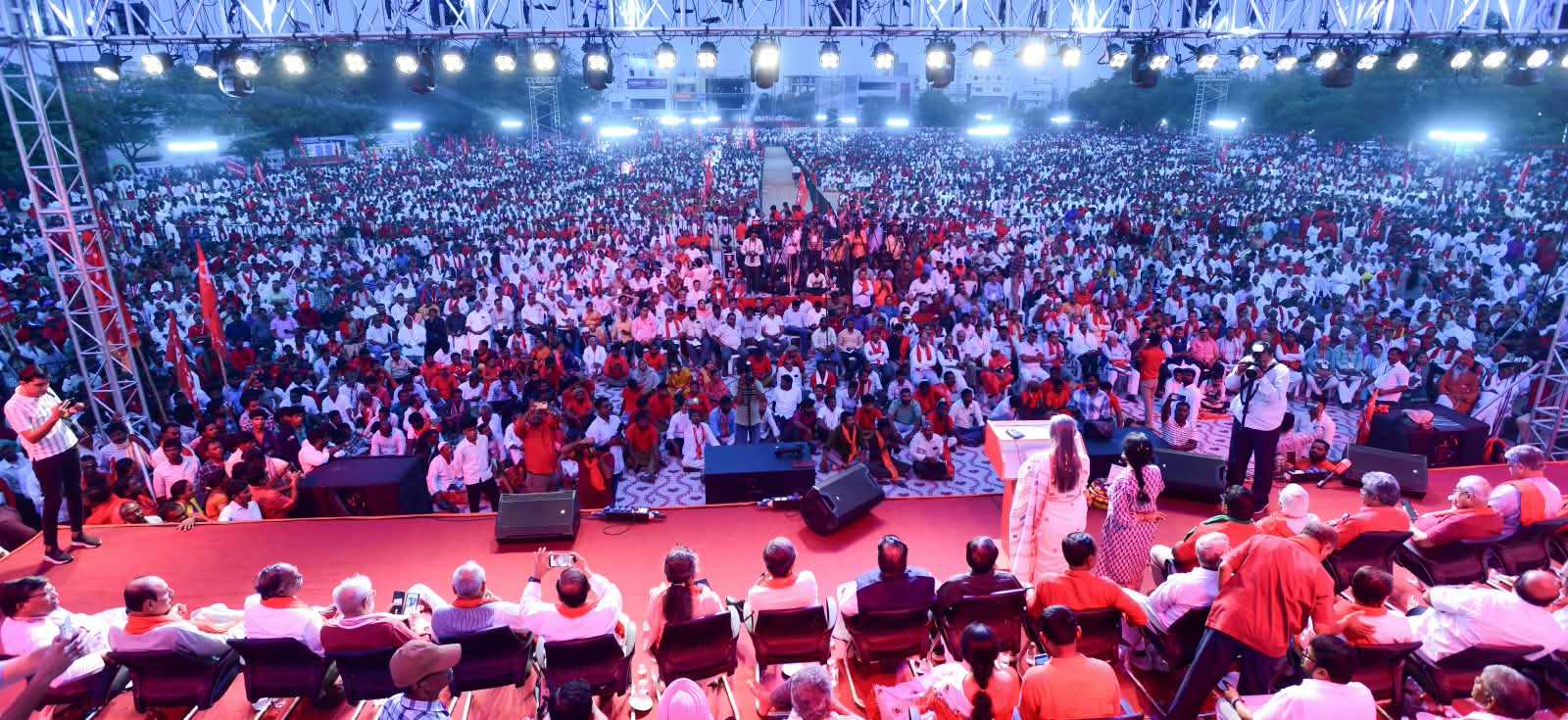
Four-day All India Kisan Sabha conference calls for intensified farmers' struggles and worker-peasant unity
CPI(M)-backed All India Kisan Sabha conference calls for intensified farmers' struggles and worker-peasant unity
Held under the slogan “Resist Corporate Attacks on Farmers and Agriculture; Unite to Build a People's Alternative,” the conference carried particular historical significance. It coincided with the 90th anniversary of the AIKS, founded in Lucknow on 11 April 1936, and the 80th anniversary of the beginning of the Telangana peasant struggle in July 1946. Nalgonda, one of the centres of that historic struggle, provided the setting for the gathering.
A historic legacy and a growing organisation
The conference sought to connect the history of the Indian peasant movement with the challenges confronting rural working people today. The Telangana struggle against feudal landlords, forced labour and the Nizam's rule, led by the Communists, remains a central reference point for the AIKS. Its legacy was recalled alongside other historic struggles, including Tebhaga in Bengal, Punnapra-Vayalar in Kerala and the Warli Adivasi revolt in Maharashtra.
In an article published ahead of the conference in People's Democracy, AIKS President Ashok Dhawale emphasised three central tasks: preserving the organisation's historical legacy, objectively analysing the new agrarian and political challenges, and establishing a concrete direction for future mass struggles. He described the conference as part of the effort to strengthen the organisation and advance the struggle for agrarian transformation.
The AIKS reported that its membership had increased by approximately 2.2 million over the preceding four years, reaching 15,867,771 members. Its units were active in 36,763 villages, with 62,597 primary units across 27 states and Union Territories. These figures, presented by the organisation, underline the scale of its nationwide presence and the importance it attaches to strengthening its grassroots structures.
Agrarian crisis and the demands of farmers
The conference took place against a background of mounting rural distress. Rising costs of seeds, fertilisers, pesticides, diesel and labour, inadequate prices for agricultural produce, indebtedness and increasingly severe climate-related crop losses are placing enormous pressure on farming households.
A central demand remains a legally guaranteed Minimum Support Price (MSP), calculated at 50 per cent above the comprehensive cost of production, in accordance with the Swaminathan Commission recommendations. Although the government announces MSPs for 22 crops, farmers argue that the absence of guaranteed procurement leaves many producers unable to secure remunerative prices.
The AIKS also opposes the privatisation of electricity and irrigation, corporate control over agricultural markets, land acquisition benefiting corporate interests and trade agreements that could expose Indian farmers to greater competition from imports. The organisation argues that these policies deepen the vulnerability of small and marginal farmers while strengthening the position of large corporations.
The unresolved demands following the 2020–21 farmers' movement remain central to the agenda. The repeal of the three farm laws demonstrated the potential of a united nationwide mobilisation, but the demand for a legal MSP guarantee and other assurances has yet to be fulfilled.
The situation in Telangana also featured prominently. Farmers in the state face problems including incomplete implementation of loan waivers, delays in the distribution of Rythu Bharosa assistance, irrigation-water shortages, difficulties in crop procurement and delayed compensation for crop losses. Tenant farmers remain particularly vulnerable because they lack formal recognition and are frequently excluded from government schemes.
Ahead of the conference, AIKS General Secretary Vijoo Krishnan also highlighted the scale of the crisis, referring to more than five lakh farmer and agricultural-worker suicides over the preceding 12 years. The organisation called for stronger relief measures, including compensation for drought-related crop losses and support for tenant farmers and agricultural labourers.
Opposition to corporate and communal policies
The political character of the conference was made clear in the presidential address delivered by Ashok Dhawale. He warned that attacks on farmers, workers and agricultural labourers would intensify if the BJP-led government continued its present course. He accused the government of favouring domestic and foreign corporate interests and weakening national sovereignty.
Dhawale also criticised the political and ideological influence of the RSS and the wider Sangh Parivar, arguing that it threatened democracy, secularism, federalism and the Constitution. He compared aspects of RSS ideology with historical tendencies associated with fascism and Nazism, and called for struggles on ideological, social, cultural, organisational and agitational fronts, rather than limiting resistance to electoral politics.
At the public meeting on 16 November, CPI(M) leader Brinda Karat similarly called on farmers throughout the country to unite against what she described as anti-farmer and pro-corporate policies. She demanded that the India-US trade agreement be halted, arguing that farmers had not been consulted. She also reiterated the demand for a legal MSP guarantee, criticised rising prices and electricity privatisation, and called for the implementation of land-ceiling laws and distribution of surplus land among the poor.
Karat placed particular emphasis on the position of women in agriculture. Women who perform agricultural work must be recognised as farmers in their own right, she argued, with equal rights to land, credit, procurement, crop insurance and government support.
Women farmers and worker-peasant unity
The conference's attention to women's rights was also reflected in a resolution calling for equal rights and economic independence for women in agriculture. It demanded recognition of women farmers irrespective of land ownership, equal access to agricultural schemes and institutional credit, and stronger rural employment guarantees, equal wages and social security. It also called for the implementation of the 33 per cent reservation for women in Parliament and state legislatures without linking it to future census and delimitation exercises.
The AIKS places the strengthening of worker-peasant unity at the centre of its political strategy. Its cooperation with the Samyukta Kisan Morcha (SKM), central trade unions and agricultural workers' organisations is presented as essential to resisting policies affecting both rural and urban working people.
This approach draws on the experience of the 2020–21 farmers' movement, in which the AIKS was a leading constituent of the SKM. The year-long mobilisation, supported by workers' organisations and other sections of society, forced the government to repeal the three farm laws. For the AIKS, the lesson is that sustained mass organisation and solidarity across social and occupational groups can defeat policies backed by powerful corporate interests.
The next stage of the movement
The conference unanimously re-elected Ashok Dhawale as President and Vijoo Krishnan as General Secretary of the AIKS. Pushpendra Tyagi was elected Finance Secretary.
The Nalgonda conference concluded with a call to strengthen the AIKS at the village level, expand its work among peasant women and youth, and develop the political education and organisational capacity of its activists. The organisation's leadership sees these tasks as essential to sustaining a nationwide movement capable of challenging corporate influence over agriculture and defending the livelihoods of rural working people.
For the CPI(M), the conference represents both a celebration of nine decades of peasant organisation and a renewed commitment to the struggle against agrarian exploitation. Its historical reference point is the Telangana peasant struggle; its immediate programme centres on remunerative prices, debt relief, land rights, public investment and protection against privatisation and corporate control.
The central message from Nalgonda is that the agrarian crisis cannot be resolved through isolated concessions or electoral promises. The AIKS intends to build broader and stronger struggles, linking farmers with agricultural labourers, industrial workers, women and other democratic forces. As the organisation moves towards its centenary in 2036, it presents the task of building a powerful mass peasant movement as inseparable from the wider struggle for a democratic, secular and socialist India.