
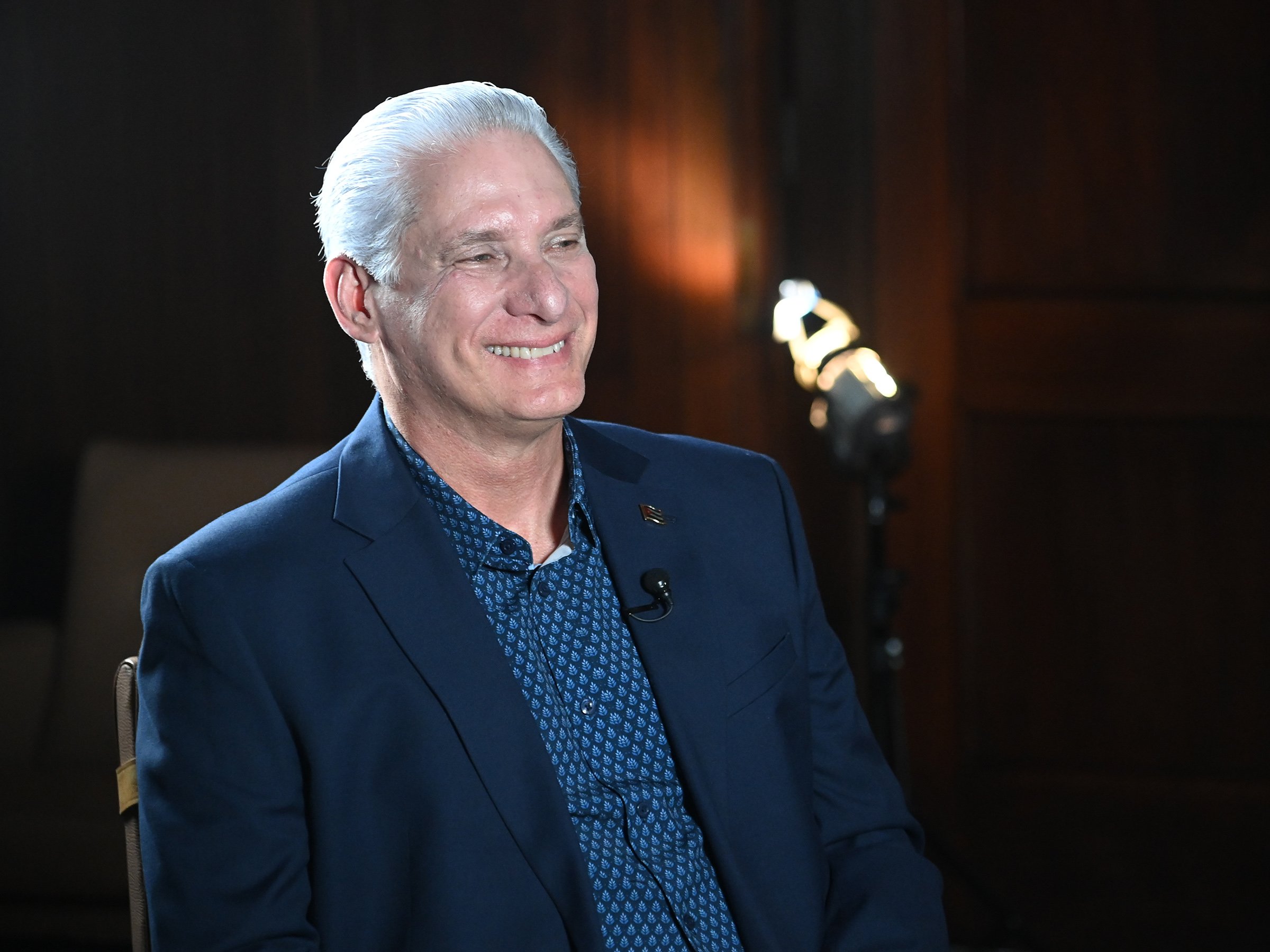
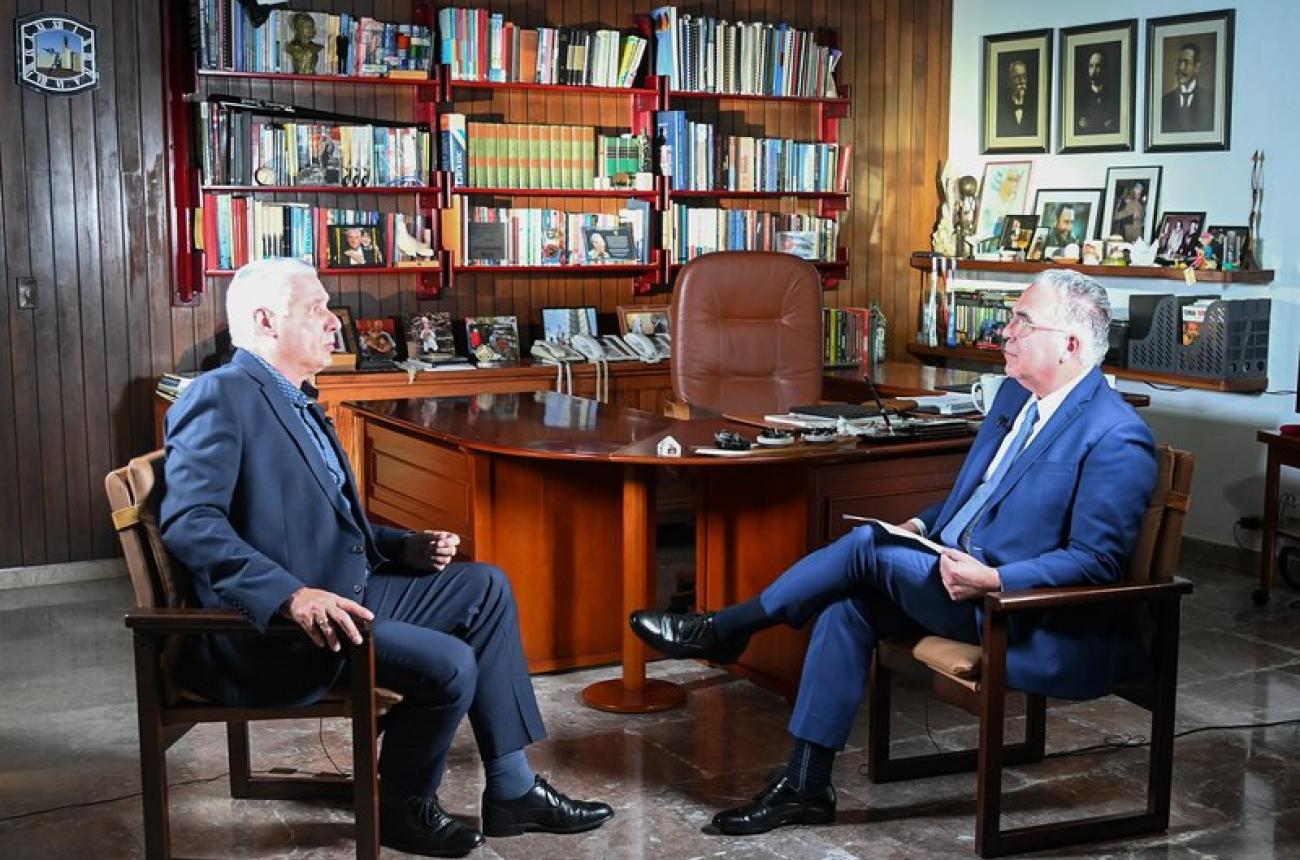
Miguel Mario Díaz-Canel Bermúdez, First Secretary of the Central Committee of the Communist Party of Cuba and President of the Republic, gave an interview to journalist Roberto Cavada, of the Grupo de Comunicación Corripio, of the Dominican Republic, at the Palace of the Revolution, on June 19, 2026, “Year of the Centenary of Commander-in-Chief Fidel Castro Ruz”.
Diaz-Canel emphasises "a renewed impetus for the ideas of the Revolution"
Roberto Cavada.- Mr. President, thank you for granting this interview to the Corripio Communications Group, of the Dominican Republic, our news program, Telenoticias.
Thank you, thank you so much.
Miguel M. Díaz-Canel.- Thank you, Cavada, for giving us the opportunity to address the Dominican people whom we love so much.
Roberto Cavada - Thank you.
The news these days, the announcement of a package of measures that has been said to be unprecedented in the history of the country, mainly in economic and social matters, first discussed within the Central Committee of the Party, then submitted to the Cuban Parliament and finally approved, one hundred and seventy-six measures!, if we could summarize them for the Dominican public in important or fundamental points, how would you summarize it?
Miguel M. Díaz-Canel.- Cavada, to understand the measures or the transformations, as we have stated, there is a group of background information.
First, this isn't a new phenomenon in the country. During the Special Period, under the leadership of the Commander-in-Chief, Cuba also had to take measures to adapt to changes, not only to the Cuban situation but also to the geopolitical shifts occurring globally at that time. Things were approved then that seem quite normal to us today, but which had a tremendous impact under those circumstances, such as the decriminalization of foreign currency; a measure that was very complex at the time because it was one of the first to generate a certain degree of social inequality in our country. We opened ourselves up to foreign investment, and thus a series of necessary measures were taken.
Later, in other years, already under the leadership of the Army General, a series of measures also had to be taken. There has been a debate since the Sixth Party Congress, where the first version of the Guidelines was presented, which brought about many of the transformations, already mentioned, that we are now trying to implement.
At that time, for example, the new Migration Law and the new Constitution were approved, which also transformed a whole set of views regarding how to continue the practice of socialist construction in Cuba.
And that is precisely what we are talking about: how, under the current conditions, a small island subjected to the longest and most genocidal blockade in history, for more than 60 years, and now an intensified blockade, with an additional component which is the energy blockade, how to build socialism, how to find ways to maintain the social gains of the Revolution.
Times have changed, geopolitics have changed, and the United States' aggression toward Cuba has changed. We cannot remain the same; we must transform. These are times of transformation. Fidel always asked us that in times of crisis we should not renounce either thought or creativity, and that we should find in crises opportunities not only to resist, but to grow, to advance, to improve, and that is precisely what this is about.
From the moment we began analyzing what could happen to us with the aggressiveness of this new US administration, we had identified a set of priorities. One of those priorities was related to the economy and involved a Government Program, a set of economic measures to address structural problems, which already included these transformations. We submitted this to public debate at the end of last year and in January of this year, and a series of proposals emerged from that process.
We have been working all this time on the proposals made by the people, which strengthened the Government Program. Therefore, we have consulted economists and experts; we have reviewed the processes of socialist construction in other countries like Vietnam and China, the experiences of Vietnam and China, always considering our own characteristics, because the intensified and prolonged blockade is a unique feature of the Cuban Revolution. And from this entire process has emerged this set of actions, this set of measures, or this set of transformations.
Some say, “But no one was consulted.” Yes, it did start with a consultation.
Roberto Cavada - The people were consulted.
Miguel M. Díaz-Canel: It started with the processing of that consultation, and now the National Assembly has to approve it again, the Political Bureau approves it; these are the mechanisms or procedures we have in the country. And anyone who proposes something better, anyone who proposes a change that is... is transformed, because this has to be in a constant state of development. And now we will have to carefully evaluate, when we implement it, what works well, what becomes widespread, what needs to be discarded, and what other new things need to be done.
You were talking to me about key elements. There's a group of fundamental elements that can summarize all of this. The first key element is to change or refine, to update the Economic Management System, where there is an appropriate relationship between centralization and decentralization, and where there is an appropriate relationship between what we plan and what will be driven by market signals.
Roberto Cavada - So, Cuba does not rule out continuing to plan part of its economy.
Miguel M. Díaz-Canel.- No, there are things: strategic issues, issues of balance between the different regions of the country, sectoral issues require planning; but you have to give more possibilities, more powers, and this is another of the central axes of these transformations, to the municipalities, which I would say is the fundamental scenario, the most natural scenario that the country has, and you have to give power and autonomy to the socialist state enterprise.
Roberto Cavada - Now, giving power to the municipalities is a brave gesture, because do they have all the conditions to manage everything you have proposed, such as exporting and importing?
Miguel M. Díaz-Canel: Look, in the first version of the Guidelines, at the Sixth Party Congress, the autonomy of municipalities was already being discussed. The municipalities themselves are demanding it, because it makes no sense for the plan to come to the municipality from the national level, given its range of problems. No matter how much participation is involved, there will always be a set of priorities that underlie the municipality's own priorities.
But on the other hand, tying municipalities down or favoring them from the central government stifles their initiative: it hinders initiative, it stifles creativity, it prevents them—because they haven't had that autonomy, that power—from driving development, from seeking foreign currency to develop the municipality, and from simply waiting for allocations from the central government. I believe that will revitalize the economy, it will create new networks of interconnection; with that, endogenous forces and local talent, the knowledge that exists in many regions of the country, will be better utilized, and that will strengthen them.
It's true that not everyone is prepared; but how can you expect everyone to be prepared? How long would that take? I think some will advance more than others, and the country, with that central planning, redistributing the wealth that is created, will have to mitigate which areas remain more vulnerable or less developed than others—these are processes that have occurred in other countries around the world—but as they compare themselves to see who is advancing more and why, everyone will also develop their capacities to continue along that path.
I have always believed that the stronger the municipalities in the country are, the stronger the provinces will be, and the stronger the country will be.
Another central point is the autonomy of state-owned enterprises. Today, our state-owned enterprises, which we defend as the main economic actors, are at a disadvantage compared to other economic actors. Therefore, we want everything to function equally. And, above all—and I think the interventions in the Plenum of the Central Committee and in the National Assembly on this topic were very insightful—people are describing the idea of having a single business system in the country, a single business system within the framework of socialist construction in Cuba. This business system has state components, cooperative components, and non-state or private components; but all participate, all are interconnected, all are linked, all are working toward the development of the country, the development of the nation, and, above all, contributing to territorial and local development strategies.
Another key aspect is the restructuring or resizing of the state apparatus, the governmental apparatus, the institutional apparatus.
Roberto Cavada - Are the ministries being reduced?
Miguel M. Díaz-Canel: The number of ministries is being reduced, and there is a draft bill, currently open for public comment on digital platforms, so that the population can also provide their input before it is submitted to the National Assembly. The aim is to create more robust, coherent, and integrated structures that will allow us to bypass bureaucracy, making them more agile, dynamic, and proactive, and enabling them to make better use of their talent resources.
This will also reduce public spending and allow us, with that decrease in public expenditure, to allocate those funds to other urgent matters. For example, salary reform in the state-funded sector, which is a more constrained sector; and the programs we can implement for retirees and for individuals, families, or communities facing vulnerability.
There are other related elements that combine greater flexibility and ease in foreign investment and foreign trade, with the participation not only of foreign investors but also of Cubans residing in Cuba and those living abroad. I believe these elements surrounding this axis are of great interest to the Cuban community living in the Dominican Republic, and also to Dominican businesses, with whom the country has always had a significant relationship, especially in sectors like agriculture and tourism. But I think there are many areas between Cuba and the Dominican Republic that we need to further explore in our economic and trade relationship, building upon the shared cultural, historical, and affectionate bonds between our peoples.
Roberto Cavada: Now, Mr. President, looking at the measures, I've reviewed some that are quite—I repeat the word—bold for the Cuban context. I mean, talking about private banking, whether with foreign or even local capital; talking about the presence of foreign brand franchises here in the country is quite a significant step in economic terms. Could Burger King or McDonald's, or a Dominican brand like Rico Hot Dog, come and set up shop here tomorrow without any problems?
Miguel M. Díaz-Canel: Look, Cavada, it all comes down to the same concepts. It's about everyone being on equal footing, because we're talking about foreign brand franchises, but we're also talking about Cuban franchises abroad.
Roberto Cavada.- Also.
Miguel M. Díaz-Canel: If you support foreign investment, it makes no sense not to support investment by your own citizens, in any form. If you create opportunities for foreign investment, you must also provide support for national businesses, whether state-owned or private. You can't offer foreign investment a set of advantages or opportunities while simultaneously stifling state-owned socialist enterprises or hindering the performance of private or cooperative entrepreneurs.
What we will always start from is that everyone who comes to Cuba does so without imposing anything; everyone who comes to Cuba should participate in how businesses are run, how agreements are made, how investment projects are developed anywhere; and in that same way we will also go abroad.
A key element, speaking of priorities, is also the necessary reform of the banking and financial system. Today, our banking and financial system creates obstacles, hinders development, and does not facilitate investment, development, or agricultural production.
Much is said about our problems, which we have acknowledged, but all these distortions are also closely related to the concept of a "besieged city" imposed upon us by this blockade. And these are ideas that have matured over time, having had to face so much adversity, so many limitations.
Today there are even limitations that we didn't impose; the blockade did. While there's now more flexibility, we have been open to foreign investment. The problem is that the blockade, and its intensification through the secondary measures of the second Executive Order of May 1st, is what limits companies' ability to trade with Cuba or conduct business with Cuba. This aspect is never discussed; the focus is always on blaming the Cuban government for the existing limitations. We fail to recognize how internationalized the relationships and intricate web of the US blockade against Cuba truly are.
Roberto Cavada - How does education and health fit into this...?
Miguel M. Díaz-Canel: These are sacred things; social achievements are sacred. And note that one of the principles we will follow in addressing these transformations is that everything we do must, before implementation, consider vulnerabilities. We cannot leave any family, any person, any community at a disadvantage, much less do anything that goes against social achievements.
There will continue to be a universal education system and a universal healthcare system; free education and free healthcare with access for all Cuban citizens, fully inclusive and of high quality. In addition, these same principles will apply to culture, sports, social security, social assistance, and programs addressing a range of social problems.
With a stronger economy, where productive forces are unleashed and contribute more, there will then be more possibilities not only to sustain the immense work of social justice and social programs that the Revolution has developed, but also to expand it and achieve more social justice.
The other option makes no sense: you can have the will to defend social justice, but if you don't have an economy that supports that, those ideals of social justice will simply crumble and crumble.
Roberto Cavada - It remains a utopia.
If a theorist listens to our conversation and reviews all these measures and tries to categorize the Cuban model, from now on what would it be, “one country-two systems” or how would they define it?
Miguel M. Díaz-Canel.- It will continue to be the same country: an independent, sovereign, socialist Cuba, with a tremendous vocation for social justice that will seek to achieve the prosperity that this people deserves.
Roberto Cavada: There's always an underlying fear with these kinds of measures, a fear that they might be reversed at some point. I mean, they're implemented today, investors come, Cuban investors invest—the micro, small, and medium-sized business owners, entrepreneurs—they use their savings, and then the measures might be reversed. What guarantees or legal security are there for Cuban investors, those from here, those from abroad, or foreign investors?
Miguel M. Díaz-Canel: That's one of the elements we've taken into account: there have to be clear rules and legal certainty. Everything must be built on legal certainty that guarantees it's not a temporary problem, but rather that anything done right, anything that works well, will also have long-term durability and sustainability. That's one of the areas where I believe we need to make progress.

Roberto Cavada - Does that legal framework exist?
Miguel M. Díaz-Canel : Today that framework exists, but with these transformations, that framework must now also be broadened in terms of concessions. For example, we are now being more open regarding the years in which the usufruct can be exercised, as well as the use of certain spaces; there is a whole range of options in that sense.
Roberto Cavada – Some believe that this series of measures or transformations underway in Cuba is a response to the considerations or pressure exerted by the United States on the Cuban government, which has even been called inefficient. Is this a response to Trump?
Miguel M. Díaz-Canel : There's always manipulation. Trump doesn't rule Cuba, nor does the U.S. government. Cuba is sovereign, and Cuba defends its self-determination. And, as I was saying, this is a process that is a consequence of things that have been discussed for the last ten or fifteen years.
The current situation of maximum pressure forces us to accelerate things a bit, to make decisions faster, to have to do something; but not because we are giving in to pressure from the United States, but because we are looking for ways to overcome these pressures without jeopardizing the sovereignty, independence, and self-determination of our country, which also depends on the decisions of our people.
The enemy, whose lies, slander, and character assassination of everything related to the Revolution we are already accustomed to, always seeks ways to present this as their victory. But it is truly an exercise in sovereignty, which also stemmed from a popular consultation; it is a broadly democratic exercise in popular participation. And now, popular participation must be translated into concrete action through the people's involvement and the popular oversight that must also be exercised over the implementation of these transformations. Therefore, these are quintessentially Cuban solutions, entirely Cuban.
Roberto Cavada : By the way, US Vice President Vance said just a few days ago that if they made smart decisions, there might be better relations. What would he say today? Are they smart? Are relations better?
Miguel M. Díaz-Canel : They will never understand what we do, nor will they ever accept what we do, because what they aspire to is a different Cuba. They aspire to a Cuba that is totally dependent on the United States and a completely privatized Cuba, while we have a socialist ideal enshrined in our Constitution with popular support. We are not seeking a capitalist restoration in the country; we are seeking to perfect the construction of socialism under the very adverse conditions we face today internationally, and also as a consequence of the United States' policy toward Cuba.
If we had acted differently, if we had acted in response to pressure from the American government, things would have been done that would have yielded to their pressure, and then they would have asked for something more, and so they would be constantly asking for something until we gave in, and that would be humiliating us, making us kneel, and that is not up for debate.
Even in the dialogue process, in the conversations that Cuba has historically sought to achieve with the United States, as an aspiration to develop a civilized relationship between neighboring countries or nations with many things that can benefit both peoples, both the American people and the Cuban people, our political system and our sovereignty have never been on the negotiating table.
Roberto Cavada : Now, during my time here, I've noticed that one of the biggest problems affecting the country and its population is the long periods of power outages. I read the other day that 62% of the country was without power. What short- or medium-term solutions are there for the issue of electricity generation?
A taxi driver who was picking me up from the airport was telling me a story—I don't know if it was a fable or just wishful thinking—about some new oil wells that had been discovered, and that some Russians or Germans, or God knows what other country, were interested in participating in the exploration and extraction. How much truth is there to that? How is Cuban crude oil used? What's the real outlook on this issue?
Miguel M. Díaz-Canel .- Look, Cavada, there is a whole energy strategy for the country, which has a fundamental element, which is to go to an energy transition, to go to an energy transition!, because we have been very dependent on fossil fuels and, above all, on imported fossil fuels.
Many lies have also been spread about this by the United States government and its spokespeople. They've said that we refused to pay for fuel, and that we were begging for it. That's not true.
In the 1960s, 70s, and 80s, when we had a trade relationship through the CMEA with the socialist bloc, the Soviet Union gave us more than 13,000,000 tons of fuel annually; but we exported sugar and other products to the Soviet Union that compensated for that fuel.
Later, during the Venezuelan era—and this has been part of the lies told by some of these representatives of the United States government—the presence of Cuban doctors and a group of medical services compensated for the energy contribution made by Venezuela, which was also a project conceived by Chávez, an exchange of medical services for fuel. Therefore, we did it that way, and that's how it was paid for. These reciprocal systems are also part of how some projects are negotiated internationally.
And when we couldn't get all the fuel we needed, because Venezuela was already subject to certain sanctions and certain internal situations, we had to go to the international market to buy fuel and nobody gave us the fuel for free.
Roberto Cavada - You paid for it.
Miguel M. Díaz-Canel : We paid for it. Many of those entities, which are now being denied the right to bring fuel to Cuba, didn't bring it for free. That fuel had to be paid for.
So, to eliminate that dependence, we began a profound process of energy transformations or energy transition last year.
Last year, we secured an investment of over 1,000 megawatts of installed capacity in photovoltaic parks, harnessing solar energy that no one can block. This meant that in just one year, we went from 3% renewable energy generation to 10%. We grew by 7%. Furthermore, recent international publications have indicated that Cuba is one of the five countries with the most dynamic energy transition currently underway in the world.
We have continued that program this year. These days, a new park of more than 20 megawatts and several battery storage stations are being inaugurated, which will give us greater capacity to utilize all the photovoltaic energy we have installed, better utilization of the photovoltaic parks we have installed, and will give us greater stability in the system's frequency regulation, and we will continue.
But another set of programs has been developed around renewable energy sources. For example, today every municipality in the country has a network of community centers that provide services to the population, powered by photovoltaic systems. So, even if there's a power outage in the municipality, the emergency room at the polyclinic, the bank branch, and other services remain operational, and we're going to continue expanding this network.
More than 5,000 isolated homes across the country, previously without electricity, will now have photovoltaic systems; these have already been installed in over 300. Additionally, a number of families, including children with specific illnesses and workers who make outstanding contributions to society, have received photovoltaic systems.
The state sector itself has made investments in photovoltaic systems, and more and more Cuban workplaces and institutions, both productive and service-oriented, are beginning to use this energy, thus reducing the load on the national power grid.
The private sector has not only been supportive of itself, but has also been very consistent and supportive of society. Therefore, many private economic actors, in addition to installing photovoltaic systems for their businesses and homes, have also done so in community centers, and that has been a significant contribution. Now, keep in mind that I'm talking about just one year. And looking at it from the other side of the coin, if we hadn't done that last year, what would be happening today?
Because, you see, those photovoltaic parks are generating more than 50% of the country's energy during daylight hours, when there's more sun. If that weren't the case, we'd be experiencing one blackout after another, because the system would be completely unstable. The system wouldn't even be able to supply energy to 20% of the population during daylight hours.
The other element is, well, to follow the maintenance programs of our infrastructure, which is obsolete, but with maintenance can continue to function.
Now in the coming months we will also incorporate some plants that have been undergoing prolonged maintenance, for more than 6 months since the deterioration they had, and they will give us additional capacity or allow us to carry out other maintenance.
But in everything we've been doing over the last two years, we've recovered more than 1,400 megawatts of distributed generation capacity. These are distributed generation islands located throughout the country. We can't use them today because of the energy blockade, because of the fuel shortage. Imagine, if we could use that—1,400 megawatts plus the photovoltaic capacity—we wouldn't have blackouts during the day. And at night, the blackouts would be minimal. That's where you see how perverse this energy blockade is, depriving us of more than 1,400 megawatts of capacity to generate electricity for our population.
The other issue is domestic crude oil. Today, our current levels of domestic crude oil production are sufficient to supply our thermoelectric power plants.
Roberto Cavada - How much are we talking about?
Miguel M. Díaz-Canel - I'm not going to give figures because I don't want anyone to start calculating needs and how far we can or cannot go.
Roberto Cavada : Is it a crude oil that's coming out? It's always been said that it was...
Miguel M. Díaz-Canel .- It is a heavy crude, with a high sulfur content, but our thermoelectric plants adapted during the Special Period.
Roberto Cavada - To process it.
Miguel M. Díaz-Canel - To process it, and working with a group of inconveniences, maintenance has to be done more often, scale buildup in boilers is more frequent and all that complicates the operation; but we work with it.
But with the extraction of domestic crude oil comes gas. Gas is used to supply domestic gas to a portion of Havana; but also, a portion of that gas is used to generate the most efficient and optimal systems we have today, known as Energas.
Roberto Cavada .- Energas.
Miguel M. Díaz-Canel : It's electricity generation from that accompanying gas. And there was always the taboo of whether Cuban crude oil was refinable or not. We turned once again to science and innovation—remember that we have declared science and innovation as one of the pillars of the country's government management—and our scientists in the country's own energy system research centers have found processes, a technology, a Cuban solution to refine our national crude oil.
We have already converted domestically refined crude oil into usable products. The problem is that this production is still not enough to cover the deficit created by the energy blockade. But as we increase crude oil production, we will have more crude available to be processed into gasoline, diesel, or fuel oil, and used in other sectors of the economy or even in distributed generation.
That's going to be a longer process, because we need to make investments to extract more oil; we'll have to drill new wells. Some companies that were working with Cuba on those projects have withdrawn due to the sanctions that have been imposed. But there are other possibilities and other potential, but it's going to be a medium- to long-term process. However, a fundamental element—the question of whether or not we could refine Cuban crude—has been resolved, it's resolved! And that opens up a new perspective.
We have also committed to electric mobility, and investments are being made in electric mobility, which will help solve the country's problems.
We are assembling photovoltaic systems and electric mobility equipment in the country, and this is giving us a boost that will increase our chances of solving the problem. However, it remains a complex and difficult issue.
We do not relinquish our right, like any other country in the world, to import fuel.
But, in a few years, with this program, a time will come when we will be very little dependent on importing fossil fuels and will become increasingly independent, even from using fossil fuels, even those of Cuban origin, for electricity generation. It's a major effort that won't have immediate results… and yet I say it has had an immediate result that hasn't been visible because of the current situation. That's why I was saying: let's look at it differently. If we hadn't started it last year, what would be happening right now? The situation would be much more serious than it is now.
Now, what I will say is that it's overwhelming and deeply repulsive that the world's leading power, with all its resources, resorts to such inhumane, criminal, and genocidal practices to suffocate a friendly, supportive people who don't attack anyone, and that they've put us in this situation. It's truly perverse.
Roberto Cavada - When was the last time a fuel tanker came in?
Miguel M. Díaz-Canel : In the last six months, only one cargo ship has entered the country—the Russian cargo ship, which became the most famous ship in the world—and which allowed us to have a completely different situation for fifteen days. This demonstrates that we do have the capacity to generate wealth and improve our situation, and that it is the blockade that prevents us from doing so.
Roberto Cavada - Have other ships been blocked?
Miguel M. Díaz-Canel .- All the other ships that have tried to come have been pressured, threatened, and have had to return or change their course.
And all the shipping companies and all the entities that offered Cuba fuel trade have also been pressured and threatened with sanctions, which has caused them to withdraw. Even with the authorization for the private sector to import fuel, things haven't been all smooth sailing.
Today, imports from the private sector have brought in no more than 40,000 tons of fuel, which is equivalent to one ship out of the many ships that Cuba needs in a single month.
Roberto Cavada - You have spoken and explained the issue of the blockade, from the entire life of the Revolution and its intensification now with the energy blockade.
The United States has recently stated its willingness to provide $100 million in aid, to be distributed through churches, particularly the Catholic Church and Caritas. How much of that $100 million has actually entered the country, and how has it been distributed? (The President laughs) Why are you laughing?
Miguel M. Díaz-Canel - Because it seems like a joke (Laughs).
Roberto Cavada - A joke? The 100 million proposal or my question?
Miguel M. Díaz-Canel - The 100 million thing.
We've had three offers of humanitarian aid, as they call it, from the United States government. The first was on October 25th of last year, for $3 million; of that, $2.6 or $2.8 million has been disbursed since October 25th, benefiting approximately 8,000 Cuban families. Then they proposed $6 million in aid, which is only now beginning to be distributed.
When they offered the $100 million, they started saying that the Cuban government did not accept it, which is a lie. The Cuban government informed the United States government that it accepted the aid, even in writing.
Now, contradictory elements have emerged, saying that those 100 million, of which none has yet arrived in Cuba, will not begin to be distributed until after September.
Roberto Cavada - And why?
Miguel M. Díaz-Canel : We don't know. It seems they're making some calculations about what will happen in Cuba over time. Furthermore, they've said that those 100 million don't include medicine or food.
It's hard to believe that if they want to help the Cuban people, and if two of the most needed things we have, due to their own policy of maximum pressure, are medicine and food, why can't the aid include medicine and food?
Roberto Cavada - So what is the aid for then?
Miguel M. Díaz-Canel .- We'll have to see, because they haven't defined it, they haven't clearly stated what the aid is for.
Now, consider the contradictions of this aid: first, the fact that it includes limited products that are very necessary; second, that while this aid is appreciated, taken into account, and reaches a group of people, it is very limited for the needs of the country; a third element is that they are giving this aid amidst the worsening of the national situation, caused by this criminal policy of intensified blockade, now combined with an energy blockade.
And besides, that aid is nothing compared to the damage the blockade has caused Cuba. According to the latest estimates, the blockade costs Cuba over $5 billion annually, and they're offering only $100 million.
A fourth point is that this aid is completely inadequate; it bears no comparison to all the international assistance we receive from the solidarity of various movements in other countries, from friends of Cuba, from solidarity movements, and from social movements. Therefore, it's a farce, a charade, a pretext to blame the Cuban government.
Roberto Cavada - By the way, speaking of aid and solidarity, as you mentioned, we have seen that aid has come to Cuba from various places, from Colombia I think recently, and from the Dominican Republic I believe a modest amount, but it arrived.
How has the relationship with the Dominican Republic been? You have served a term parallel to that of the Modern Revolutionary Party and Luis Abinader, meaning you have held the presidency of your respective countries simultaneously. How has the relationship been during this time, both with solidarity groups and with the government, of course?
Miguel M. Díaz-Canel : We maintain a relationship of respect, cooperation, and solidarity with the peoples of the world, and particularly with the Latin American and Caribbean region. The Dominican Republic is very close to us, and in Cuba, in particular, there is a feeling with the Dominican Republic rooted in historical, cultural, and identity-based foundations.
History tells of a Dominican chief, Hatuey, who came to Cuba to organize our indigenous peoples in what may have been the first uprising against the Spanish colony. Hatuey was burned at the stake. This is a symbol that one learns from a very young age in Cuban history, something that becomes ingrained, and it's related to the bond between Cuba and the Dominican Republic.
But there is a towering figure in Cuban history of Dominican origin, for whom we feel tremendous admiration because he was a man of admirable revolutionary, human, military, and ethical character: the Generalissimo. It is not without reason that in Cuba he is called Generalissimo Máximo Gómez Báez, someone who taught Cubans to fight with the machete, who earned the highest ranks in the Mambí Liberation Army through his own merit, who was recognized by the Cuban people, who formed a Dominican-Cuban family, and who for us is one of the most important heroes. There is a photo there (He points), he is next to Martí and next to Maceo, and we always keep him very much in mind.
But another milestone of that relationship, of that foundation, of that forging of identities has to do with the fact that one of the most important events of our independence struggles, in terms of manifesto, of political program, was signed in Montecristi, precisely by Gómez and Martí, which is the well known Manifesto of Montecristi , which was the guiding document of the Cuban Revolutionary Party to carry out the Necessary War and the War of Independence that began in 1895.
Therefore, it was Montecristi, the Dominican Republic, that was the setting where that important document for the history of Cuba was signed by two figures such as a Dominican-Cuban, Máximo Gómez, and our Apostle, José Martí.
But later in history there have also been moments that unite them. Many Dominicans participated as generals in the Cuban wars of independence. Fidel is one of the links, one of the connections in that relationship.
When Fidel was 21 years old and studying at the University of Havana, he already belonged to the Dominican Pro-Democracy Committee, and he became involved in the expedition that we know of Cayo Confites.
Roberto Cavada - From Cayo Confites.
Miguel M. Díaz-Canel .- In 1965, Fidel was the first to publicly denounce the military intervention in the Dominican Republic, and he did so with tremendous strength, energy, and vehemence.
There are figures who link the history of the two countries, such as General Caamaño and General Delio Gómez Ochoa. Cuba was the setting where an admirable figure like Juan Bosch and the Dominican National Poet, Pedro Mir, spent part of their lives.
Many Cubans have been welcomed in the Dominican Republic and have built their lives there. And young Dominicans have been educated and trained in Cuba, so there is a very direct relationship. We have maintained a good relationship with the Dominican government.
I believe trade between us is still limited, although it has grown in the last two years, but it could reach a much higher level given our proximity and shared cultural and economic ties. We have almost the same economic projections: agriculture, tourism, and sometimes exchanges in biotechnology as well.
The solidarity movement with Cuba in the Dominican Republic is impressive. In addition to the recent aid that has arrived, we cannot forget the Dominican Republic's support during the COVID-19 pandemic. Many things arrived that we desperately needed during the pandemic, when we were already facing an intensified blockade, and these supplies came thanks to that movement.
When the United States, when the Biden administration pressured a group of companies not to sell oxygen to Cuba, in the midst of COVID-19, when we had a breakdown in our medical oxygen production plant, Dominican entities provided that medical oxygen to Cuba, and that is a gesture we will never forget.
Therefore, the relationship between our peoples, more than the relationship between the governments, the relationship between our peoples is indestructible, and if at any time there were any kind of incident that could cause a misunderstanding, that history of unity, solidarity, affection, and respect between our peoples would be able to resolve it, and there would always be a space to resolve any kind of contradiction through dialogue.
Roberto Cavada : You have spoken on several occasions about young people and youth. Yesterday, in outlining all the measures, you referred to the concerns and involvement of young people in the economic changes taking place here in the country. What would the Cuban government do to ensure that young people can realize their dreams and build their future here, rather than leaving the country as their only option?
Miguel M. Díaz-Canel : The first thing is that we are guaranteeing universal access to education for all young people, meaning that all young people in Cuba can receive an education. And I would say, without any chauvinism, that our educational standards are high; our general education and our university education are robust and efficient systems. This has allowed young people trained at our universities to achieve great success internationally. Therefore, it is essential to maintain this.
The other question, then, is what incentives do we need to create and what programs do we need to develop so that these young people, when they reach those levels of qualification, can build a life plan. I believe that all these economic transformations we are making facilitate those plans, create spaces for young people to grow. We also need to look at salaries, monetary policy, and access to credit so that young people can advance when they begin their lives. This is supported by the Family Code, which is one of Cuba's most recent pieces of legislation, and also by Law 178, the Code for Children, Adolescents, and Youth. I believe that we will move forward in this direction and achieve this goal.
Roberto Cavada – Speaking of young people – and not to limit or discriminate against them, since we were all young at some point, and we still feel young – especially in times of crisis, and as each seeks solutions according to their own perspective on life, there are those who see the solution to the crisis in Cuba as a US intervention, and sometimes they even say so on social media, that they prefer the Americans to come, they invite Trump to come. What would you, as a young president, say to the young people of your country?
Miguel M. Díaz-Canel - I believe that young people need to have confidence in themselves and need to have a critical mindset about what they are experiencing, and for that they need knowledge, for that they need culture.
Above all, what we do in the education of young Cubans must lead us to a sense that people, young people, are not distinguished by their material possessions, but rather by their culture and knowledge, and that they can use that knowledge and culture, as good citizens, to contribute to the development of their country. But they must have confidence in themselves and realize that they are key players in the present and are part of the nation's future.
When a young person delves into the roots of our identity, when they delve into our history, into our culture, they would have to be incredibly foolish not to realize that Cuba's alternative could never be annexation to the United States. There is no future for Cuba with annexation to the United States, and this leads them to take a stance on life that is quite the opposite: it's about how to make their country great, how to perfect the country, how to develop it; it's about how to contribute from that vision of identity, of being Cuban, of commitment to the homeland, and this cannot be separated from a commitment to the Revolution.
We must ensure that our young people prioritize humanism, which is fundamental to our identity and the very essence of the Revolution, over algorithms. We must ensure that young people embrace their cultural identity, their connection to our roots, in the face of cultural colonization, neocolonialism, and the global trivialization of culture. And we must empower our youth to prioritize solidarity over the selfishness fostered by capitalist and consumer societies.
Look, there's always a lot of talk about young Cubans emigrating, as if emigration were a problem unique to Cuba; emigration is a global problem, and those who emigrate the most are young people, who have the most energy, the most rebellious spirit, and the greatest opportunities to do so. However, we should also talk about the young people in Cuba who don't emigrate and who today hold important leadership positions, not only in management but also in technology and business, in our industries.
I, for example, remember a few months ago, during one of my visits to the Antonio Guiteras thermoelectric plant, that a significant part of the Board of Directors of that company are young, young engineers, and that they have a leading role and tremendous recognition for the innovations they have made, for the contribution they have made.
Today, the Party has young people leading provinces in this country. And we need to see how these young people are managing these territories, how they are confronting this crisis.
I will never forget that during the COVID-19 pandemic, when we realized we needed to call on young people to work in the neighborhoods and we went to find them, they had already mobilized on their own and were all in the red zones, in the essential centers, in the places where we were isolating people, bringing essential supplies to the elderly, to the oldest members of our community, with a tremendous response. That is the part they try to hide, to keep invisible, or who the young people are who are involved in our main scientific projects.
I remember during COVID-19, when we were trying to boost the production of one of the vaccines in the reactors, I went into a room where the team was young and very frustrated because they weren't achieving the desired results, but they were incredibly committed, working almost full time, without sleep or rest. All I could offer them was a little encouragement, especially since we needed that result, and within a week those young people had achieved it!
There are incredible feats like that. Whether it's our young people serving in defense or those in the classroom.
For example, I spend time weekly with a very young couple who are my artificial intelligence professors; they're the ones who introduced me to the world of AI. And I enjoy it so much… They give me the classes right here.
The young woman is the current Dean of the Faculty of Mathematics at the University of Havana, and her husband is also a brilliant young man.
Besides what one learns from them, it's so rewarding to see the capacity these young people have developed, how they find solutions, how they're able to propose things that… I think we've already surpassed the course content, which was an engineering course in progress. Now we're talking about projects, and they're giving me ideas on how we can implement artificial intelligence as a service for public administration, for the business sector, and they're bringing projects and things they've developed, and you're left in awe of these young people. Therefore, I have tremendous confidence in Cuban youth.
Roberto Cavada - I have two final questions.
President Donald Trump recently said that after Iran he would make a stop in Cuba. Are you waiting for him?
Would you be willing to talk to Trump?
What is the dialogue about?
Does it really exist or are they just statements on social media from one side to the other?
Are there any issues on the table to move forward?
Miguel M. Díaz-Canel - There are attempts at dialogue and a channel has been established, as we have reported.
Dialogue processes are very serious processes, they require enormous sensitivity, because the bilateral relationship between two nations and between two peoples is at stake, which is assumed with great responsibility.
These are processes that must be approached ethically, and one cannot allow oneself to be provoked by the media manipulations that are constantly emerging, and that is one of the elements that makes it difficult for dialogue to move forward.
What have we always proposed? We believe that it is possible to find a solution to our bilateral differences through dialogue.
It is possible, if both sides are willing in this dialogue process, to find common ground where we can develop projects that benefit our people and guarantee the security of both nations, as well as the security and stability of the region, and that allow us to build spaces that move us away from confrontation—away from confrontation! And all of this must be based on equality, on respect, and without pressure. We cannot talk or negotiate under pressure, much less condition the dialogue on a change to our political system, or a change that affects our sovereignty, our independence, our self-determination. It must be a process of reciprocity where the principles of international law are respected.
Roberto Cavada - Couldn't they think that after these economic changes there might be a political change on the table?
Miguel M. Díaz-Canel : I believe they must be convinced that in Cuba there is ideological unity, revolutionary unity, unity of thought, and unity of action. And that the Revolution has always demonstrated the capacity to transform, to advance, but always with a well-defined objective: to perfect the process of socialist construction, to advance toward socialism, to achieve the prosperity this country desires.
But there is an opportunity there, an opportunity for American entities and American businesses to invest. There is every possibility of working on common issues of cooperation, which we have already discussed, and this is not the only time this has been raised.
But there's an asymmetry here: one country always acts as the aggressor, and the other has always been the victim. One constantly harasses the other, while we have never engaged in any act of harassment against the United States.
When there has been dialogue, we have fulfilled the commitments of the dialogue, and the United States has failed to fulfill some of those commitments.
All of this creates a great deal of distrust, and it also creates a great deal of distrust in the attitude the administration has shown recently. When it was supposed to be engaged in dialogue with Venezuela, it attacked Venezuela, kidnapped the President and his wife, and removed them from the country—an action that is completely illegal and against international law. When it was supposed to be engaged in dialogue with the Islamic Republic of Iran, it attacked Iran.
We have, for instance, all the pretexts and lies they've used to attack Iraq, Libya, Syria, and other countries; the way they've supported the Israeli regime in the genocide they've committed against the Palestinian people in Gaza. All these elements also create a great deal of distrust among the Cuban people when it comes to any kind of negotiation.
We continue to express our willingness to engage in dialogue, but it must be a dialogue between equals, without pressure and with respect for our sovereignty.
Roberto Cavada - And aren't you worried that with this double standard, while there is dialogue on one side, there is an attack on the other, a military attack on Cuba could occur?
Miguel M. Díaz-Canel – The danger of US military aggression against Cuba is ever-present. It is ever-present, especially because they constantly manipulate and express it in their rhetoric. There is a whole combination of media warfare and psychological warfare at play, all aimed at intimidation.
Cuba prioritizes defense preparedness. And our concept of war, which is the War of the Entire People, is one where, with the participation of the Cuban people, everyone has a place and something to defend, a mission.
Ours is a completely defensive strategy, not aggressive; it is for self-defense, and, moreover, demonstrating that we have the capacity to defend ourselves and avoid confrontation.
We have been preparing intensely all this time in response to this escalating rhetoric, not to attack or threaten the United States, but so that they respect us and so that they understand the cost of a military adventure against Cuba if some hothead were to believe that this were the solution for Cuba. But Cuba has never attacked the United States. Cuba has never committed an act of terrorism against the United States, and yet terrorist acts have been carried out against Cuba by forces from the United States. More than 3,000 people are victims of terrorism perpetrated by the United States against Cuba.
Cuba does not pose a threat to the national security of the United States. That is a lie they constantly repeat.
The United States' own agencies—intelligence agencies, military agencies—know that Cuba does not represent a danger to the security of the United States, and this is a pretext that they keep repeating to turn it into a false truth, as is now used on social media and in this whole media structure of the new times.
Therefore, by showing our willingness to engage in dialogue, we are also preparing ourselves so that there will be no surprises or defeats—so that there will be no surprises or defeats! But what our people deserve is dialogue, not confrontation.
Between the Cuban and American people, there could be a multitude of cultural, scientific, sporting, business, cooperative, and commercial channels that could be mutually beneficial. And yet, these bridges have not been built or have been destroyed by an aggressive policy directed against them, a policy spearheaded by the United States government. It is not Cuba that has opposed dialogue, nor has it opposed building these bridges.
Roberto Cavada : Finally, you weren't at the Moncada Barracks, you weren't on the Granma, you weren't in the Sierra Maestra, you weren't even born yet; however, you have had to assume and live through a historic moment, perhaps on par with those great feats in Cuban history. Looking ahead, your term ends in 2028. I know, from friends we have, that you don't think much about the place history will reserve for you, but what would you like Cubans to remember about you, what would you like them to take away from your story and your mark on the government when you finish as President of the Republic?
Miguel M. Díaz-Canel .- Cavada, you've taken me off guard with that question, haven't you? Because it's something I've never thought about, I've never thought about that!
I think that, as for anyone of my generation, you are of my generation, or we are of the same generation, there are many other people of our generation, for us legacies have always been associated with the heroes, the heroes and heroines of the homeland, of the nation, of the country.
I have indeed assumed a legacy, I have assumed Fidel's legacy, the legacy of the country's history, of which I am proud; Raúl's legacy, Che's legacy, the legacy of our thinkers; the legacy of our culture, of our identity, of our history, of our mixed heritage, of our Cuban color, of our nobility, of our courage.
And like any other Cuban, born during the Revolution, I believe I have dedicated myself to the work of the Revolution, also taking advantage of the opportunities the Revolution gave me to educate and prepare myself. But I've never thought about leaving a legacy or being remembered for one thing or another.
What I have worked on, I would say, with enormous sensitivity—I say this from my own heart, from my own commitment—is with great sensitivity toward the problems of the people. When I see people struggling, unable to get ahead, when I see that a country like this, with all its talent and potential, can achieve so much, and yet we have to go through such difficult times, it hurts me deeply. It hurts, I would even say it sometimes irritates me; but I always think that, because of what I represent today, it is my duty to call for solutions, to promote them, drawing also from that legacy.
I believe we have worked in this way. First, we have tried to promote a more participatory system of lawmaking in recent years, especially because we have faced the challenge that a new Constitution requires that, in the shortest possible time, it has all the laws and regulations that support it, and we have done so from a participatory framework, starting by listening to the legal sector on how we should improve our system of lawmaking.
Today, in all policies, in all the design of public policies and laws, there are groups of experts who combine all the knowledge, who contribute, and then the laws have been subjected to very broad processes of popular consultation.
I have promoted three pillars… not me, but our team, because we have shared it with the people, no one can promote anything alone, and we have done it not as a legacy, but to move the country forward: social, political and institutional communication, and with that I still have enormous dissatisfactions, to move to a different moment.
Science and innovation as a way to find solutions to problems through scientific research and knowledge.
Digital transformation and artificial intelligence, because they can lead us to make processes more productive, processes more valuable.
We have defended the most just causes in the world and I believe that Cuba has played a very important role, for example, in defending the Palestinian cause in these times.
We have maintained a foreign policy consistent with the teachings of the foreign policy designed by the Commander-in-Chief, and we have an excellent relationship with most countries in the world and, of course, very strong relationships with groups of countries that have always been historical brothers, historical friends.
We have strengthened food sovereignty, which, although we have not achieved it, we have strengthened.
Together, we have been implementing or building a work system that links us more from the neighborhoods, from the municipalities, from the territories with a more systematic, more permanent presence.
Greater integration of the Government System with the knowledge sector, with universities and also with the territories.
Listening a lot, having the ability to listen to the people, learning from the people, giving voice to everything the people express, and above all, we have had to face many adversities during this time. Adversities of all kinds: from weather phenomena, technical issues, or accidents, and this extremely aggressive policy of the United States government.
Therefore, I believe there is a sense of historical continuity and, above all, a dialectical continuity, which has not been a matter of simply repeating past actions without adopting new attitudes. There are also feelings of dynamism, of a renewed impetus for the ideas of the Revolution, especially in adapting to the present times and promoting strategies for confronting them. This has been done with courage and rigor; but we are still far from achieving our dreams of the prosperity we desire for the country, and we will dedicate all the time we have left to that endeavor.
But above all, with great loyalty to the people, loyalty to the Revolution, loyalty to socialist construction, because I hold it as a conviction. I hold it as a conviction. If I didn't hold it as a conviction, I couldn't act this way. But I had never before faced the dilemma of wondering whether I would leave a legacy or not.
I think I've approached this with an attitude, as the Cubans say, of being brave, pushing forward, and taking the heat. And if one day we're going to talk about legacy, let others be the ones to say it.
My fundamental purpose now is that the country can move forward, that we as a people can improve the situation we face, that we do not renounce our ideals; that people continue to see Cuba as a hope that a different world is possible, that there are other relationships between people that are more dignified than those that sometimes lead to a society of inequality and a consumer society.
I can't give you any other answer to that question. I don't think it will meet your expectations.
Roberto Cavada - No, no, but I thank you, I thank you very much for this conversation, for having it for our entire audience.
Thank you very much, Mr. President.
Miguel M. Díaz-Canel - Thank you, Cavada, and thank you for being in Cuba during these times.
Roberto Cavada - Thank you.
(Photos: Estudios Revolución)