
The Communist Party of Israel (Maki), the communist-led Democratic Front for Peace and Equality (Hadash), and the Joint List stepped up their political activity over the weekend of 23–25 October, ahead of Israel’s parliamentary elections on 27 October.
Hadash and Joint List intensify final election campaign with academic endorsement and solidarity action in West Bank
Their campaign combined a public appeal signed by more than 320 academics, solidarity with Palestinian farmers facing settler attacks, efforts to attract Jewish voters, and a call for a stronger Joint List to help bring down the Netanyahu government.
More than 320 academics endorse the Joint List
On 23 October, more than 320 Jewish and Arab academics from higher-education institutions across Israel published an appeal titled “We Will Not Give Up on a Shared Future: For Equality, Peace, and Democracy, We Will Vote for the Joint List.” The signatories included professors Amos Goldberg, Oded Goldreich, Nurit Peled-Elhanan, Oren Yiftachel, Yehouda Shenhav-Shaer and Omri Boehm.
The statement endorsed full equality between Jews and Palestinians, recognition of Palestinians’ civil and national rights, an end to the occupation, a just peace, opposition to racism and discrimination, and equal political representation for all citizens.
The academics warned that racism and incitement were deepening while opportunities for Jewish-Arab political partnership were shrinking. They pointed to the war in Gaza, the situation in the occupied West Bank, the treatment of prisoners and the spread of violent crime in Palestinian society. They argued that democracy required equality and that a shared future depended on Jewish-Arab political cooperation.
Joint List activists join Palestinian olive harvest
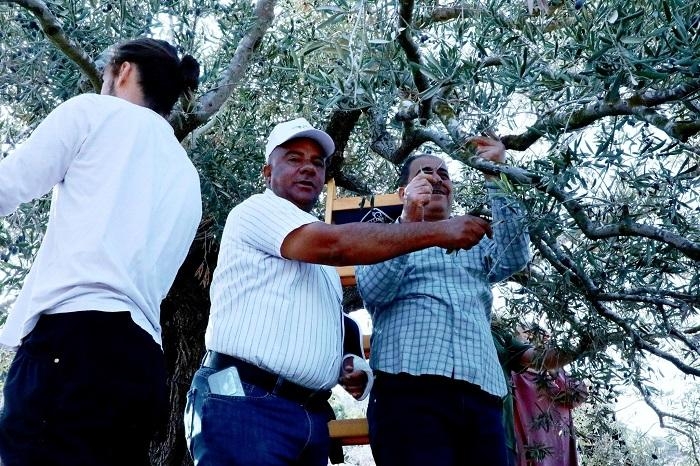
On the morning of 24 October, Joint List activists, including Hadash and Communist Party member Ofer Cassif, travelled to the Palestinian village of Farkha in the occupied West Bank to join local farmers in the olive harvest.
The action expressed solidarity with Palestinian agricultural communities facing attacks by Israeli settlers. Cassif said that farmers in Farkha and elsewhere in the West Bank had experienced attacks during the harvest season, which is crucial to their livelihoods. He accused the Israeli military and state authorities of restricting Palestinian access to their land while protecting violent settlers.
Cassif stated that the Joint List stood with Palestinians’ right to harvest and cultivate their land and to live without fear of violence or displacement. He reiterated the demand to end the occupation.
The action linked the election campaign to a concrete expression of solidarity with Palestinians living under occupation, rather than limiting the campaign to parliamentary politics.
Campaign to broaden Jewish support
In an interview published by Zo Haderekh on 24 October, Noa Levy, deputy chair of Hadash and director of the Joint List’s Hebrew-language election campaign, described an effort to expand support among Jewish voters.
Levy said the campaign was addressing Jewish voters who opposed racism, supported peace and wanted a genuine Jewish-Arab partnership but remained hesitant about voting for a list whose candidates were predominantly Arab. She argued that the Joint List offered a political partnership based on shared principles and long-term cooperation, rather than a temporary arrangement intended simply to secure parliamentary seats or government funding.
The Hebrew-language campaign targeted both Jewish voters and Arabic-speaking citizens who read Hebrew. According to Levy, campaigners had held meetings in private homes in Tel Aviv, Haifa, Jerusalem, Hod Hasharon and Kfar Saba, alongside street campaigning in several cities, towns and communities.
The campaign presented the Joint List’s programme as an alternative to continued war and occupation, discrimination, organised crime and socioeconomic inequality. It also advocated the establishment of an independent Palestinian state alongside Israel.
Polls and the struggle over a possible change of government
A Zo Haderekh report published on 24 October said that the final television polls gave the Joint List around nine seats. The same polls showed that neither the Netanyahu bloc nor the opposition bloc led by Gadi Eisenkot had enough seats to reach a parliamentary majority on its own.
In an editorial published on 25 October, the newspaper argued that a strong Joint List could be important to any attempt to replace Netanyahu’s government. It criticised the refusal of major opposition parties to commit to including the Joint List and the United Arab List (Ra’am) in a governing coalition, describing their exclusion as a barrier to building a parliamentary majority.
The editorial also highlighted Joint List leader Yousef Jabareen’s stated readiness to negotiate support for a new government in exchange for concrete commitments, including action against organised crime, a halt to home demolitions and progress towards a political solution to the Israeli-Palestinian conflict.
The party’s newspaper argued that the Joint List represented not only opposition to the incumbent government but also a distinct political programme centred on ending the occupation, establishing a Palestinian state, equality and Jewish-Arab partnership.