
The Iraqi Communist Party (ICP) has recently addressed several pressing political issues in Iraq, combining demands for the restoration of state authority and the return of displaced residents with criticism of the country's sectarian power-sharing system.
Image
Iraqi Communist Party calls for state authority in Jurf al-Sakhar and criticises Iraq’s political system
Iraqi Communist Party calls for state authority in Jurf al-Sakhar and criticises Iraq’s political system
Its interventions have included a statement on developments in Jurf al-Sakhar, a political seminar with Central Committee Secretary Raed Fahmi in Baghdad, and a meeting in Erbil addressing the political crisis in the Kurdistan Region.
ICP calls for the return of displaced residents to Jurf al-Sakhar
In a statement issued on 21 November, the ICP Political Bureau addressed the redeployment of security and military forces in Jurf al-Sakhar, in Babil province. The party described the move as a step towards restoring state authority in an area where armed factions have exercised control for years, preventing state institutions from fully carrying out their responsibilities and thousands of displaced residents from returning home.
The ICP argued that the process must lead to the establishment of the rule of law and the subordination of all armed formations to the command of the armed forces. It called for an end to parallel military and security structures and foreign interference in Iraq's national decision-making.
The party also demanded independent and transparent judicial investigations into suspected corruption, oil smuggling and violations involving public and private property. It stressed that the return of displaced residents, many of whom have been away for more than 12 years, must become an urgent national and humanitarian priority. The ICP called for a clear timetable to ensure their safe and voluntary return, alongside reconstruction, compensation for affected families and clarification of the fate of missing persons.
Raed Fahmi discusses economic crisis and political reform in Baghdad
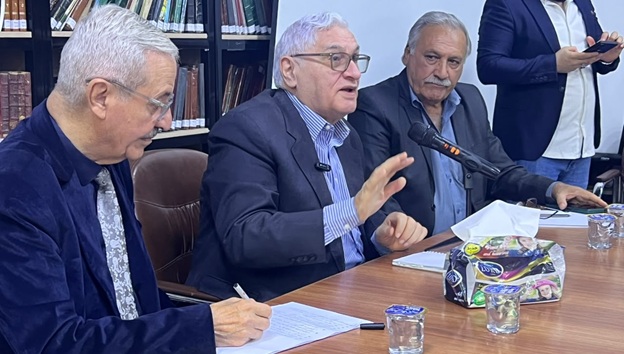
On 16 November, the ICP's Kadhimiya organisation, part of its Karkh district organisation in Baghdad, held a political seminar at the Kadhimiya Public Library featuring Raed Fahmi, Secretary of the party's Central Committee.
Fahmi discussed the effects of the economic crisis on workers, public employees and low-income groups. He addressed difficulties in exporting oil, the consequences of disruptions around the Strait of Hormuz, the question of bringing weapons under state control and fluctuations in the exchange rate of the Iraqi dinar against the US dollar. He highlighted rising food and consumer prices, concerns over the payment of salaries and the government's growing reliance on borrowing to cover budget deficits.
Fahmi also criticised the sectarian power-sharing system, known as muhasasa, which he identified as a fundamental source of recurring political and economic crises. He argued that ordinary people were being made to bear the costs of economic difficulties while the political arrangements protecting established privileges remained unchanged. Referring to growing protest activity in several provinces, he called for comprehensive change to the existing system rather than measures that merely manage its consequences.
Political seminar in Erbil examines Kurdistan's institutional deadlock
On 14 November, the ICP's Erbil organisation hosted Hoger Chto, a member of the Political Bureau of the Kurdistan Communist Party-Iraq, for a seminar on political developments in the Kurdistan Region and the wider area.
Chto discussed a recent meeting of communist and left-wing parties in Kurdistan, the failure to form a regional government despite two years having passed since the elections, and disagreements between the federal government in Baghdad and the Kurdistan Regional Government. The discussion addressed the obstacles to restoring the functioning of regional institutions and the consequences of continuing political divisions.