
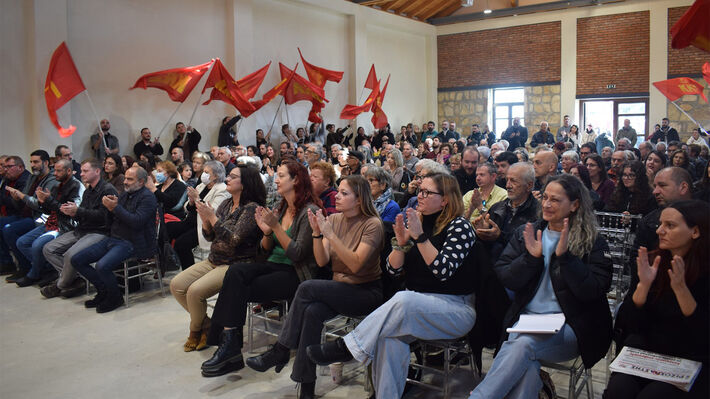
The Communist Party of Greece (KKE) held a political event in Alexandroupoli on 18 October, bringing together representatives of the KKE and the Communist Party of Turkey (TKP) to promote friendship and joint struggle between Greek and Turkish workers against exploitation, imperialist rivalries and war.
Image
KKE and TKP in Alexandroupoli call for joint struggle against imperialism, nationalism and war
KKE and TKP call for Greek-Turkish peoples’ common struggle against war
Organised by the KKE’s Regional Organisation of Eastern Macedonia and Thrace, the event took place at Warehouse 1 in the port of Alexandroupoli, Under the slogan “We respond to exploitation, capitalist rivalries and war with friendship and the common struggle of the peoples. Socialism is the real way out for the peoples!”, the speakers addressed tensions between Greece and Turkey, competition over energy and transport routes, NATO’s role in the region and the political responsibilities of communists on both sides of the Aegean.
The event opened with remarks by Vangelis Evangelopoulos, secretary of the KKE’s Evros Sectoral Committee, who highlighted the intensifying US-China rivalry, the escalation of conflicts in Ukraine and the Middle East, and preparations for a wider military confrontation. He argued that workers were being asked to bear the costs through sacrifices in wages, pensions, healthcare and education, while facing the danger of being drawn into wars and displacement. He contrasted the interests of business groups seeking to turn Greece and Turkey into energy and military hubs with those of workers seeking peace and better living conditions. Referring to the Turkish poet Nâzım Hikmet’s 1952 letter to the Greek people, he spoke of “two Greeces and two Turkeys”: one representing business interests, exploitation and military preparations, and the other representing workers, friendship and common struggle.
KKE: Energy competition and military infrastructure serve business interests
Eliseos Vagenas, member of the KKE Central Committee and head of its International Relations Section, examined the causes of Greek-Turkish tensions, linking them to competition over energy resources, transport corridors and the geopolitical position of the two countries’ ruling classes.
Vagenas addressed disputes over maritime zones, marine parks and the Greece-Cyprus-Israel electricity interconnection, as well as Turkish claims challenging Greek sovereignty over islands and their sovereign rights. He argued that these disputes were connected to competition over the exploitation of regional resources for the benefit of capitalist businesses and foreign monopolies. He also pointed to the deterioration of Turkish-Israeli relations and the strengthening of political, military and economic ties between Greece and Israel as factors shaping regional rivalries.
Particular attention was given to Alexandroupoli’s role in the planned Vertical Corridor, intended to transport US liquefied natural gas to the Balkans and Eastern and Central Europe. Vagenas argued that Greece’s efforts to become a major energy transit hub competed with Turkey’s own ambitions. He questioned what ordinary people gained from these infrastructure projects, asking whether they resulted in cheaper gas, electricity or transported goods.
Citing the joint statement of the KKE and TKP, he stressed that workers and capital did not share the same interests. In his account, workers in both countries faced the consequences of military preparations and the possibility of being drawn into conflicts fought for business profits and the interests of monopolies.
Vagenas also challenged appeals for “national unity” and geopolitical upgrading, arguing that they demanded the subordination of popular needs to the priorities of capital. He contrasted working-class internationalism with both nationalism and what he described as the internationalism of capital, maintaining that genuine patriotism should be based on workers’ and popular interests.
Turning to military spending, he cited the example of France selling Rafale fighter aircraft to Greece while also selling missiles to Turkey capable of shooting them down. He argued that costly arms programmes and attempts to impose political outcomes through military strength increased the danger of armed confrontation.
Vagenas reiterated the KKE and TKP’s position against changing existing borders and the treaties that define them. Their common demands, he said, included ending involvement in imperialist wars and military plans, withdrawing armed forces from missions abroad, leaving NATO and the European Union, and removing US and NATO bases, including those in Alexandroupoli. He also expressed solidarity with the Palestinian and Cuban peoples and called for stronger coordination between the two communist parties in the struggle for socialism.
TKP: Turkish foreign policy, NATO and regional alliances
Murat Akad, a member of the TKP Party Council, focused on Turkey’s foreign policy and the relationship between the country’s regional ambitions and the interests of Turkish capital.
Akad argued that the Turkish government’s diplomatic manoeuvres sought to expand the reach of Turkish capital and improve its position within the international imperialist system. He linked the concept of “neo-Ottomanism” to efforts to establish new spheres of influence and expand economic and political power.
He also described NATO membership as a fundamental pillar of Turkish capitalism since 1952, rather than simply a military commitment. Referring to NATO bases, military systems and US nuclear weapons stationed in Turkey, he warned that these arrangements could expose the population to the consequences of wars and regional conflicts.
Akad also discussed the security agreement involving Saudi Arabia, Pakistan and Turkey, known as the “Mecca Agreement”. He argued that it served wider imperialist interests and could facilitate Turkey’s deeper involvement in the war against Yemen and other regional conflicts.
Another central issue was the contradiction between the Turkish government’s public support for Palestine and the continuation of economic links with Israel. Akad pointed to the flow of Azerbaijani oil through Turkey’s Ceyhan port to Israel, using the example to question the consistency of Ankara’s declared position on Palestine.
Greek-Turkish tensions and the interests of outside powers
Addressing relations between Greece and Turkey directly, Akad argued that the competing ambitions of the two countries’ ruling classes fuelled new rivalries. In his assessment, tensions between the two NATO members also served the interests of the United States, NATO and the European Union by creating opportunities to discipline and constrain their regional policies.
He maintained that nationalism was used to rally workers behind state and business interests while obscuring class divisions. He also linked the strengthening of Greek-Israeli relations, tensions between Turkey and Israel, and the rapid increase in military expenditure in both countries to the broader regional competition.
Akad argued that the struggle for peace must go beyond calls for a multipolar international order. Changes in the balance of power among capitalist states, he said, could not guarantee peace while the capitalist system and the exploitation underpinning imperialist rivalry remained in place.
He therefore called for an explicitly anti-capitalist and anti-imperialist movement that exposed the class interests behind international conflicts. He said that organised and conscious working-class action was the essential guarantee of peace.
Concluding his speech, Akad emphasised the responsibility of Greek and Turkish communists to strengthen cooperation between their parties and their respective working classes. He declared that the KKE and TKP would continue to stand together in the struggle against imperialism and for peace on both sides of the Aegean, ending with calls for the brotherhood of peoples and opposition to imperialism.
The event concluded amid applause, raised flags and slogans, including “In Greece and Turkey, the enemy is the same; imperialism is not invincible” and “Alexandroupoli, a port for the peoples, not a launching pad for the imperialists.”
The meeting highlighted the KKE and TKP’s shared position that peace between Greece and Turkey cannot be separated from opposition to nationalism, military escalation and the economic interests driving regional competition. Both parties presented internationalist working-class cooperation and the struggle for socialism as their proposed alternative to the existing geopolitical order.