
KKE General Secretary Dimitris Koutsoubas called for a strengthening of the Communist Party of Greece (KKE) and a “popular counterattack” against the policies of the New Democracy government, capitalism, the EU and NATO.
KKE calls for “counterattack” against government policies
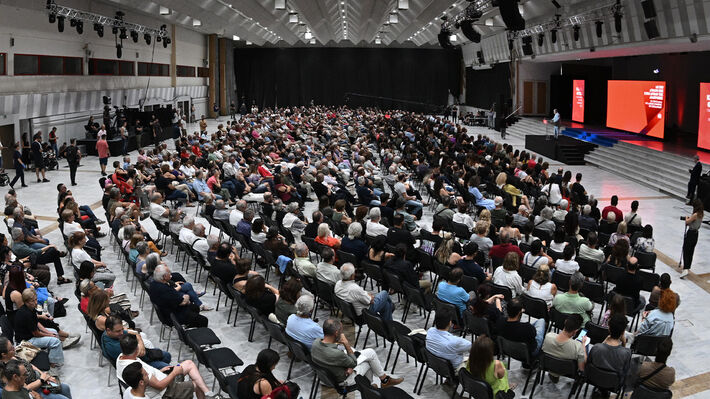
Speaking at a major KKE event at the Vellideio Conference Center in Thessaloniki during the Thessaloniki International Fair (TIF), Koutsoumbas argued that the government’s economic programme offered no fundamental solution to workers’ and popular needs and that the country’s economic growth had benefited capital rather than the majority of the population.
The event was attended by large numbers of workers, trade unionists, farmers, self-employed people, academics and young people. Koutsoumbas presented the KKE as the political force capable of challenging what he described as a common anti-popular framework shared by New Democracy and the opposition parties, particularly PASOK and the political forces associated with former prime minister Alexis Tsipras.
Criticism of the government’s economic programme
Koutsoumbas rejected Prime Minister Kyriakos Mitsotakis’s presentation of the government’s economic measures as a “growth dividend”. He argued that the €2.2 billion package announced by the government was insignificant when compared with annual tax revenues exceeding €74 billion, most of which, according to him, came from working people.
He maintained that workers, pensioners and small self-employed professionals were being asked to accept the erosion of rights and incomes accumulated over the previous 15 years. Among the losses he highlighted were collective bargaining rights, the 13th and 14th salaries and pensions, the €12,000 tax-free threshold for the self-employed, and purchasing power lost through inflation.
According to Koutsoumbas, the government’s measures for pensioners, farmers and small businesses amounted to limited concessions while leaving the underlying taxation and economic framework unchanged. He also criticised tax exemptions for banks, shipowners and what he described as “strategic investors”.
“The pie has grown, but the people have become poorer”
A central theme of the speech was Koutsoumbas’s rejection of the argument that economic growth and increased corporate profitability would eventually improve living standards.
He cited increases in GDP, state primary surpluses and corporate profits as evidence that the Greek economy had already expanded significantly. He pointed in particular to the increase in the net profits of companies listed on the Athens Stock Exchange and the substantial profits recorded by the major banks, energy companies, refineries, construction groups and other sectors.
At the same time, he argued, workers had experienced declining purchasing power, while average pensions remained low and indirect taxation had increased. Koutsoumbas therefore presented the distribution of the benefits of growth—not the absence of growth itself—as the fundamental problem.
He argued that this was not a temporary failure of Greece’s economic model but an inherent feature of capitalism. In his view, investment is directed towards sectors offering the highest returns rather than towards meeting social needs. He cited tourism and real estate as examples and warned that a slowdown in the Greek economy and growing signs of a new international crisis of capital overaccumulation could further expose these contradictions.
Attack on the EU and the government’s foreign and military policy
Koutsoumbas also linked domestic economic policy to Greece’s membership of the European Union. He argued that successive governments had accepted EU fiscal rules, expenditure ceilings and policies that prevented state surpluses from being redirected towards social needs.
He criticised EU policies concerning labour flexibility, the Common Agricultural Policy, energy markets and the commercialisation of housing, healthcare and education. The KKE leader also attacked the government’s policy of deeper integration into the EU and NATO, arguing that the EU should not be presented as synonymous with prosperity or social progress.
A major part of the speech focused on military spending and Greece’s strategic relationship with Israel. Koutsoumbas strongly criticised the planned €3.5 billion “Achilles Shield” defence system, arguing that Greek public resources were being used to benefit Israeli and other arms industries while drawing Greece deeper into regional military conflicts.
He similarly criticised NATO membership, the presence of US military bases in Greece, military cooperation with Saudi Arabia and the government’s strategic alliance with Israel. He argued that successive governments had presented these policies as measures to “protect” Greece, while in reality they increased the country’s involvement in international and regional rivalries.
Koutsoumbas presents the KKE as an alternative to the existing political system
Koutsoumbas argued that the main political parties shared fundamental commitments to the interests of capital, the EU and the existing economic framework despite their differences. He rejected the idea that the population simply had to choose the most competent or honest government within this framework.
He presented the KKE's political proposal as an alternative based on workers’ and popular power. According to Koutsoumbas, the central political divide was between the interests of workers and those of capital, which he described as two fundamentally opposing social interests.
He argued that a genuinely realistic programme should be based not on what is compatible with capitalist profitability but on Greece’s existing scientific, technological and productive capabilities and on the satisfaction of social needs.
KKE programme for workers’ and popular needs
Koutsoumbas outlined the KKE’s programme for what he described as a socialist organisation of the economy. Key productive sectors and resources—including energy, telecommunications, transport, industry, mineral wealth, trade and large-scale agricultural enterprises—would become socially owned and subject to central economic planning.
Alongside socialised production, he proposed the development of agricultural cooperatives. The stated objective would be to organise production around social needs rather than profit and to guarantee employment and improved working conditions.
Among the specific social measures he advocated were:
- A seven-hour, five-day, 35-hour working week.
- Expanded public and free healthcare, with the abolition of private business activity in healthcare.
- Increased state funding and permanent recruitment in health services.
- A free, unified public education system without class barriers.
- More teachers and support staff and smaller classes.
- Affordable and safe housing treated as a social right rather than a commodity.
- Protection of primary residences from auctions and the abolition of ENFIA.
- Expanded student housing.
- Guaranteed agricultural prices and lower production costs for farmers.
- Full compensation for losses caused by natural disasters and animal diseases.
- Measures to address gender inequality and provide social support for families, children and the elderly.
Koutsoumbas argued that such measures were possible because modern society possessed the necessary scientific and technological resources, but that these resources were currently subordinated to private profit.
Thessaloniki and local demands
The KKE leader also addressed problems specific to Thessaloniki and Central Macedonia. He criticised the government’s development policies for the region, arguing that investment and infrastructure projects were being pursued primarily according to the interests of business groups.
The KKE called for increased investment in flood prevention, forest protection and firefighting, stronger measures against industrial pollution, expanded green and recreational spaces, and free sports and cultural facilities.
On transport, Koutsoumbas called for the completion and extension of the Thessaloniki Metro to western parts of the city, permanent employment for contracted OASTH drivers, more frequent services and improved connections between western Thessaloniki, the city centre, railway station, industrial areas and universities.
Elections and the strengthening of the KKE
Koutsoumbas concluded by arguing that a stronger KKE in the next parliamentary elections would strengthen the broader workers’ and popular movement rather than simply contribute to the formation of another government.
He said that political instability or difficulties in forming stable governments should not frighten voters. Instead, he presented them as opportunities for the popular movement to alter the balance of forces and obstruct anti-popular policies.
He portrayed the KKE as an independent political force without commitments to the existing system and argued that its electoral strength remained within the party rather than being transferred to other political forces.
The central message of the speech was therefore a call for a stronger KKE, increased mobilisation around workers’ and popular demands, opposition to Greece’s involvement in NATO and EU policies, and ultimately a transition towards workers’ and popular power and socialism.
(Photo: 902.gr)