
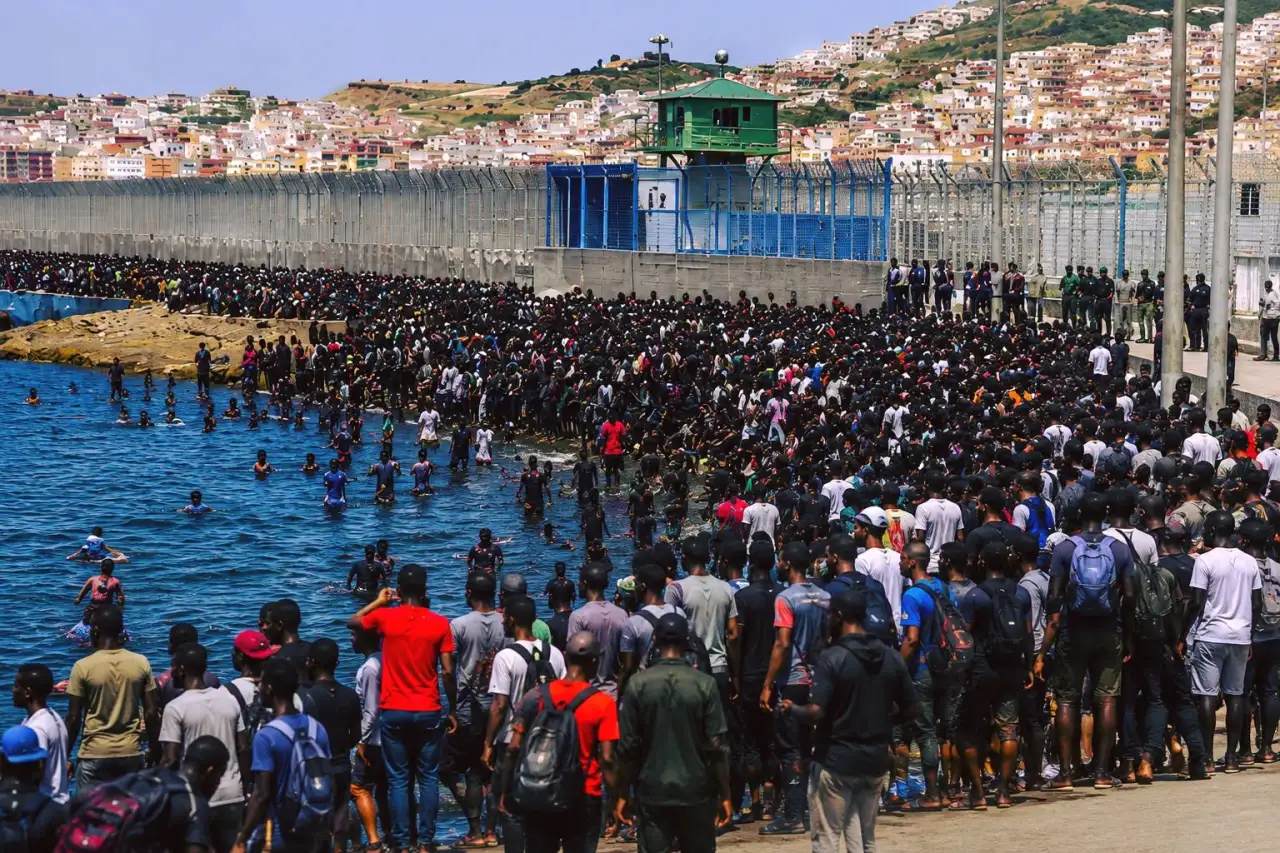
With a question submitted to the European Commission by the Party's MEP, Kostas Papadakis, the Communist Party of Greece (KKE) Europarliamentary Group highlighted the responsibilities of the EU, as well as the social democratic government of Spain, for yet another hecatomb of refugee and immigrant victims.
KKE Europarliamentary Group on massacre in Ceuta
According to 902.gr, Papadakis stated that the Spanish government had once again received praise from all EU governments—whether social democratic, liberal or far-right—during a recent video conference of interior ministers. He argued that, following the Melilla massacre, the Spanish government was now being praised for the deaths of 99 uprooted people and the disappearance of dozens more in the Spanish enclave of Ceuta.
Papadakis stated that thousands of refugees and immigrants, driven from their countries by imperialist interventions, poverty and exploitation, had been subjected to the repression of the social democratic government of Pedro Sánchez. He described this as further evidence that there could be no “progressive” management of the EU’s Migration and Asylum Pact or of the EU’s broader reactionary immigration policy. According to him, these policies were being implemented through deaths, mass pushbacks and expulsions, while also creating a supply of cheap labour for capital. He pointed to the use of water cannons and floating barriers by the deployed army and to mass pushbacks carried out without basic reception and accommodation procedures, asylum examinations or adequate measures to protect unaccompanied minors.
He further stated that refugees and immigrants were once again being instrumentalized for geopolitical and other purposes amid intense competition between the EU and NATO and other imperialist centres, as well as conflicts within the EU itself. He cited the lifting and reinstatement of Schengen arrangements between Spain and Italy as an example of these antagonisms.
Papadakis argued that, regardless of their political orientation, bourgeois governments followed a common strategy combining harsh repression with competition to secure the cheap labour required by capital. He noted that both the social democratic government in Spain and Italy’s far-right government had arranged for residence permits to be granted to around half a million immigrants, despite their geopolitical differences, in order to provide cheap labour for major employers.
Regarding Greece, Papadakis stated that the New Democracy government’s proposals to legally institutionalize practices already seen in Ceuta, Evros in 2020, and in the Baltic countries and Poland in 2021—including the military treatment of refugees and immigrants as “invaders” and their immediate deportation without asylum procedures—revealed dangerous plans. He warned that, amid preparations for war, such policies could potentially lead to the complete abolition of the right to asylum under certain conditions.
He also criticized Greece’s social democratic parties, arguing that they sought to present the EU and its Migration and Asylum Pact in a favourable light by portraying massacres, repression and deportation centres as deviations from EU policy rather than as expressions of the policy itself. At the same time, he accused these parties of endorsing exploitative labour conditions for those who manage to escape repression at Europe’s borders.
Based on the above, the KKE MEP submitted the following questions:
"What is the European Commission's position:
-The fact that the Spanish government proceeded with repression with deaths and disappearances and immediate mass deportations of refugees and migrants, with the full support of EU institutions and governments, without prior asylum examination and other elementary reception procedures, in violation of the Geneva Convention on Refugees?
-In the unacceptable proposal of the New Democracy government to essentially completely abolish the right to asylum, citing another case of "emergency" from a mass movement of refugees and immigrants that could be defined as a "hybrid attack"?
-What exactly do the measures announced by the Commission include, to further "increase the powers" of the Frontex and Europol repressive mechanisms at the borders, given that a generalized filing regime is already applied within the Schengen framework, which is sometimes reinforced by government decisions with additional border controls, violating the rights of peoples as well as refugees and immigrants?