
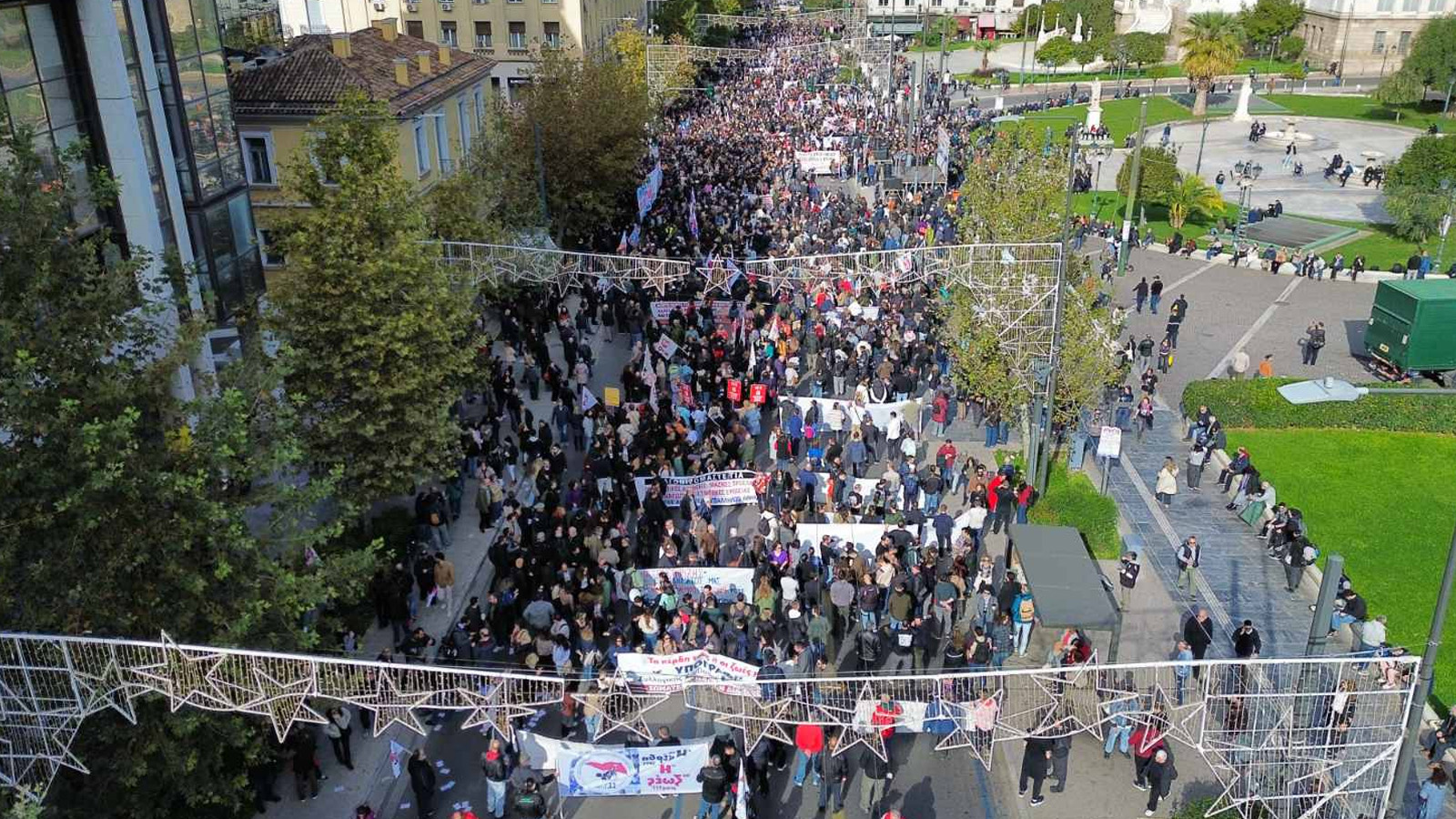
Tens of thousands of workers and demonstrators took to the streets across Greece on 25 November in a nationwide general strike against low wages, the rising cost of living, attacks on labour rights and the government's involvement in military preparations.
KKE taking lead as nationwide strike brings workers, farmers and youth into streets in Greece, against war spending and austerity
Under the slogan “Give money for wages, pensions, housing, healthcare and education—not for the slaughterhouses of war,” the mobilisation brought together workers from the public and private sectors, farmers, self-employed professionals, students and school pupils.
The strike was organised through a broad network of trade unions, with the participation of 31 Labour Centres, 16 sectoral federations and hundreds of first-level unions, according to the Communist Party of Greece (KKE) and its daily newspaper Rizospastis. The Civil Servants' Confederation (ADEDY) had called a 24-hour strike across the public sector, while numerous unions and labour centres organised action in the private sector. The KKE and the All-Workers Militant Front (PAME) played an active role in building the mobilisation.
Massive demonstrations in Athens and across the country
In Athens, tens of thousands of workers from public and private-sector workplaces filled the city centre, marching under banners demanding higher wages and pensions, collective labour agreements, shorter working hours and measures against the rising cost of living. General Secretary of the KKE Dimitris Koutsoumbas attended the demonstration.
The demands included substantial wage and pension increases, the restoration of the 13th and 14th salaries in the public sector, collective agreements, a seven-hour working day, a five-day working week and a 35-hour working week. Demonstrators also called for protection of household incomes, measures against energy poverty, affordable housing and stronger public healthcare and education.
The mobilisation extended across more than 60 cities. In Thessaloniki, thousands of workers from public and private-sector workplaces marched to the Ministry of Macedonia and Thrace. The demonstrations included a joint procession of student associations, university administrative employees, researchers and teaching staff. Students demanded free education, affordable accommodation and meals, and increased public funding for education rather than NATO military expenditure.
In Piraeus, the port and ship-repair facilities were brought to a standstill. Seafarers, dockworkers, COSCO port workers, metalworkers and shipbuilding and repair workers joined the strike. According to 902.gr, participation among ferry crews was comprehensive, with ships remaining docked. Workers in chemical industries, construction, catering, private healthcare, railways and public services also took part. Work stopped at five major construction sites employing more than 700 workers.
The strike also reached the mining facilities of Skouries in Halkidiki. Workers at Hellas Gold stopped work across the company's installations, including mines and processing plants. Miners gathered outside the Skouries construction site from the early morning to organise strike pickets and symbolically block access roads. Their unions accused the company of seeking to impose nine- and ten-hour shifts and circumvent the existing collective agreement through individual contracts, while demanding that workers bear the costs of the company's pursuit of higher profits.
In Patras, strike pickets were organised in the industrial zone, including at metal-industry workplaces. The mobilisation also highlighted occupational health and safety following the death of a 59-year-old worker at the Akhron Panel factory only days earlier. Workers demanded safety measures, collective agreements and an end to workplace deaths.
Koutsoumbas: The strike heralds a new period of working-class counteroffensive
Speaking at the Athens demonstration, KKE General Secretary Dimitris Koutsoumbas stated that the government's policies were making workers pay the price of ensuring the profitability of major business groups and participating in military plans. He pointed to high prices, heavy taxation, wages remaining at levels comparable to 2009, and what he described as the effective confiscation of pensions and the 13th and 14th salaries in the public sector.
Koutsoumbas stressed that the strike had been organised from below, through the initiative of workers, their unions and associations. He also highlighted the participation of farmers and livestock breeders in rural areas, self-employed professionals, craftspeople and shopkeepers in the cities, as well as young people, university students and school pupils.
He described the mobilisation as a precursor to a new period of revival and counteroffensive by the workers' and popular movement, coordinated with movements in other European countries and internationally.
Against the military budget and the policy of sacrifices
The KKE and the unions involved in the mobilisation connected workers' economic demands with opposition to Greece's participation in imperialist military plans. Their argument is that public resources are being directed towards military expenditure and the country's international commitments while workers face stagnant wages, inadequate public services and growing difficulties in meeting basic needs.
The slogan of the strike expressed this connection directly: public money should be directed towards wages, pensions, housing, healthcare and education rather than military preparations and war.
The mobilisation is also part of the unions' opposition to the government's economic priorities and the 2027 state budget, which the KKE describes as a budget serving business profitability and military preparations at the expense of popular needs.
Following the strike, the organisers announced a new demonstration against the military budget on 15 December at Syntagma Square in Athens. The KKE and PAME called for the momentum of the strike to be carried into workplaces, factories, construction sites, offices and shops, strengthening trade unions and coordinating struggles with farmers, self-employed people and young people.
(Photo: 902.gr)