
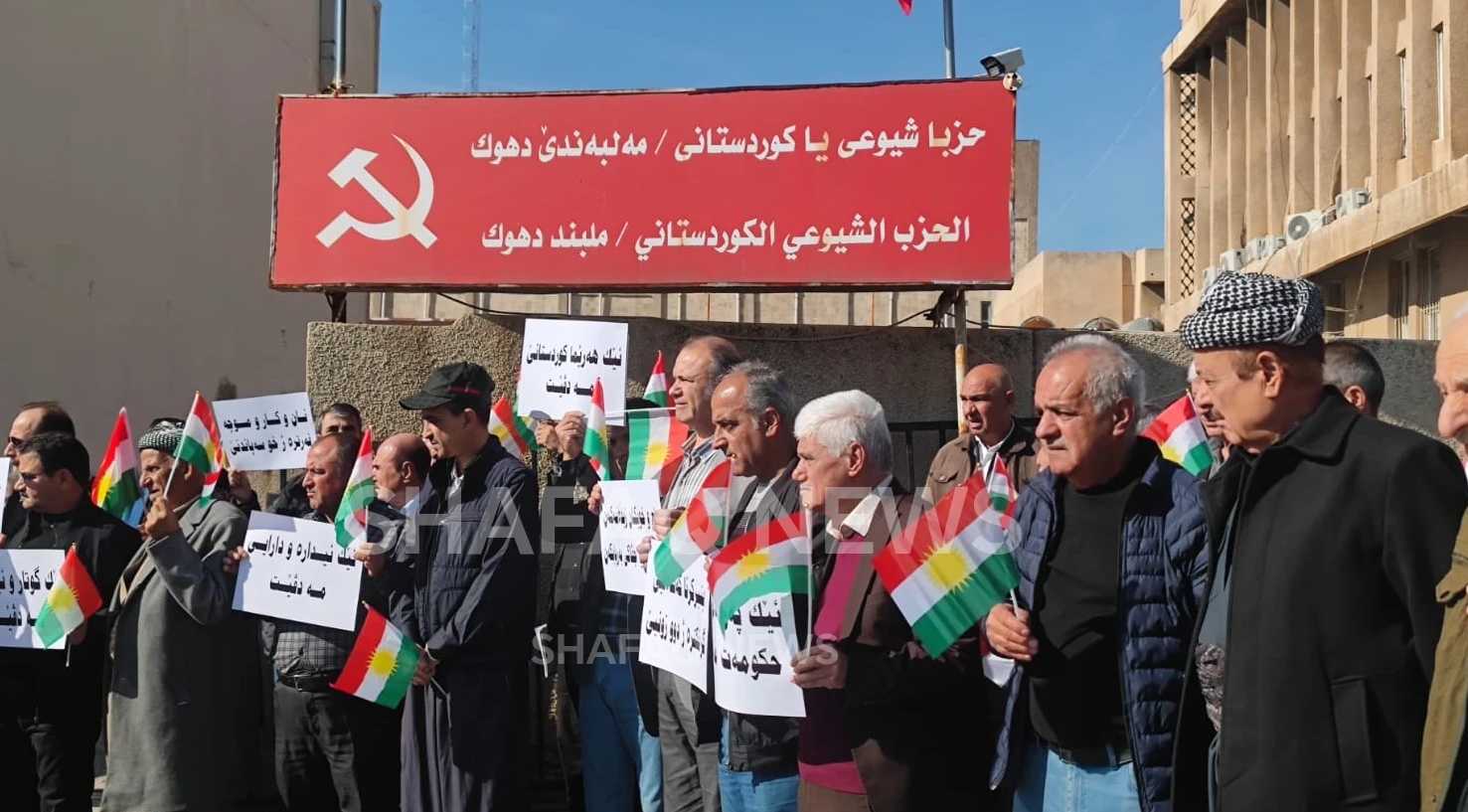
The Kurdistan Communist Party-Iraq (KCP) organised demonstrations in several cities and towns across the Kurdistan Region on 14 November under the slogan “We Want a United Region”, calling for an end to the political divisions between the Kurdistan Democratic Party (KDP) and the Patriotic Union of Kurdistan (PUK).
Kurdistan Communist Party-Iraq mobilises against political division in Kurdistan region
The party warned that the escalating confrontation between the two dominant political forces could lead to a return to separate administrations, further weakening regional institutions and worsening the conditions of the population.
The demonstrations followed a call issued by the KCP Political Bureau on 12 November, which urged citizens, political organisations and civil society groups to defend the unity of the Kurdistan Region. The party argued that the political deadlock had reached a dangerous stage and that popular pressure was necessary to prevent further fragmentation.
In Sulaymaniyah, KCP official Hassan Mahmoud addressed the political crisis, criticising the prolonged failure of the KDP and PUK to form a new regional government and resume the normal functioning of parliament. He argued that the two parties had reinforced administrative, financial and security divisions through their political arrangements, while the population continued to face deteriorating living conditions.
In Duhok, dozens of party supporters demonstrated outside the KCP's provincial headquarters. Local party official Rebar Amedi warned that the rivalry between the two major parties had reached a dangerous stage and was exposing the Kurdistan Region to external pressure and interference. Similar gatherings were reported in Zakho, Bamdri and other parts of Badinan.
The KCP's demands went beyond an appeal for political reconciliation. The party called for the unification of the Peshmerga forces, security agencies, public finances and regional administration under common institutions. It also raised demands concerning employment, reliable electricity, education and healthcare, arguing that the concentration of wealth and influence among a limited political circle had come at the expense of the population.
The demonstrations took place amid a deepening dispute over the functioning of the Kurdistan Parliament. On 4 November, parliament reconvened and elected a new speaker despite a boycott by the PUK and several opposition forces. The PUK rejected the proceedings and warned that it could establish parallel institutions in areas under its control if the KDP proceeded unilaterally with forming a new government. The KCP's protests sought to oppose precisely this prospect of renewed administrative division.
The party continued its intervention after the demonstrations. On 20 November, KCP Political Bureau member Subhi Mahdi called for negotiations between the KDP and PUK and for the participation of all political forces represented in the regional parliament. The party argued that the political deadlock could not be resolved through unilateral decisions or the exclusion of other forces. It called on the two dominant parties to reduce their demands and place the interests of the population above partisan calculations.
The KCP also maintained that the restoration of parliamentary activity should be accompanied by an agreement that allows all elected political forces to participate. It opposed any arrangement that would institutionalise a division between the Erbil-Duhok and Sulaymaniyah areas.
The KCP's position was also discussed at a political seminar organised by the Erbil organisation of the Iraqi Communist Party on 14 November. Hoger Chto, a member of the KCP Political Bureau, spoke about the political situation in the Kurdistan Region, the failure to form a new regional government more than two years after the parliamentary elections, and disagreements between Baghdad and the Kurdistan Regional Government. The meeting also addressed cooperation among communist and left-wing parties in Kurdistan.
Through its demonstrations and subsequent political interventions, the KCP has sought to make the defence of the Kurdistan Region's institutional unity a popular issue, connecting it with demands for public services, employment and democratic participation. Its criticism has been directed at the political arrangements maintained by both the KDP and PUK, which it holds responsible for perpetuating administrative fragmentation and placing partisan interests above the needs of the population.
(Photo: Shafaq News)