

The Portuguese Communist Party (PCP) has condemned police operations against housing-rights protesters in Lisbon and Porto, demanding political accountability and an urgent parliamentary debate on the government’s handling of the demonstrations.
Image
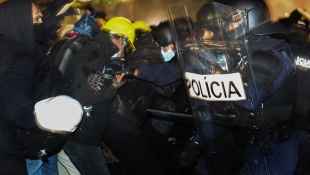
Portuguese Communist Party condemns police brutality on protestors demanding housing rights
PCP condemns police repression of housing protests and demands urgent parliamentary debate
The party states that the authorities are responding to the housing crisis by restricting the right to protest rather than addressing the conditions that have driven people onto the streets.
The events followed a major demonstration on Saturday, 31 October, in Lisbon, where thousands of people marched against the government’s proposed changes to rental legislation. Protesters argue that the bill would make evictions easier and weaken protections for tenants, aggravating an already severe housing crisis. After the demonstration, participants set up more than 50 tents in Rossio Square. A smaller encampment was also established in Porto.
In the early hours of Sunday, 1 November, police moved into the two squares to dismantle the encampments. In Lisbon, officers, some accompanied by police dogs, cleared the tents and dispersed protesters who had gathered around them. Police also removed the camp in Porto. The operations followed warnings that the tents would be dismantled. The police response drew criticism from opposition representatives and renewed debate over the right to peaceful assembly and protest.
In its statement of 1 November, entitled “Housing Requires a Solution, Not Repression”, the PCP described the police intervention as part of a broader government offensive against workers’ and popular rights. It connected the housing crisis with rising living costs, low wages and pensions, the weakening of public services and the dismantling of the social functions of the state.
The party argued that the housing struggle had intensified in recent weeks because the government was introducing measures that would worsen, rather than resolve, the problem. It accused the PSD/CDS government, with the support of Chega and Iniciativa Liberal (IL), of seeking to restrict civil liberties, particularly the freedom of demonstration.
According to the PCP, the government had adopted an excessively restrictive interpretation of the law, contrary to constitutional guarantees and established practice, and had given the police instructions that resulted in repression. The party insisted that “it is not indignation and protest that are illegitimate”, but rather government actions that, in its assessment, violate the law, the Constitution and the democratic achievements of the April Revolution.
The PCP also pointed to a statement by a public prosecutor indicating that placing tents in public squares did not in itself constitute an illegal act or offence. Against this background, it described the police intervention as disproportionate and violent and called for a full investigation into the political responsibilities behind the operation.
The party’s parliamentary group acted on the same day, requesting that the President of the Assembly of the Republic convene a Conference of Leaders to arrange an urgent plenary debate on police conduct during the early hours of 1 November in Lisbon and Porto. The PCP argued that Parliament could not remain indifferent while citizens were being repressed for peacefully demanding the fulfilment of the constitutional right to housing.
The parliamentary initiative was taken despite the ongoing detailed examination of the 2027 State Budget. The PCP maintained that the Assembly must exercise its responsibility to scrutinise government activity, particularly in response to events generating widespread public indignation.
On 2 November, Parliamentary Speaker José Pedro Aguiar-Branco asked the parliamentary parties to indicate within 24 hours whether they would agree to an exceptional change in the parliamentary timetable to allow the urgent debate. The Speaker said that such a change required consensus among all parties represented in the Conference of Leaders. The request therefore remained subject to the other parliamentary groups’ agreement.
The PCP has also called for the expansion of the housing-rights movement and announced two further dates for mobilisation: actions for the right to housing on 14 November and a nationwide demonstration organised by the CGTP-IN trade-union confederation on 21 November. The party presented these mobilisations as important opportunities to demand the implementation of constitutional rights, including the right to demonstrate, and to advance an alternative direction for the country.