
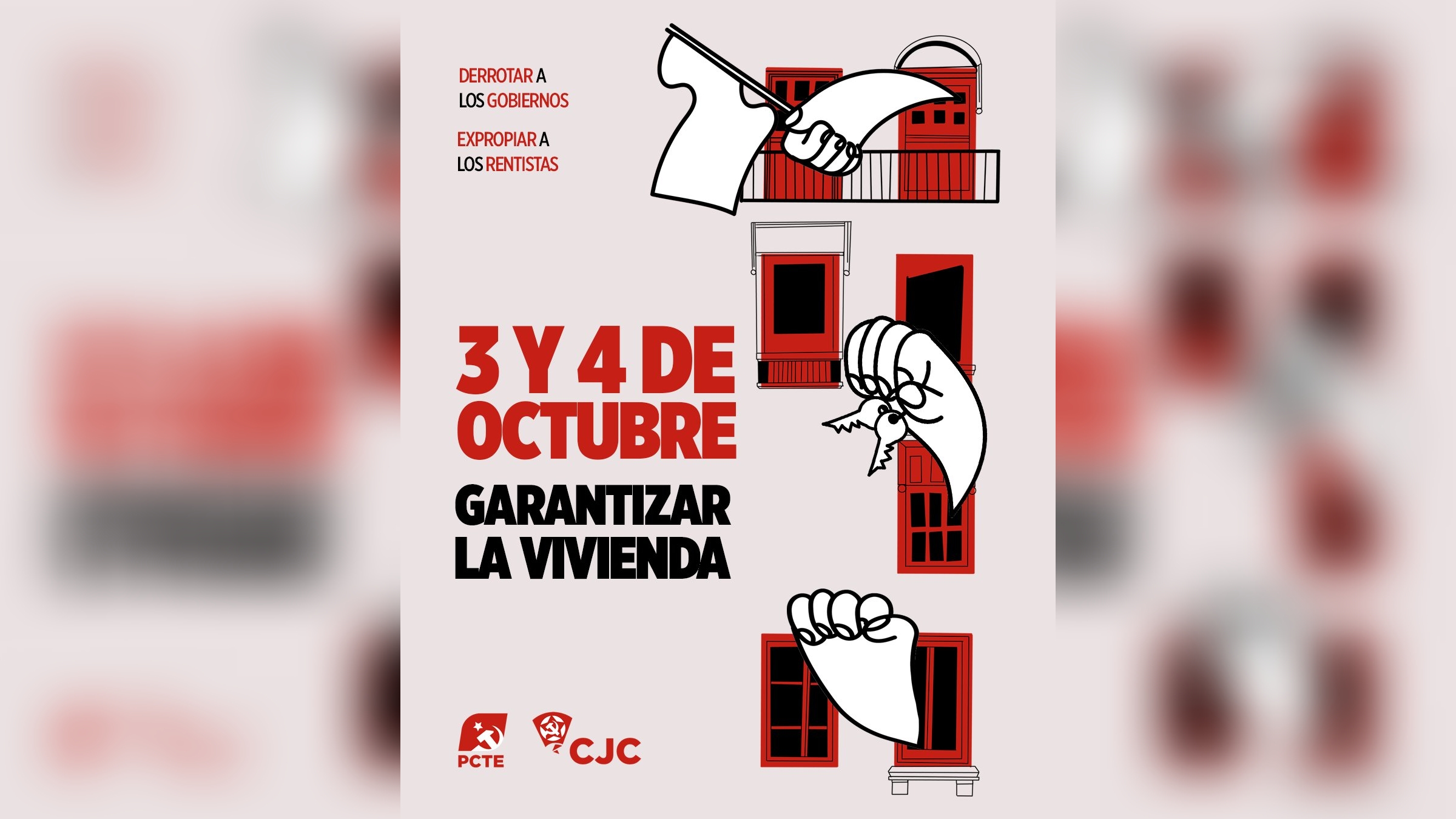

The Communist Party of the Workers of Spain (PCTE) issued a press release and assessed the mobilisations taking place across Spain for rights to housing. The mobilisations started after an 87 year-old woman was evicted. The Party called for further mobilisations on 3-4 October: "Once again, organization and struggle prove to be the most powerful tool: they serve to wrest victories and to assert our interests."
PCTE celebrates mobilisations for right to housing
The PCTE celebrates the breadth and forcefulness of the mobilizations for the right to housing that are taking place throughout the country, and particularly in the Puerta del Sol, following the eviction of Maricarmen.
The coalition government has been forced, solely and exclusively due to popular pressure in the streets, to approve two Royal Decrees to urgently adopt several measures, while the unstoppable increase in rental and purchase prices and the threat of eviction make it increasingly difficult for millions of workers to access housing.
Once again, organization and struggle prove to be the most powerful tools: they serve to win victories, they serve to impose our interests. The lesson we must learn as the working class is to deepen our commitment along this path. For some time now, the number of strikes and mobilizations by different labor groups in Spain has been steadily increasing, and the task now must be to strengthen the unified perspective: organizational unity and programmatic unity.
Not only in the streets, but in every workplace and neighborhood. The example of struggle and social mobilization must be translated into daily action. Starting with workplaces, centers of militancy to guarantee a class-conscious perspective.
This must also increasingly permeate the struggle for housing itself, both in form and content. The immediate struggle for access to housing cannot be directed solely at intervention in the real estate market; the capitalist class constantly undermines the purchasing power of the working majority in pursuit of increased profits, so the struggle for higher wages must occupy a central place in a class struggle for housing.
If the approval of both Royal Decrees is to be attributed solely to popular mobilization, the mostly lukewarm and concessionary content towards rent-seeking, far removed from the emergency and social sentiment, is the responsibility of the coalition government.
Analyzing the information that has emerged so far, the extension of existing contracts, the ban on home purchases by vulture funds until 2028, and the ban on evictions until 2030 are considered small but necessary steps. However, this very timeframe presents a significant limitation: the fact that these measures only extend until 2028 and 2030 demonstrates that the aim is to provide temporary relief, rather than a long-term structural solution that guarantees access to housing.
Of particular note are the tax breaks offered to landlords who rent apartments below market value. With the exorbitant price increases of the last decade, what should be considered "normal" has thus become ingrained in the collective consciousness as a practice to be rewarded.
Granting greater tax benefits to landlords has been a general trend for the past decade, during which social democracy has governed for eight years. The underlying logic of the public subsidy system, whether directed at landlords or passed on to them through tenants, remains the permanent transfer of income from labor into private hands.
Pending a closer look at the fine print, the potential regulations on seasonal rentals should be added to the above. It's worth remembering that both the Housing Law passed in 2023 and the coalition agreement signed between the PSOE and Sumar parties in October of that year exempted seasonal rentals from any regulation—a loophole that landlords have exploited ever since to continue raising prices, as evidenced by the explosive growth of this type of rental.
All of the above demonstrates the inability of any capitalist government to actively and effectively intervene in the housing market to ensure access for the entire population. Ultimately, the underlying problem is the commodification of housing.
Challenging and ending this commodity status requires the rearticulation of a workers' opposition to capital that is not subject to other political agendas or the interests of other social classes, nor limited by the margins of possibility of the system or the State.
A workers' opposition that, while fighting to demand concrete measures within capitalism, proposes overcoming this mode of production and building a society where housing can truly be an essential right.
PCTE Press Office
September 29, 2026