
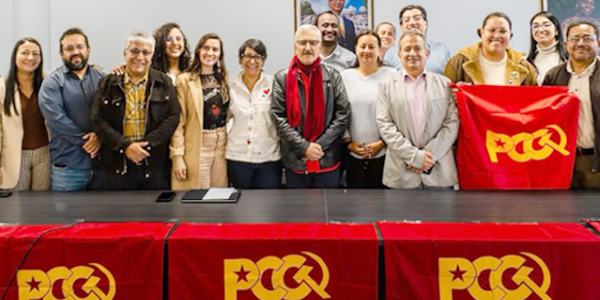
On August 5, the Comprehensive Collective Reparation Plan (PIRC) of the Colombian Communist Party was approved. For the first time, under Law 1448 of 2011, a political party was recognized as a subject of collective reparation at the national level, as it was one of the political entities that suffered the highest number of deaths, along with the Patriotic Union, during the political persecution and violence that plagued the country.
Plan for Collective Reparation of Colombian Communist Party approved
According to Valentina Bolaño Senior from Semanario Voz, reaching this point took months of work and negotiation. The process consisted of four phases that allowed them to build their case and establish the damage that the violence inflicted on their organization, their activism, and their political project.
“These moments were: first, identification; second, enlistment; third, the diagnosis of the damage, which is, in my opinion, the most important phase; and, finally, the design and formulation of the Comprehensive Collective Reparation Plan,” Jorge Amaury Gómez, deputy director of Collective Reparation at the Victims Unit, told VOZ.
The final phase was approved on August 5th, and it includes: “the actions established by the State, not the Government, to provide comprehensive reparations to the collective subjects who were victims of the armed conflict,” explained the deputy director.
With the approval now in place, the implementation phase begins, which, for Amaury Gómez, represents the greatest challenge: “As I have stated, these measures are not the Government's, nor do they depend on the Government's will; rather, they are State measures. This means that there is a legal and constitutional obligation to implement these actions.”
Given this, the Communist Party needs to remain active and organized to continue demanding and diligently monitoring the implementation of the actions outlined in the PIRC: “The implementation of these measures is the real possibility of aspiring to comprehensive reparation for the individual, which, as we have said, is very important for Colombian society,” Gómez continued.
The victims in the center
In the midst of this process, Gómez also highlighted the results achieved during Gustavo Petro's government in terms of individual reparations to victims of the armed conflict.
According to the deputy director, the investment allocated to reparations doubled during this administration compared to previous ones. He stated that these figures demonstrate a budgetary commitment that allowed for an increase in the number of people receiving compensation.
“By the end of this administration, we will have provided administrative compensation to more than 670,000 people. We released these figures during our accountability report, which represent almost 40% of what has been accomplished in 30 years,” concluded Amaury Gómez.
The voice of the PCC
This approval was accompanied by representatives of the Communist Party, such as Jaime Caycedo, president of the Party; Claudia Flórez, general secretary; Sara Klinger, on behalf of the Colombian Communist Youth, and other members of the Central Executive Committee.
It was Flórez who took the floor to acknowledge the significance of the moment. Her speech traced the history of an activism marked by decades of struggle for peace and life. “We receive this moment with the historical depth it deserves. It is not just another ceremonial act; it is an event that challenges the national memory and compels Colombia to look at itself in the mirror of its own history,” said the general secretary.
For the Party, what happened that day could not be understood solely as the approval of an administrative instrument. It was also the acknowledgment of political violence that had consequences for the organization, but which, at the same time, affected Colombian democracy.
“They sought to erase from history a political force that always defended the democratic organization of the people, social justice, and peace. Each assassinated leader represented a lost opportunity for leadership. Each exterminated union member weakened labor rights. Each persecuted peasant further delayed agrarian reform,” Flórez stated.
Behind every reparation measure there are names, families and interrupted life projects; but also a political history that seeks to be recognized.
The truth, essential for repair
For the Colombian Communist Party, acknowledging the harm done cannot be separated from the search for truth. Knowing who was behind the persecution, how it was orchestrated, and how it became a sustained practice against those considered political enemies is part of the reparation process.
“This comprehensive reparation requires definitively dismantling the doctrine of the internal enemy and the elimination of political opponents. It requires guaranteeing that no one in Colombia will ever again be persecuted for their ideas, and it requires that new generations learn this history so that it is never repeated,” stated the general secretary of the Colombian Communist Party.
The recognition came during Gustavo Petro's administration, something Claudia Flórez also highlighted as fundamental to the political significance of the day.