
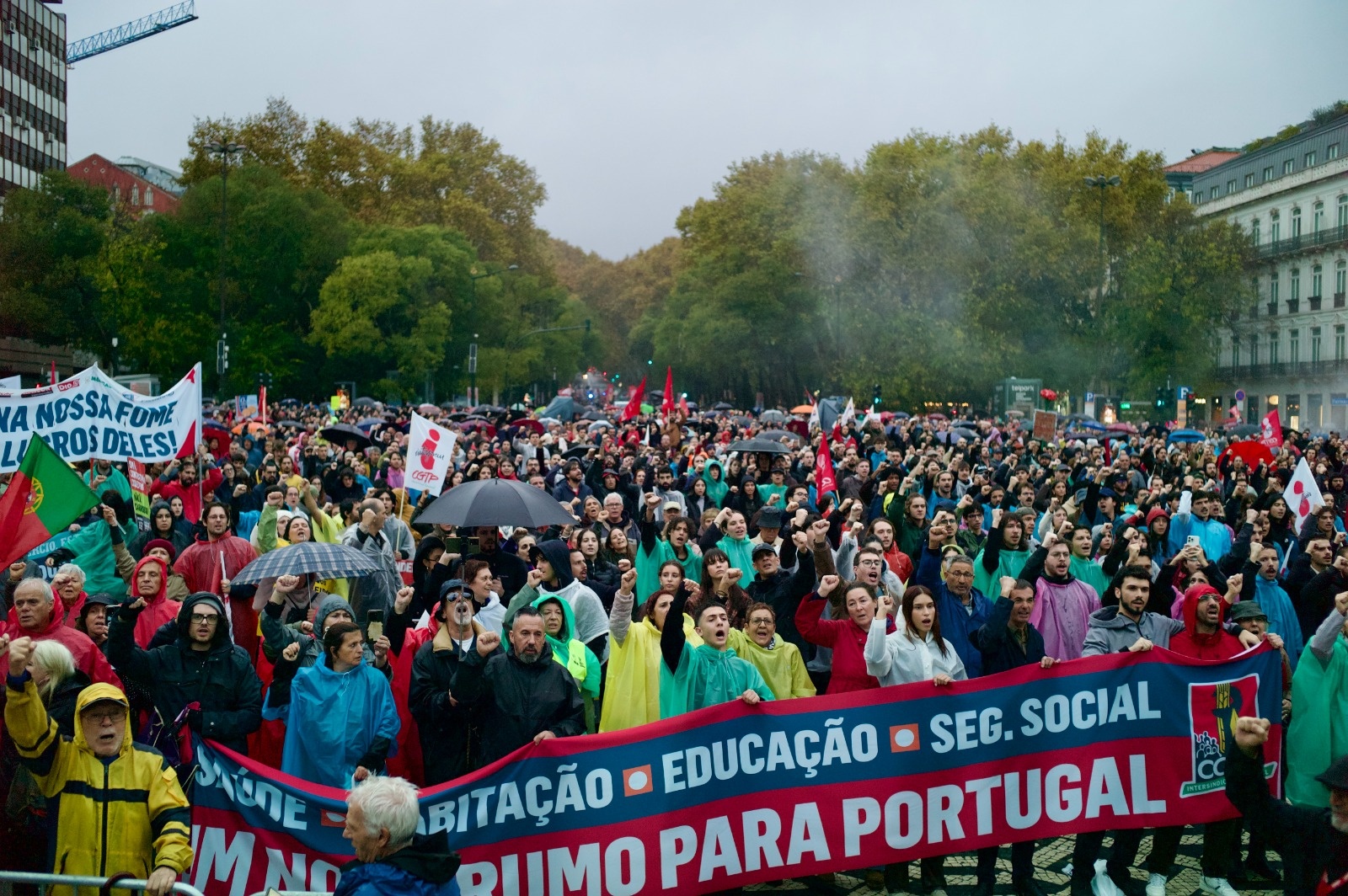

Thousands of workers took to the streets of Lisbon on 21 November in a national demonstration organised by the General Confederation of Portuguese Workers (CGTP-IN), demanding higher wages and pensions, action against the rising cost of living and stronger public services. The Portuguese Communist Party (PCP) supported the mobilisation, with General Secretary Paulo Raimundo joining a party delegation attending in solidarity.
Portuguese Communist Party backs mass trade-union mobilisation for higher wages and pensions
The demonstration, held despite heavy rain, brought together workers from different parts of the country under the slogan “Everyone to Lisbon – Higher wages and better pensions! Against the rising cost of living!”
The march began at Praça Duque de Saldanha at around 14:30 and proceeded along Avenida da Liberdade towards Praça dos Restauradores. According to the CGTP-IN, tens of thousands participated, filling the avenue and the square. The main demands included general increases in wages and pensions, measures to reduce and control the prices of essential goods and services, and stronger public provision in healthcare, education, housing and social security.
In its resolution for the demonstration, the CGTP-IN connected the deterioration of living standards with low wages and pensions, rising prices, insecure employment and the lack of affordable housing. It criticised employers for using labour legislation to expand precarious work, impose irregular working hours and weaken collective bargaining, while large economic groups continued to accumulate profits. The resolution also denounced the government's programme of privatisation and disinvestment in public services, as well as the diversion of public resources towards military expenditure and the arms race.
These demands correspond closely to the PCP's broader criticism of the government's economic and social policies. In a statement on 4 November, Paulo Raimundo argued that the government was prioritising banks, property funds and large landlords while workers, pensioners and young people faced rising food, fuel and housing costs. The PCP has called for higher wages and pensions, stronger public services, rent regulation, expanded public housing and a break with policies that place social rights under the logic of private profit. Raimundo had also identified the 21 November CGTP demonstration as an important moment in the wider mobilisation against the government's policies.
The CGTP-IN highlighted the participation of public-sector workers who had staged a nationwide strike on 20 November and joined the demonstration the following day. Its resolution pledged to continue the mobilisation through workplace campaigns, collective bargaining and further public actions. The next announced initiative was a demonstration outside the Assembly of the Republic on 24 November at 10:30, coinciding with the final vote on the 2027 State Budget.
For the PCP, the mobilisation forms part of the wider struggle for a different political and economic direction for Portugal. The party's position is that the defence of purchasing power, public services, housing and workers' rights requires sustained collective action, not merely changes to individual government measures. Its participation alongside the CGTP-IN placed it in the broader workers' mobilisation against the government's policies, while the union federation's own resolution set out the immediate demands and next steps of the campaign.