
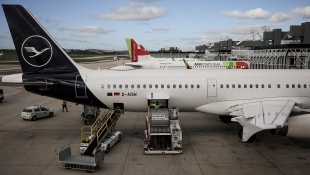

The Portuguese Communist Party (PCP) has condemned the government’s decision to select Germany’s Lufthansa Group for the partial privatisation of TAP Air Portugal, describing the deal as a threat to the country’s economic sovereignty and calling for a campaign to prevent the sale from proceeding.
Portuguese Communist Party condemns privatisation of TAP
The party also highlighted TAP’s role in connecting Portugal with South America and Africa, arguing that the airline provides the country with strategic economic links that could be weakened if control passes to a foreign multinational.
The PCP rejected the government’s claim that the state would retain effective control because it would continue to hold a majority of the shares. It argued that a shareholders’ agreement could transfer practical control to Lufthansa despite the state retaining a majority stake. The party further noted that the government had discussed the possibility of selling the remainder of TAP by 2028, raising concerns that the current transaction is only the first stage of a complete privatisation.
Opposition to Privatisation and Call for Mobilisation
The statement places the TAP sale within a broader critique of the transfer of strategic Portuguese assets into foreign ownership. The PCP cited energy, telecommunications, airports, motorways, finance and industrial sectors as examples of areas where it believes decisions are increasingly made outside Portugal.
It stated that these policies contribute to the outflow of national wealth through dividends, reduced tax revenue and delayed investment in infrastructure. The party also criticised the political convergence of the Social Democratic Party (PSD), CDS-PP, Chega, Iniciativa Liberal and the Socialist Party (PS) around the privatisation process, saying that opposition to the sale requires a break with the existing economic policy.
The PCP called on TAP workers and members of the public opposed to privatisation to mobilise against the decision. It said it would pursue all available initiatives, particularly in the Assembly of the Republic, to reverse the decision as soon as possible.
The statement concludes that the outcome of the privatisation is not inevitable and that political and public pressure can still prevent it from going ahead.