
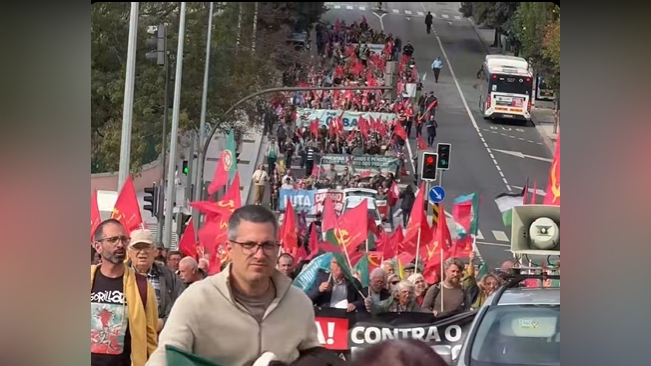

The Portuguese Communist Party (PCP) condemned police operations against housing-rights protesters in Lisbon and Porto on 25 October, accusing the government of attempting to restrict the constitutional right to demonstrate instead of addressing the country's worsening housing crisis. Over the weekend, the party also participated in housing protests and held its own march and rally in Porto under the slogan “Salaries, Rights, Peace”.
Portuguese Communist Party organises rally for wages, rights and peace
PCP denounces police action against housing protesters
In the early hours of Sunday, police dismantled protest camps at Rossio Square in Lisbon and Praça D. João I in Porto. Officers used batons and police dogs, while 31 people were detained across the two cities. The authorities reported 11 injuries, while protest organisers reported considerably higher numbers, including dozens of injured people in Porto.
The demonstrations demanded changes to government rental legislation, protection against evictions without alternative accommodation, restrictions on speculative property purchases, increased public investment in housing and genuinely affordable rents.
PCP General Secretary Paulo Raimundo condemned the police operations, describing them as acts of “violence, arrogance and incapacity”. Speaking in Porto, he argued that the government's response demonstrated its inability to address the housing crisis and rising living costs.
Raimundo warned that the government would not succeed in limiting the right to demonstrate. He also said the PCP would confront the government in parliament and present alternative proposals during discussions on the state budget.
The party's position was also articulated by João Ferreira, a PCP representative in Lisbon, who argued that housing had become a national problem affecting broad sections of society. Rather than repressing protesters, he said, the government should respond to their demands and introduce measures to make housing more accessible.
Housing crisis linked to wages and living costs
The PCP placed the demonstrations within a wider social crisis. It argued that rising rents and property speculation could not be separated from low wages and the broader increase in the cost of living.
The party opposes government proposals that would facilitate changes to rental arrangements and weaken existing protections for tenants. It advocates more public housing, stronger tenant protections and measures to curb speculation.
By defending the right to protest alongside the housing movement, the PCP presented the police operations as a democratic-rights issue as well as a failure of social policy.
“Salaries, Rights, Peace”: PCP mobilises in Porto
On Sunday afternoon, the PCP organised a march from Boavista to the gardens of Palácio de Cristal in Porto, followed by a rally under the slogan “Salaries, Rights, Peace”. The event was organised within the framework of the European Parliament's European United Left/Nordic Green Left group.
Participants included PCP General Secretary Paulo Raimundo, European Parliament member João Oliveira and Carolina Gonçalves of the Portuguese Communist Youth. International guests included former Irish parliamentarian and European Parliament member Clare Daly, Omar Mih of the Polisario Front's representation in Portugal, Shawan Jebreen, director-general of the Palestinian human-rights organisation Al-Haq, and José Ramón Saborido Loidi, Cuba's ambassador to Portugal.
The programme also included morning discussions on education and housing, alongside activities for children.
The PCP sought to connect demands for higher wages and pensions, better living conditions and stronger public services with the defence of peace, national sovereignty, international cooperation and solidarity.
In its political message, the party argued that the forces promoting militarism, rising military expenditure and war were also responsible for intensifying exploitation, inequality and attacks on democratic rights. It presented the struggles for housing, healthcare, education and workers' rights as interconnected with opposition to militarism and support for international solidarity.