
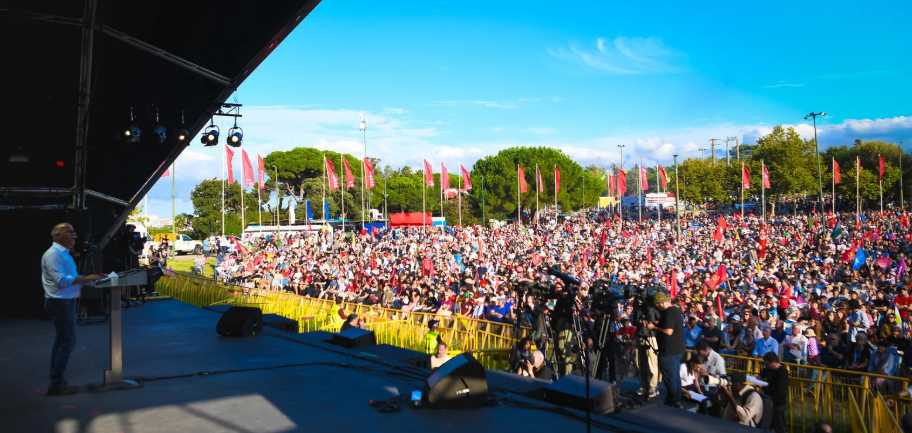

The 50th edition of the Festa do Avante!, the festival organised by the Portuguese Communist Party (PCP), took place from 4–6 September 2026 at Quinta da Atalaia in Amora, Seixal.
Portuguese Communist Party's Festa do Avante! concluded
The 2026 Festa do Avante! marked the 50th anniversary of the festival, whose first edition was held in Lisbon in September 1976, shortly after the Portuguese Revolution of 25 April 1974. The event has subsequently become an annual combination of political gathering, cultural festival, music event and social meeting organised by the Portuguese Communist Party (PCP).
The PCP presented the anniversary as an opportunity not simply to celebrate the festival's history but to reaffirm its political purpose. Manuel Rodrigues, a member of the PCP Political Commission and director of Avante!, described the festival as a collective construction involving communists, other democrats, friends of the PCP and the Portuguese Communist Youth. He characterised it as a celebration of the values of the April Revolution, workers, the people, youth, freedom, democracy and culture.
The programme combined political debates with more than 60 musical performances, theatre, cinema, sport, exhibitions, regional and international spaces and food from different parts of Portugal and abroad. Major performers included Ney Matogrosso, Carolina Deslandes, António Zambujo, Carlão, Bombino, 47 Soul and Pedro Jóia.
Paulo Raimundo's central political message
The principal political event was the traditional Sunday evening rally, addressed by PCP General Secretary Paulo Raimundo, alongside Manuel Rodrigues and Inês Castro of the Portuguese Communist Youth.
Raimundo used the occasion to launch a strong attack on the government of Prime Minister Luís Montenegro, particularly over its economic and social policies. His principal warning concerned what he called an “assault on Social Security.” He argued that the government was preparing measures that would weaken the public social-security system and called on workers to mobilise against them.
He also warned the Socialist Party (PS) that supporting the government's forthcoming state budget would make it politically responsible for attacks on public services. According to Raimundo, PS support would facilitate the government's attacks on the National Health Service (SNS), public education, wages, pensions and Social Security, as well as privatisation and rising prices.
Thus, the PCP's message was not simply opposition to the governing PSD/CDS administration. Raimundo also sought to position the PCP against what he described as the broader continuation of right-wing economic policy, including any cooperation between the government and the PS.
The PCP's appeal to workers and social mobilisation
The speeches repeatedly stressed the need for collective struggle and mobilisation.
Raimundo presented the Festa itself as evidence that collective organisation remains possible in a political environment marked by social inequality, attacks on public services and the growth of the far right. His message was directed particularly at workers and young people.
Manuel Rodrigues similarly presented the 50-year history of the Festa as a history of resistance: the festival was born in the aftermath of the April Revolution but, in his account, immediately confronted attempts to reverse its social and political gains. He linked its continuing existence to the defence of the values associated with the Revolution.
Inês Castro, representing the Portuguese Communist Youth (JCP), placed particular emphasis on youth struggle. She argued that young people were confronting the consequences of right-wing policies and that the Festa represented a space in which a different future could be imagined and organised.
International solidarity: Cuba
International solidarity was a prominent component of the festival.
On Saturday, the PCP held a specific solidarity event entitled “Cuba Resists and Will Win! End the Blockade!” at the International Space. Paulo Raimundo used the event to condemn the US blockade of Cuba, describing it as a criminal blockade that had become particularly severe in relation to Cuba's access to energy, fuel, medicines and food.
An especially notable feature was a message from Miguel Díaz-Canel, President of Cuba and First Secretary of the Communist Party of Cuba, addressed to the Festa and the Portuguese people.
Díaz-Canel thanked the PCP for its continuing solidarity with Cuba and specifically mentioned its support for the Cuban Revolution and opposition to the US economic, commercial, financial and energy blockade. He described the relationship between the two communist parties as one of “firm and indissoluble brotherhood.”
This gave the festival a clear international communist dimension, with Cuba presented not simply as an international issue but as an example of resistance to US imperialism and sanctions.
Palestine and international solidarity
Palestine was another major international theme.
The festival programme included a session entitled “Free and Independent Palestine!” at the International Space, while the PCP explicitly described the Festa as a place for solidarity with the Palestinian, Cuban, Sahrawi and Guinean peoples.