

The South African Communist Party (SACP) held its main Red October rally in Bushbuckridge, Mpumalanga, on 25 October 2026, bringing its campaign for working-class power, public services and economic transformation into the run-up to South Africa’s local government elections.
Image
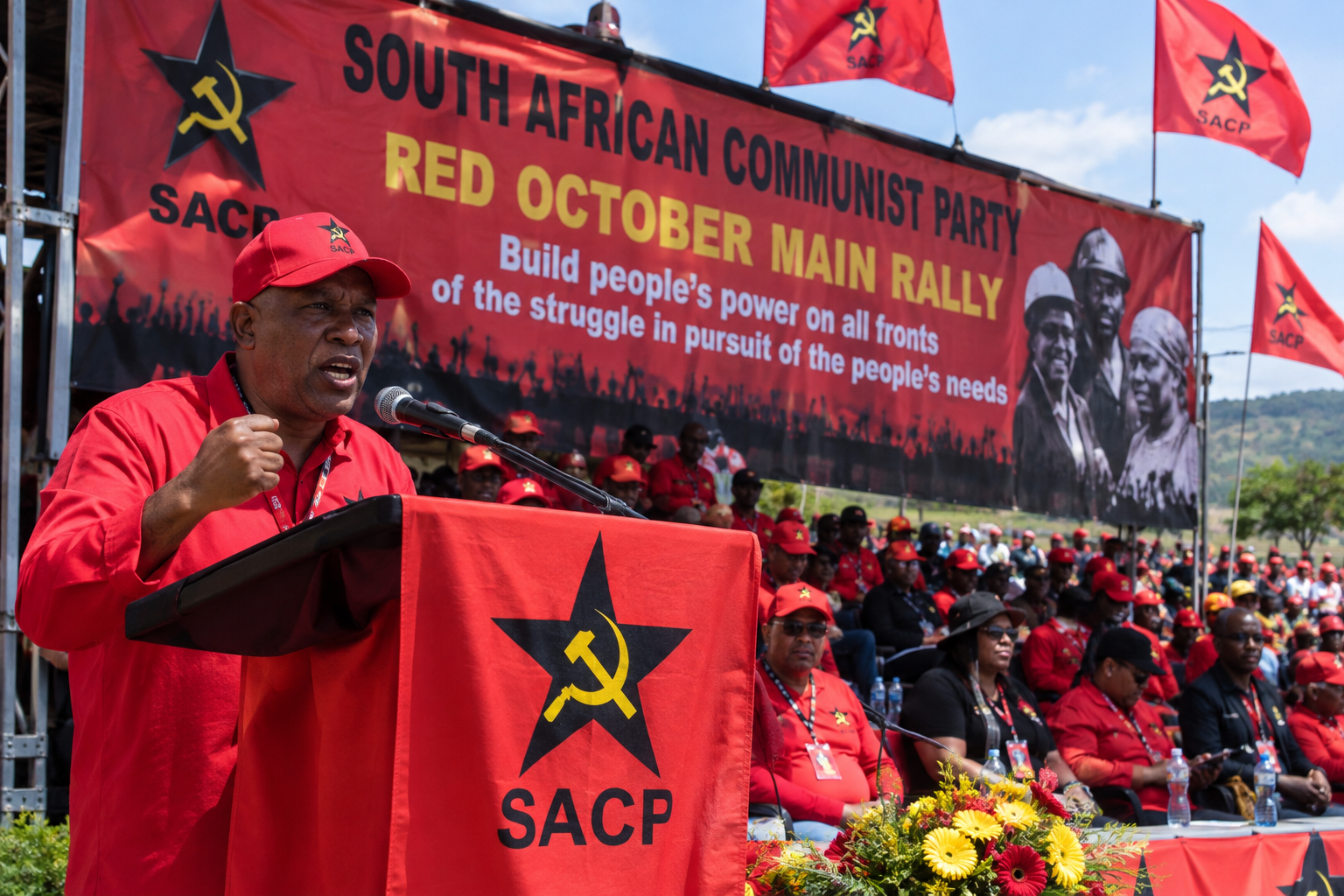
South African Communist Party holds main Red October rally ahead of elections on 4 November
SACP’s Red October rally calls for working-class power and public ownership
Addressing the rally, SACP General Secretary Solly Mapaila called for communities to build people’s power across workplaces, municipalities and popular organisations.
The rally took place under the slogan “Build people’s power on all fronts of the struggle in pursuit of the people’s needs.” The campaign’s priorities include the right to work, reliable water and electricity, decent roads, housing, food security and safer communities. The party presented these demands as central to its electoral manifesto, Build People’s Power Where We Live.
Independent electoral campaign
The 2026–2027 Red October campaign coincides with a significant change in the SACP’s electoral strategy. For the first time since the democratic breakthrough of 1994, the party is contesting local government elections independently and directly under its own banner, rather than relying exclusively on the electoral arrangements of its longstanding alliance with the African National Congress (ANC).
Mapaila argued that elections must be part of a broader struggle to increase working-class influence over economic and political power. The SACP intends to use its campaign to challenge unemployment, poverty and inequality, which it attributes to an economic system that concentrates wealth and control over production in private hands.
The party called for industrialisation, large-scale public investment, expanded public employment, support for cooperatives and municipal programmes designed to create decent work. It also demanded stronger public ownership and democratic control of strategic sectors, including electricity generation and infrastructure.
Public services, electricity and municipal accountability
A major theme of the rally was the deterioration of municipal services. The SACP called for public investment in maintaining roads, repairing infrastructure, restoring reliable water supplies, improving refuse removal and rebuilding municipal technical capacity.
It opposed outsourcing and privatisation of essential municipal functions, arguing that local authorities should restore their capacity to provide services directly. The party also pledged to prioritise investigations into inflated procurement costs and alleged corruption involving electricity infrastructure and municipal suppliers.
On electricity, the SACP rejected the privatisation of generation and distribution and called for expanded publicly owned capacity, domestic industrial production of electricity equipment and a transition to greener energy that protects workers and communities.
The rally also addressed land redistribution, housing, food security, gender-based violence and the need for stronger public institutions and community participation in local decision-making.
Criticism of economic policy and austerity
Mapaila’s statement criticised the government’s economic policy, arguing that fiscal restraint and market-oriented restructuring had failed to resolve South Africa’s unemployment and poverty crises. The party called for a developmental state, public ownership of strategic infrastructure and an economic strategy centred on employment and social needs rather than private profit.
The SACP also reaffirmed its international solidarity with Palestine, Sudan, Cuba, Venezuela and other peoples it described as facing occupation, intervention or domination.
Assassination of an SACP candidate
The rally opened on a sombre note with Mapaila condemning the killing of Ernest Fipaza, the party’s councillor candidate for Ward 10 in Mbhashe, Eastern Cape. According to the SACP, armed assailants entered Fipaza’s family home and shot him on 24 October. The party also reported threats against other members in the province and said these had been reported to the police.
The SACP said it would notify the Electoral Commission, arguing that assassinations and threats undermine the conditions necessary for free and fair elections. The circumstances and responsibility for the killing remain matters for investigation.
Mobilisation ahead of 4 November
Mapaila called on supporters to intensify the SACP’s independent electoral campaign ahead of 4 November, urging voters to support the party and its candidates. He presented the campaign not merely as an electoral exercise but as part of a wider effort to organise working-class communities and strengthen their influence over public institutions.
The Red October rally therefore combined immediate demands for jobs and functioning public services with the SACP’s broader political objective of building independent working-class power. Its central message was that meaningful democratic participation must extend beyond voting to sustained community organisation and control over decisions affecting people’s lives.