
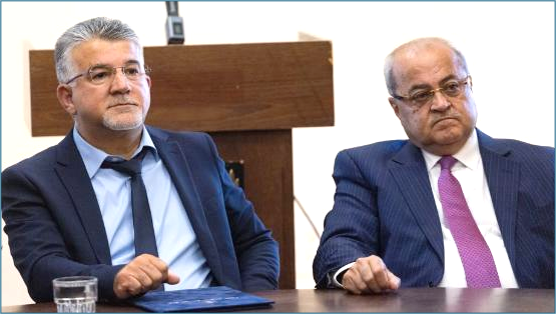

A report published by Zo Haderekh, the newspaper of the Communist Party of Israel (Maki), has drawn attention to revelations that Shin Bet chief David Zini sought to monitor Arab members of the Knesset ahead of the 27 October elections.
Shin Bet sought to wiretap Joint List leaders ahead of Israeli election
The report also describes alleged attempts by security interrogators to recruit activists of the Joint List as informants against the rival United Arab List (Ra'am).
According to the investigation broadcast by Israel's Channel 12 and reported by Zo Haderekh on 16 November, Zini intended to wiretap members of the Joint List for three days: the day before the election, election day itself and the day after. This was similar to the security services' activity towards MKs from the Israeli Communist Party (Maki) faction, Arabs and Jews, in the 1950s and 1960s.
During consultations with legal officials, he reportedly indicated his intention to carry out the surveillance. He was asked to submit a formal application, but, according to the account published by Zo Haderekh, he did not do so.
The revelations have raised serious questions about the use of Israel's security apparatus against elected Arab representatives and political organisations, particularly in the context of allegations of electoral interference and fraud directed against Arab voters.
Attempts to recruit Joint List activists as informants
The Channel 12 investigation also revealed that Shin Bet interrogators had recently summoned several Joint List activists for questioning. According to the activists' accounts, the questioning was not principally concerned with their own political activities but focused on obtaining information about Ra'am.
One activist described an interrogator attempting to use religious differences to persuade him to cooperate against the Islamic movement. The investigator reportedly told him: “You're a Christian. They're Islamists. You need to cooperate with us against them. Give me something.”
The activist said he had no connection with Ra'am and questioned why he was being asked to provide information about the party. He described the interrogation as an attempt to recruit him as an informant.
The Joint List condemned the reported conduct, declaring that the Shin Bet had become a political instrument of the government. It stated that intimidation would neither deter nor silence its representatives and activists. The alliance also warned against attempts to create divisions and suspicion between the different components of the Arab political movement, stressing that political and ideological disagreements with Ra'am did not alter the need to resist forces threatening the future of Arab citizens and their political representation.
Joint List chairman condemns political use of state institutions
Joint List chairman and Hadash member of the Knesset Yosef Jabareen described the revelations as evidence of conduct characteristic of authoritarian regimes.
He said the investigation raised grave suspicions of an attempt by Prime Minister Benjamin Netanyahu to use the police and security institutions unlawfully against the Arab public and its political leadership. The reported demand to wiretap Arab members of parliament, he argued, made the situation even more serious.
The investigation also raised questions about the involvement of officials in Netanyahu's office in the arrests of three Ra'am activists on election day. According to the report, the arrests followed information passed to the police by the prime minister's chief of staff, Ido Norden. The activists were subsequently released without conditions and without indictments.
These developments came amid a wider campaign by Netanyahu and his allies alleging electoral fraud involving Arab voters. The allegations have been disputed, and the investigation has raised questions about the evidence behind the claims and the role played by government officials and security agencies.
A threat to democratic and political rights
The reported surveillance initiative and the questioning of Joint List activists have intensified concerns about the independence of Israel's security institutions and their possible use in political competition.
For the Joint List and Hadash, the issue goes beyond the treatment of individual politicians and activists. It concerns the right of Arab citizens to political representation, the ability of parties to organise freely and the protection of elected representatives from politically motivated surveillance and intimidation.
The revelations also expose the contradiction between official claims to defend democratic institutions and the reported use of security agencies to monitor political representatives and pressure activists.
The Joint List has made clear that attempts to intimidate its members or undermine cooperation among Arab political forces will not silence its opposition. The controversy is likely to remain a significant issue in the debate over the conduct of the security services and the political rights of Palestinian citizens of Israel.
Tibi in Knesset's organising committee
Meanwhile, the Knesset's organising committee established after the elections, headed by MK Roy Folkman, today recommended to the Knesset plenum - with the support of 13 Knesset members against eight opponents - to elect nine temporary deputies for the Knesset Speaker: MKs Ahmed Tibi (Ta'al - Joint List), Eitan Ginzburg (Bihad), Yair Pink (Democrats), Oded Forer (Yisrael Beytenu), Walid Taha (RAM), Yitzhak Pindros (United Torah Judaism), Yaakov Bardugo (Likud), Limor Son Har-Malech (Otzma Yehudit) and Michael Malchieli (Shas)
(Photo: Jonathan Zindel/Flash90)