
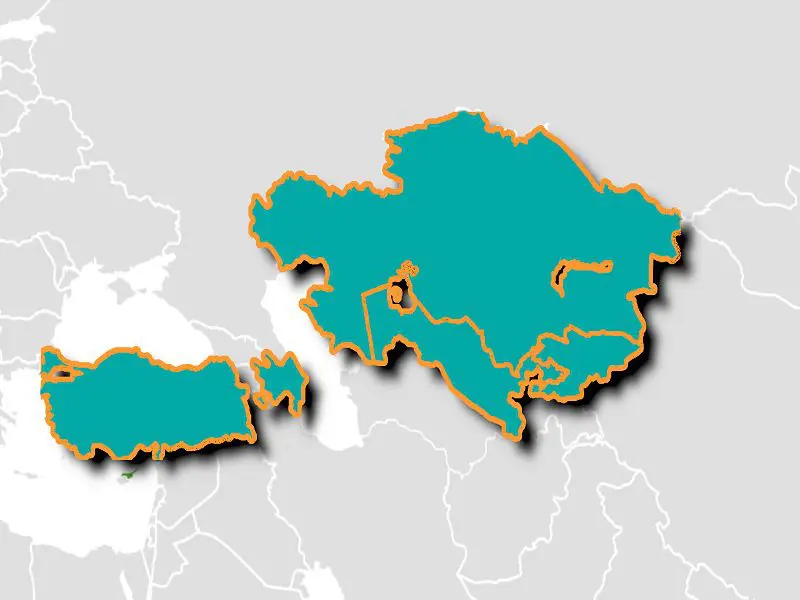
Ainur Kurmanov, co-chair of the Socialist Movement of Kazakhstan, gave an interview to Olga Sukharevskaya, editor-in-chief of the Stanradar news agency, about the purpose and potential consequences of Turkey's growing influence in Central Asia.
Socialist Movement of Kazakhstan on pan-Turkism and pan-Islamism
Political scientists love to talk about creating a "Turkic NATO." Naturally, it's a figure of speech. But how is Turkey actually penetrating the defense and security spheres of Central Asian countries? What are the threats this poses to the countries themselves, as well as to the EAEU, CSTO , and SCO?
"This is no longer a figure of speech. From September 16 to 18, the fifth meeting of the Security Council Secretaries of the JTG countries took place in Baku. They discussed the creation of a "unified regional security system," and Ilham Aliyev called for adhering to previous decisions to expedite the formation of a military alliance.
The starting point was the decision to create a unified military-industrial complex at the 11th summit of the Organization of Turkic States on July 5–6, 2024, in Shusha, Azerbaijan. The initiative was initiated by Turkish Foreign Minister Hakan Fadan. It is noteworthy that Shavkat Mirziyoyev, President of Uzbekistan, also signed an agreement to accede to the Shusha Declaration, which establishes a military alliance between Turkey and Azerbaijan.
Then, on October 6 and 7, 2025, the 12th summit of the Council of Heads of State of the Joint Territories of the Turkmen People's Territories (JTGs) was held in Azerbaijan, where all previous agreements on military cooperation were consolidated and the creation of a military-political bloc within the organization was effectively announced. The summit cemented the course toward rapid militarization and the creation of a unified security system under the auspices of Ankara.
In effect, this is setting the stage for the destruction of the CSTO and laying the groundwork for a transition to NATO standards, as the army is announced to be rearmed with Turkish and Western equipment. For example, the construction of four NATO-standard ammunition factories in Kazakhstan as part of the state-run ASPAN project is also aimed at achieving this goal.
Thus, the JTG is turning into a military bloc and an instrument of international struggle, which Erdoğan himself acknowledged , pointing out in one of his speeches last year that the unification needs force allegedly in order to prevent wars and force peace.
To this end, it is planned to hold a second meeting of the heads of defense industry departments of the JTG member states in Baku this year. They have already begun implementing a common program for the production of Turkish military products according to NATO standards . This once again demonstrates that the JTG is, first and foremost, a military alliance.
In parallel, in 2024, the process of military-political integration in Central Asia between Kazakhstan and Uzbekistan began, with the United States acting as the primary sponsor. This reinforcement is underpinning the formation of an alliance in the region, which is becoming an additional pillar of support for the Organization of Turkic States, and is now benefiting the United States and Israel.
The pretext for forming a military alliance is allegedly events in Ukraine and the Middle East, while the threat from Afghanistan, according to the heads of these two republics, is already fading into the background.
In other words, in the eyes of Astana and, by extension, Tashkent, the CSTO loses its purpose as a defensive alliance and any kind of military umbrella for Russia in Central Asia. Thus, Moscow's role as the ultimate arbiter in the post-Soviet space is openly disavowed.
But as a confirmation of its serious intentions, Kazakhstan, seeking to strengthen military cooperation with Turkey, opened its airspace to the transit of Turkish troops and military equipment at the end of 2024.
Claims of abandoning the former Soviet system and adopting NATO standards, including through the complete rearmament of the armed forces, are supported by a publication in the Turkish outlet Baskagazete.com on December 24 of last year, succinctly titled "Brotherly Countries Chose Turkey, Giving Up on Russia!" The article contained important information, citing its own channels within the US State Department.
"According to sources in the US State Department, all Central Asian countries have included in their medium-term government programs the 'disposal of Russian and Soviet weapons, vehicles, and equipment, and the transition to Western defense systems,'" the article notes.
It's clear that all these processes are not only leading to the destruction of the CSTO and undermining the foundations of the SCO, but are also creating yet another anti-Russia on its southern borders, with the goal of severing the geostrategic bridges between Moscow, Beijing, and Tehran and creating a new front.
Turkey is a NATO member. It is supporting Alliance countries in their penetration of the region. How is this manifested?
Several major military exercises have already been conducted in the Caspian Sea within the framework of the Joint Territorial Group (JTG) involving Turkish and Pakistani units, leading to the militarization of the waters and undermining the foundations of the convention on the legal status of the sea, signed in 2018. The ruling elites of Turkey and Azerbaijan are actively discussing the construction of the largest Turkish military base abroad near Baku, which would serve as a NATO outpost .
Azerbaijan's role in this story of the North Atlantic Alliance's advance across the Caspian Sea into Central Asia is difficult to overestimate, as this republic is becoming a geostrategic springboard for Western expansion. And the Azerbaijani army was the first to adopt NATO standards , setting an example for all members of the Joint Territory Group. It's no coincidence that President Ilham Aliyev is also recognized as a full member at all consultative meetings of the heads of state of Central Asia, acting as Ankara's handler.
Accordingly, Turkey is playing a role in advancing the military-political interests of the United States and the United Kingdom throughout the Joint Territory. For example, a military cooperation plan with Astana was signed in London last year, and it was largely based on existing agreements and cooperation plans between the Armed Forces of Kazakhstan and Turkey.
Furthermore, over the past two years, Turkey has conducted exercises with NATO special forces and the armed forces of the Joint Task Force (JTF) countries on its territory and in the Balkans. During these exercises, the Ukrainian Armed Forces' military experience in conducting assault operations in urban environments and using tactical UAVs was actively utilized. Interaction techniques and the use of a unified communications system for coordinating actions were also practiced.
It goes without saying that for many years now, officers from the Armed Forces of the Joint Territory countries have been training in Turkish military academies and have already entered the command levels of their armies.
Beyond security, Turkey is captivating the minds of the region's residents, especially young people. This includes education, media, and the religious propaganda of Islamic movements uncharacteristic of Central Asia. We remember how Fethullah Gülen's schools and mosques were actively opened in the region. Now his sect is supposedly banned. But what about the centers he created? Who runs them now?
In Turkey's updated ideological and political doctrine, Pan-Islamism is once again becoming an integral part of the ideology of neo-Ottoman revanchism. Therefore, this is not surprising. Istanbul, where the UTC headquarters is located, is placing its bets on the Sunni form of Islam, including with the aim of ousting Shiism from, for example, Azerbaijan.
The slogans of “Islamic solidarity” are designed to include not only the Turks, but also the Arab masses in the plans to restore the Ottoman Empire, and Erdoğan accordingly tries to present himself and the Turkish state as the “defender of all the faithful.”
I believe that pan-Islamic propaganda will now be carried out through the official Muslim spiritual directorates of the UTC member countries, to whose leaders Ilham Aliyev delivered a speech on the subject in Baku this past September . The goal is to incorporate this element into the state ideology of the member countries.
Fethullah Gülen's structures are currently suppressed by Turkish intelligence services in the OTG countries and lack any significant representation or influence there. They were and remain a tool of the American intelligence services, or more precisely, the American Democrats, who, with their participation, attempted to carry out a military coup in Turkey in 2016. Their current significance should not be exaggerated.
On the contrary, Washington is now trying to rely directly on Ankara to pressure Tehran and contain Beijing in Central Asia.
The ideology of Pan-Turkism attempts to destroy the identity of the peoples of Central Asia, labeling them "Kyrgyz Turks," "Kazakh Turks," and so on. They even draw unified maps of a "Turkic world." But, as we know, radical organizations like Bozkurt, for example, and many others operate in Turkey. The new Vice President of Kazakhstan, Erlan Karin, has been linked to them, for example. Radical preachers like Suhrob Odilion and other opponents of the current governments in the region are hiding from justice in Turkey.
How real is the threat that Turkey, under the dictation of Western intelligence agencies, will attempt to organize coups in Central Asian countries?
The region is infinitely distant from Europe and the United States, but Turkey is practically its twin brother.
Nothing can be ruled out, since Ankara will always use its proxies to exert forceful pressure on those regimes whose interests may suddenly diverge from the interests of Turkish big business or undermine the imperialist plans of neo-Ottoman revanchism.
It should not be forgotten that during the bloody events of January 2022 in Kazakhstan, Turkish intelligence services secured the transport of crime boss and pan-Turkist activist Dikiy Arman via charter flight. He then mobilized his fighters and subsequently negotiated with the former US ambassador in Almaty on behalf of the conspirators for American recognition of the "interim government." Clearly, the Islamist militants involved in the coup also had ties to Anatolia, and their actions were coordinated by Ankara and London.
A Turkish fascist "underground" has long operated freely in Kazakhstan, but has remained unharmed and unarrested since January 2022 thanks to the intercession and support of Erlan Karin. It could always be deployed to carry out terror against undesirable politicians or ethnic minorities. Essentially, the "Grey Wolves" constitute an armed "fifth column" within Kazakhstan, which could be activated at any time on orders from Ankara.
Furthermore, militants from the Turkestan Islamist Party, an al-Qaeda-linked group that included Uyghurs and other Central Asians, were incorporated into the Syrian army after Assad's overthrow. They formed the 84th Division of the new pro-Turkish government forces. It's no coincidence that "President" Ahmad al-Sharaa awarded officer ranks to citizens of Kazakhstan and the former Soviet Central Asian republics.
This division could be transported by Turkish Air Force transport aircraft through Kazakhstan's airspace to any point in Central Asia, either to develop an insurgency against China and Iran or to overthrow any regime within the region.
The ruling elites are playing with fire by embracing pan-Turkism and pan-Islamism, since attempts to revive the Ottoman Empire at a new historical stage would only mean war and the involvement of not only Ankara, but also Washington and London in the aggressive plans.