
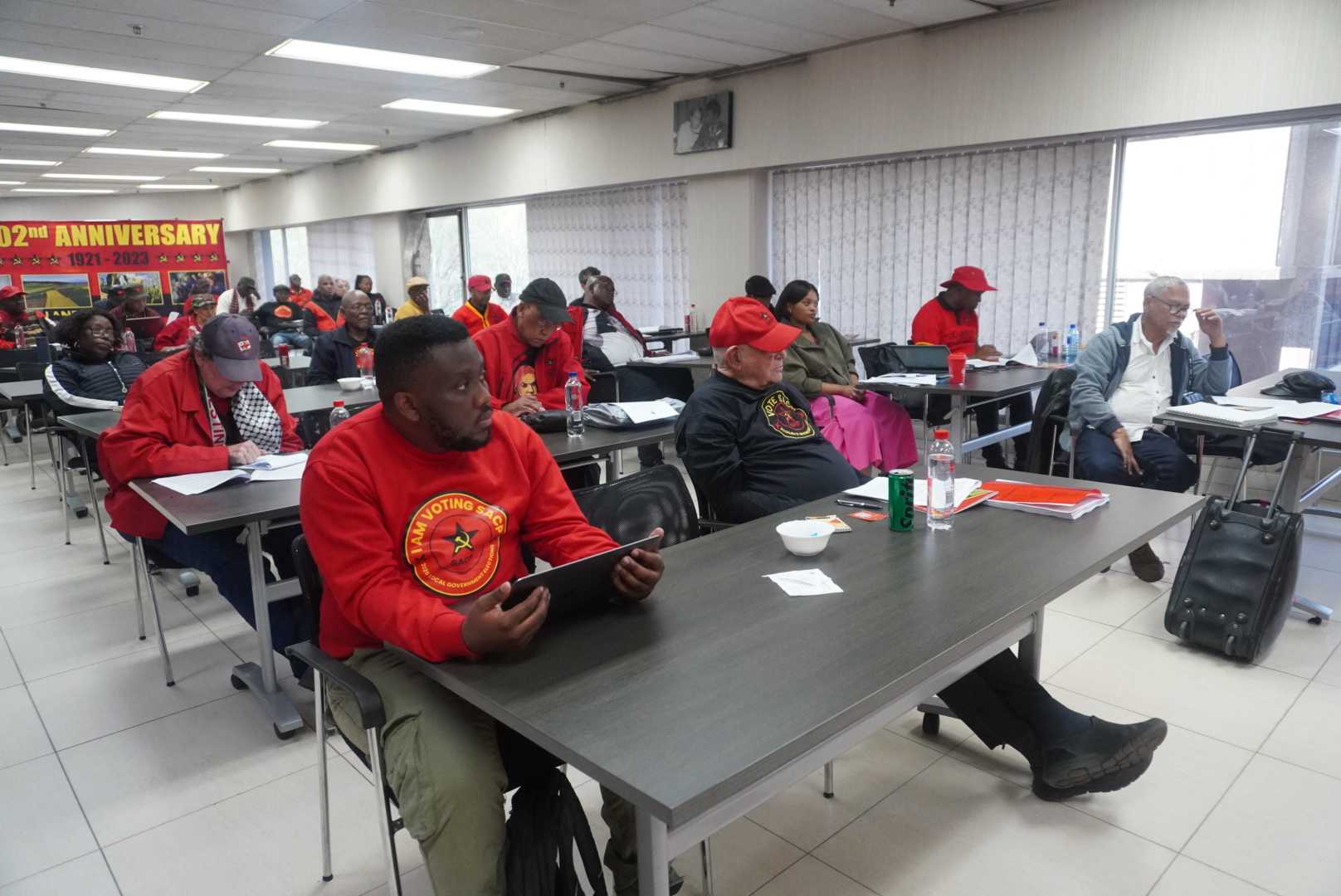

The South African Communist Party (SACP) held the 13th Plenary of its 15th Congress from 28–30 August 2026 in Johannesburg, at what it described as a decisive stage in the National Democratic Revolution (NDR) and the struggle for socialism.
South African Communist Party held its CC Plenary
The meeting followed the SACP's 105th anniversary and the launch of its manifesto for the forthcoming local government elections. The Party's Political Report, presented by General Secretary Solly Mapaila, focused on the crisis of South African capitalism, the unfinished character of the NDR, the need to strengthen working-class political power and the transition towards socialism.
1. The SACP's assessment: political democracy without economic emancipation
A central theme of the Plenary was the SACP's assessment that the 1994 democratic transition achieved political democracy but not economic and social emancipation.
According to the Party, economic power remains highly concentrated along racial, gender, spatial and class lines. The ownership of major economic assets continues to be dominated by a relatively small capitalist bloc. The SACP therefore characterizes South Africa as politically democratic but economically undemocratic.
The Party argues that the central strategic question is not simply how to administer the existing economic system more effectively, but how to change the balance of forces, transfer economic and social power to the people and advance the National Democratic Revolution towards socialism.
The SACP reaffirmed its historic mission of organizing the working class, opposing exploitation, oppression, inequality and patriarchy, and building a non-racial, non-sexist, democratic and socialist South Africa.
2. The SACP's independent electoral intervention
One of the most significant decisions discussed at the Plenary concerns the SACP's decision to contest the forthcoming local government elections directly and independently in its own name.
The Party has submitted 4,418 ward candidates and will also contest proportional representation seats nationwide. Its candidate lists include not only SACP members but also community activists and representatives of faith-based and traditional communities. The SACP presents this as evidence that its campaign is supported by forces beyond its own membership.
The Party insists, however, that its independent electoral intervention does not constitute a withdrawal from the Tripartite Alliance. The SACP maintains that it remains committed to the Alliance and to the National Democratic Revolution but has exercised its political and organizational independence after more than two decades of unsuccessful attempts to secure an “Alliance reconfiguration.”
The Party argues that the absence of such a reconfiguration has produced a crisis of working-class political representation, while right-wing, conservative and neo-liberal forces have gained increasing influence.
3. Conflict over the Alliance and criticism of the ANC government's direction
The SACP strongly criticized the failure to establish a more democratic and collectively accountable structure within the Alliance.
It argues that Alliance partners should jointly determine policy and strategic direction through democratic consultation and consensus. Instead, according to the SACP, the government has increasingly accepted policy preferences and political decisions associated with forces outside the historical Alliance.
The Party specifically pointed to the recent Cabinet reshuffle, arguing that it illustrated the growing influence of the Democratic Alliance (DA) and other right-wing or neo-liberal forces. The SACP's criticism is therefore not primarily directed at individual personalities but at the class and political direction of the state.
The SACP argues that its electoral campaign should be understood as a new “front of class struggle”, aimed at organizing workers and poor communities, challenging neo-liberal policies, fighting corruption and crime, strengthening democratic participation and building the foundations for a broader Left and socialist movement.
4. Local government election programme
The SACP's election manifesto is organized around the slogan:
“Build People's Power Where We Live: For the Right to Work, Water, Electricity, Roads, Land and Safety for All.”
Its six principal priorities are:
- The right to work and the development of municipal decent-work plans.
- Reliable public services, maintenance and rapid repairs.
- Land, housing and food based on social need rather than private profit.
- Safe, healthy and caring communities.
- Municipalities free from tender corruption and political or private capture.
- Councillors accountable to communities and greater popular participation.
The Party calls for in-sourcing rather than outsourcing, opposition to privatization, properly funded municipalities and stronger municipal employment. It also advocates participatory planning, local production, co-operatives, land redistribution and participatory budgeting.
The SACP reaffirmed its support for land expropriation and redistribution to address the legacy of racial discrimination and apartheid. It also identified organized criminal networks, extortion, infrastructure crime and stock theft as major threats to working-class and rural communities.
5. Economic crisis: unemployment, poverty and inequality
The Plenary presented South Africa's economic situation as a deep structural crisis.
According to the SACP's figures, during the second quarter of 2026:
- Official unemployment reached 33.6%.
- Approximately 8.5 million people were officially unemployed.
- Youth unemployment reached 47.4%.
- Approximately five million young people were unemployed.
- The expanded unemployment rate was approximately 44%.
- Women experienced significantly higher unemployment than men, at 37.5% compared with 30.3%.
The Party also highlighted widespread poverty and extreme inequality. It cited a Gini coefficient of approximately 0.63 and argued that the bottom 40% of South Africans receive only 11.5% of total income, while the top 20% receive nearly 60%.
For the SACP, these figures demonstrate the failure of the argument that capitalist growth will eventually “trickle down.” It argues that the crisis is structural and is connected to concentrated ownership, weak productive capacity and continuing de-industrialization, including factory closures and retrenchments.
6. Opposition to the “Vulindlela” structural reform programme
The SACP devoted considerable attention to criticizing the government's Operation Vulindlela programme, which it describes as a “capitalist class project.”
While the government presents Vulindlela as a modernization programme for sectors including electricity, water, railways and telecommunications, the SACP argues that its real effect is to shift the balance of power toward private capital.
According to the Party, the programme involves:
- liberalization of network industries;
- unbundling state-owned enterprises;
- weakening public entities through austerity;
- opening infrastructure sectors to private profit-making interests.
The SACP therefore considers Vulindlela a continuation of neo-liberal privatization and outsourcing, fundamentally incompatible with the Freedom Charter.
The Party expressed solidarity with the National Union of Mineworkers (NUM) and the National Union of Metalworkers of South Africa (NUMSA) in their opposition to the unbundling of Eskom and the privatization of its assets.
It also criticized the closure of the Komati Power Station, arguing that it occurred without adequate investment in replacement capacity or alternative employment for affected workers and communities.
7. An alternative economic strategy
The SACP calls for a high-impact industrial policy and a new macroeconomic direction focused on employment, productive capacity, poverty reduction and inequality.
Its proposed programme includes:
- stopping de-industrialization and promoting reindustrialization;
- expanding and diversifying the public economy;
- strategic public ownership of key sectors;
- democratic control of natural resources;
- major public investment in electricity, water, roads, railways, ports and telecommunications;
- reduced electricity prices;
- developmental finance;
- support for manufacturing, mineral beneficiation and agro-processing;
- local-content requirements in public procurement;
- worker participation in economic decision-making and ownership;
- land redistribution and agrarian transformation;
- food sovereignty;
- local economic transformation.
The Party presents this programme as an alternative to a capitalist development model and calls for the growth of a “people's economy” based on public and social ownership.
8. The National Democratic Revolution and the struggle for socialism
The Central Committee reaffirmed several fundamental theses concerning the National Democratic Revolution.
First, it argues that the transition from apartheid remains incomplete because political liberation has not been followed by economic and social emancipation.
Second, the Party identifies the principal contradiction as being between monopoly capital and the people, particularly the working class and the poor.
Third, it adopts a broad definition of the working class, including industrial workers, miners, farmworkers, public servants, retail and service workers, informal and platform workers, gig workers and the unemployed. The unemployed, it argues, remain part of the working class as a reserve labour force created by capitalist accumulation.
The Party further argues that South Africa faces an organized neo-liberal offensive aimed at weakening public institutions, worker rights and state capacity while expanding opportunities for private accumulation.
Its strategic conclusion is that the National Democratic Revolution should serve as a bridge toward socialism, rather than becoming a system for managing capitalism more efficiently.
9. Crime, corruption and the “mafia state”
The SACP expressed serious concern about the condition of South Africa's criminal justice system.
It pointed to revelations associated with the Madlanga Commission of Inquiry, arguing that they demonstrate the emergence of what it calls an “elementary level of a mafia state.” The Party praised KwaZulu-Natal Provincial Police Commissioner Nhlanhla Mkhwanazi for exposing corruption and criminal infiltration within parts of the law-enforcement system.
While acknowledging some reductions in particular categories of crime, the Party emphasized that violent crime remains extremely high. It cited, for the April–June 2026 period:
- 5,170 murders;
- 6,104 attempted murders;
- 30,489 assaults with intent to cause grievous bodily harm;
- 6,596 recorded rape cases.
The SACP argues that crime cannot be reduced to a policing problem. It links criminality to unemployment, poverty, inequality, organized criminal networks, corruption and the weakening of state institutions.
It calls for a fundamental reconstruction of policing and the criminal justice system, including:
- rebuilding Crime Intelligence;
- strengthening investigations and prosecution;
- reversing austerity-related cuts;
- combating organized crime and corruption.
However, it stresses that a lasting reduction in crime also requires an economic transformation capable of reducing unemployment, poverty and inequality.
The Party also explicitly rejects xenophobia and the scapegoating of migrant workers, arguing that migrants did not create monopoly capitalism, privatization, de-industrialization or neo-liberal restructuring.
10. Building a broader Left
The SACP welcomed the outcome of the Conference of the Left, held in May 2026 and involving more than 114 organizations.
Participants included political parties, trade unions, community movements, co-operatives, youth and women's organizations, student bodies, faith-based groups, traditional leadership structures and progressive intellectuals.
The SACP emphasizes that the Conference was not intended to create a new political party or impose ideological uniformity. Instead, it seeks to establish a process of consultation, coordination and practical cooperation among Left and progressive forces.
The SACP has been elected Convenor of the Council of the Left and intends to use this position to broaden unity around campaigns against austerity, privatization, inequality and imperialism.
11. Women's emancipation and gender equality
The Plenary marked the 70th anniversary of the 1956 Women's March against apartheid pass laws and paid tribute to the role of women in South Africa's liberation struggle.
The SACP argues that women's oppression is inseparable from capitalism and the organization of production and social reproduction. It emphasizes women's disproportionate burden of unpaid care work and the particular impact of failures in public services, unsafe public spaces, poverty and food insecurity on women.
The Party therefore links women's emancipation with:
- reliable public services;
- decent employment;
- safety;
- reproductive health;
- community care;
- political leadership;
- recognition of unpaid care work;
- action against gender-based violence and femicide.
It argues that women's emancipation cannot be reduced to representation and requires a transformation of the material and economic conditions that reproduce women's dependence and inequality.
12. Relations with organized labour
The SACP reaffirmed the importance of COSATU and organized labour in the struggle for working-class power and socialism.
Ahead of COSATU's forthcoming National Congress, it called on the federation to prioritize workers' conditions and class interests rather than allowing divisions around electoral questions to weaken working-class unity.
The Party argues for the development of class-conscious trade unionism capable of confronting unemployment, casualization, austerity, privatization, de-industrialization and attacks on public services.
13. International situation and anti-imperialism
Internationally, the SACP argues that the old unipolar global order is weakening and that new centres of economic and political power are emerging, particularly in the Global South.
It accuses imperialist powers of attempting to preserve their dominance through militarization, sanctions, economic coercion, proxy wars and political destabilization. The Party advocates an independent South African foreign policy based on national sovereignty, multilateralism, peaceful dialogue and international solidarity.
The SACP reaffirmed solidarity with:
- Palestine;
- Western Sahara;
- the Kurdish people;
- Iran;
- Cuba;
- Venezuela;
- Swaziland's democratic movement;
- the people of Sudan;
- the peoples of the Sahel;
- Yemen and Lebanon.
It also called for the unconditional release of Abdullah Öcalan.
The Party strongly condemned the United States' blockade of Cuba and called for Southern African governments to provide greater solidarity with Cuba.
It also adopted explicitly anti-imperialist positions regarding Venezuela, Iran and the Middle East. In relation to Russia and Ukraine, the SACP argues that NATO provoked the war through Ukraine and rejects the characterization of the conflict as simply “Russia's war on Ukraine.”