
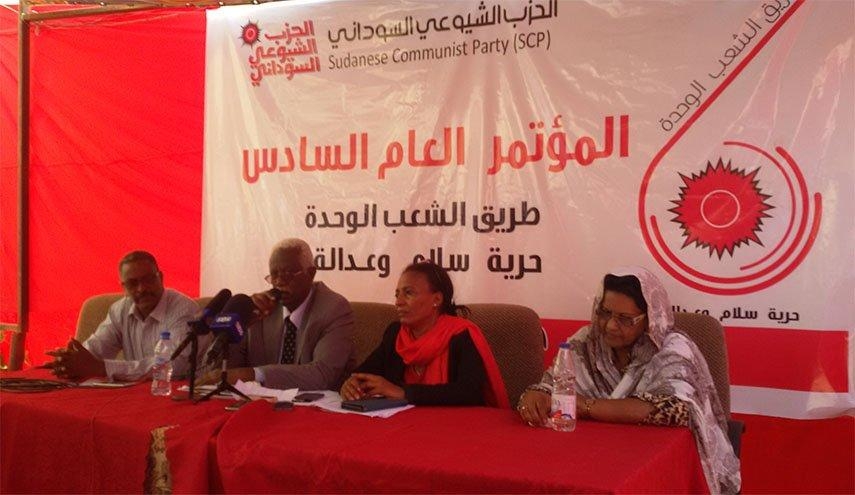

The Sudanese Communist Party (SCP) continues to oppose the political process being developed around the Sudanese authorities' proposed “Sudanese-Sudanese dialogue”, while maintaining its call for an immediate end to the war and a civilian-led democratic transition.
Sudanese Communist Party maintains opposition to war-time political dialogue
The party's position has also intersected with the continuing international and Sudanese consultations in Addis Ababa on how a political process should be organized.
SCP position on the political process
The SCP's basic argument is that political negotiations should not be used to normalize the existing military and political balance while the war is continuing. In its recent political positions, the party has called for an immediate cessation of hostilities and for the political process to be based on the forces associated with the December 2018 Revolution, rather than the two warring military camps and their allies.
This position was clearly expressed in the party's memorandum to the international “Quintet” — the African Union, IGAD, Arab League, European Union and United Nations — during the Addis Ababa consultations in June. The SCP argued that the meetings should be understood as exploratory consultations rather than negotiations over a division of power, and that neither the participants nor the Quintet had a mandate to determine Sudan's political future on behalf of the Sudanese people. It called for the military parties and their political allies to be excluded from the political process and for a broad popular front of political, civil and grassroots forces to lead the democratic transition.
The party has maintained this approach in its subsequent response to the dialogue initiative associated with army commander Abdel Fattah al-Burhan. Anti-war political and civil forces meeting in Addis Ababa in August likewise rejected Burhan's proposed dialogue, saying they would not participate in it or recognize its outcomes. They proposed instead a process centred on ending the war, establishing a civilian transition and addressing the political causes of the conflict.
What is happening in Addis Ababa
The Addis Ababa consultations are important because they represent an attempt by the Quintet — AU, IGAD, Arab League, EU and UN — to construct a framework for a Sudanese-led political process.
The first major round took place on 3–5 June 2026. The Quintet said it was seeking to establish the basis for a preparatory committee for an inclusive inter-Sudanese political dialogue. Participants submitted written proposals, while the international mediators said the consultations were intended to bring together a broader spectrum of Sudanese political and civilian forces.
The SCP, however, was critical of the format. Its June memorandum argued that the process should not become a mechanism for negotiating a new power-sharing arrangement. Instead, it wanted the political process to be rooted in the forces of the December Revolution and in grassroots organizations, while excluding the military parties and their allies.
The consultations subsequently developed into a continuing process. The Quintet said in August that it was conducting further discussions with Sudanese political blocs and parties and reviewing proposals submitted during the June meetings.
The central disagreement has therefore been not simply whether there should be negotiations, but who should participate and what kind of political settlement the consultations are supposed to produce. The SCP and other anti-war forces have objected to any process that could allow the parties responsible for the war to determine the shape of the post-war political order.
Recently SCP met with representatives of the Quintet outside the formal framework of the Addis Ababa meetings. This reflects the party's reservations about the methodology and possible results of the formal consultations. SCP's concern is not simply about the presence of the international mediators, but about whether the resulting process can genuinely represent the forces that drove the December Revolution and oppose both sides of the war.
The broader Addis Ababa process has also encountered difficulties over representation. The June consultations produced areas of agreement but also disagreements over which political forces should be included.
The SCP's activity and statements remain centred on several connected demands: an immediate end to the war, a civilian democratic transition, accountability for crimes committed during the conflict, and a political process led by Sudanese civilian and popular forces rather than the military parties.
The party also continues to invoke the objectives of the December Revolution as the political reference point for the transition. In this framework, ending the war is not regarded as sufficient on its own: the post-war settlement should also address the political and social structures that produced the conflict and prevent a return to military rule.