
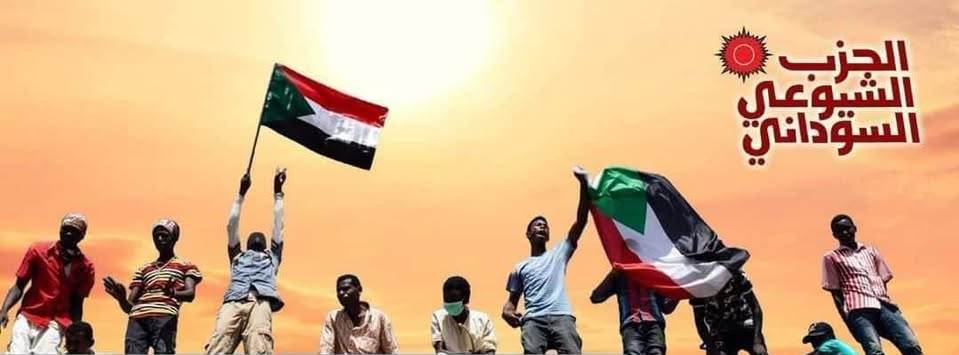

The Sudanese Communist Party marked its 80th anniversary on 16 August. The following article was published in No. 4502 of Al-Midan, the organ of the Party.
Sudanese Communist Party marks 80th anniversary
We mark the 80th anniversary of the founding of the Sudanese Communist Party while our country remains under the control of two de facto authorities and the bloody war enters its fourth year—a struggle over power and wealth and their distribution, for which millions of Sudanese are paying the price with their livelihoods, wages, savings, and their children's future.
The country stands on the brink of collapse, despite possessing enormous resources and potential: agricultural land, gold and mineral wealth, water resources, and a strategically important geographical position. The forces of war and destruction are draining these resources to finance the war and its parasitic economy, opening the country to foreign intervention and turning the Sudanese conflict into a battleground for a proxy war in which the interests and calculations of neighbouring states and international powers intersect.
In the face of the suffering and severe repercussions of the war, our people continue their movement, healing their wounds and closing ranks, drawing on a long tradition of persistent struggle against dictatorships, repression and tyranny. They draw from the memory of their leaders and righteous fighters a spirit of sacrifice and dedication in the service of the people and the nation, and from the traditions of political parties, trade unions, federations and mass organisations the proven tools of struggle and their ability to organise the masses and defend their rights and interests.
On this day, 16 August 1946, the Sudanese Movement for National Liberation, “Hashito” (HASTU), the nucleus of our Party, was founded by workers, intellectuals and students. From its earliest steps, the movement was guided by Marxism as a method of analysis and action, adapting it in light of Sudan's circumstances and the particular characteristics of its social, economic and political structure.
The founding of HASTU was a natural continuation of the traditions of the anti-colonial national movement, embodied in the establishment and activities of the Sudanese Union Society and the White Flag League, in the 1924 Revolution, and in the growing cultural, literary and sporting movements. The emergence of the party of the Sudanese working class was therefore an expression of the development of national thought and the accumulation of experience in popular struggle, responding to an objective need arising from the country's circumstances and transformations.
From its foundation, HASTU was engaged in a determined struggle against colonialism. This was evident in the mass movement, particularly the demonstrations by Sudanese students in 1946. The movement's leadership also undertook to disseminate Marxist literature, attracted growing numbers of intellectuals, nationalists and workers to its ranks, and became actively involved in the national liberation movement from its inception.
This was particularly evident in its position on the struggle over Sudan's future. It led the fight against projects to incorporate Sudan into a unity of the Nile Valley under the Egyptian crown or to incorporate it into the British Commonwealth, putting forward the national alternative that expressed the aspirations of our people: the withdrawal of colonialism from Sudan and the right of the Sudanese people to self-determination.
The movement's early years witnessed an intellectual and political struggle over the Sudanese Communist Party's political, ideological and organisational independence, as well as over its position among the Unionist parties and within the national movement's project. This struggle continued as the Party was built and its identity developed, culminating in its First Congress in October 1950, where the Central Committee presented political, ideological and organisational issues for discussion. The Party's constitution was adopted, helping to consolidate its organisational stability and subsequently evolving through its congresses: the Second Congress in 1951, the Third in 1956, the Fourth in 1967, and the Fifth in 2009.
Thus, over the course of eight decades, our Party has put down deep roots in the soil of Sudan and strengthened its connection with the concerns of its people. Through the country's great historical turning points, it has accumulated political, intellectual and organisational experience that has made it one of the pillars of the national and democratic struggle—against colonialism and imperialism, and for democracy, peace, social justice and national sovereignty.
On this solemn occasion, we recall with pride the historic role played by the Party's leaders and fighters, foremost among them Abdel Khaliq Mahjoub, Qasim Amin, El-Shafie Ahmed El-Sheikh, Joseph Garang, Khalida Zahir, Fatima Ahmed Ibrahim, El-Tigani El-Tayeb, and Mohamed Ibrahim Nugud, as well as all the Party's fighters who devoted their lives, ideas and sacrifices to the people and the nation.
As we commemorate this anniversary, we renew our commitment to following the path of struggle forged by generations of workers, farmers, revolutionary intellectuals and other working people, and to building the Democratic National Front as an essential instrument for uniting the forces of revolution and change and as a solid foundation for a broad popular alliance capable of overthrowing the two de facto authorities, reclaiming the state from the grip of the forces of war, corruption and tyranny, and opening the way towards a Sudan of freedom, peace and justice.
Eighty years of struggle place a renewed historic responsibility on our Party: to preserve its tradition of struggle, examine its experience with a critical eye, develop its intellectual, political and organisational tools, renew its connection with the people and their concerns, and continue the struggle for a free and democratic nation governed by social justice, in which national sovereignty is protected and its resources and potential are directed towards serving its people and building its future.
On the 80th anniversary, our salute goes to the generations that founded the Party, to the fighters who continued along the path, and to the masses who made Sudanese history through their struggles and sacrifices. Glory to the martyrs of our people, and our pledge to continue the march until the will of the people prevails and Sudan's horizons open towards a civilian democratic state founded on justice, peace and development.