
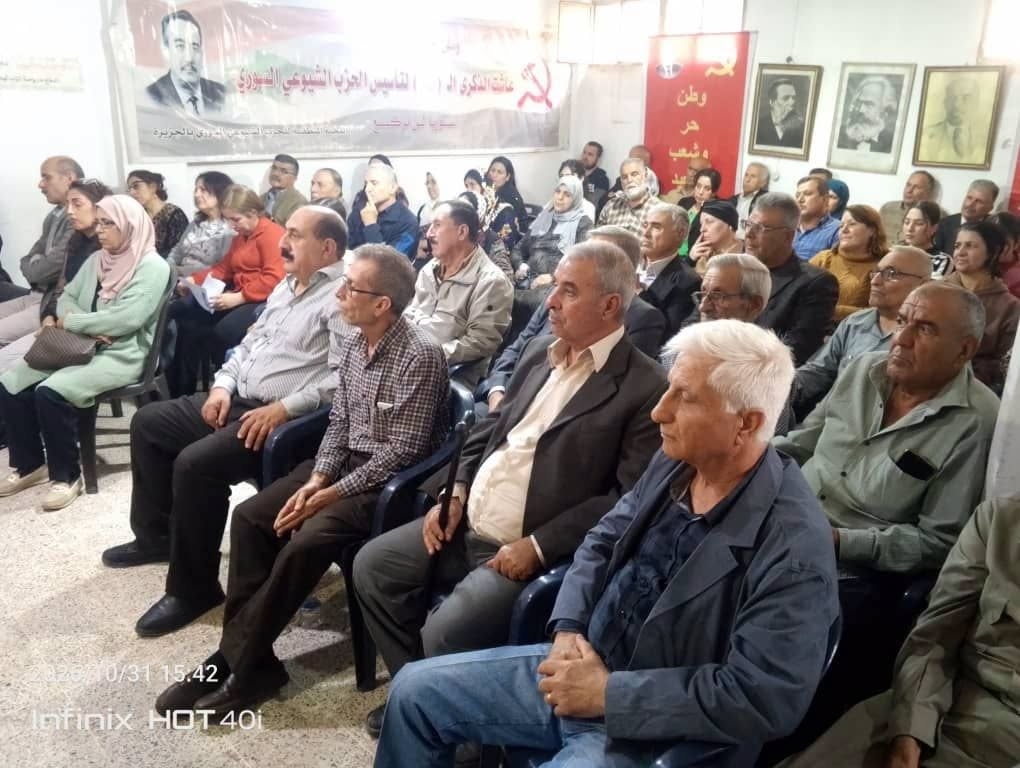
The Syrian Communist Party marked the 102nd anniversary of its foundation with political meetings organised by its local branches in Hasakah and Qamishli, in the northeastern region of Al-Jazira.
Syrian Communist Party marks 102nd anniversary with meetings in Hasakah and Qamishli
The gatherings brought together party members, supporters, young people and representatives of friendly political and social organisations. Speakers reviewed the party’s history and its role in the struggles for national independence and social rights, while discussing the political and economic challenges facing Syria and the region.
In Hasakah, the party’s local organisation held two meetings in the neighbourhoods of al-Kallasa and al-Salihiyah. Dozens of party members, friends and young people attended. The meetings opened with a minute of silence in memory of the party’s and country’s martyrs and those who had fallen in national liberation movements around the world.
Speakers recalled key stages in the party’s history, the circumstances that led to its foundation and the role of its long-time leader Khalid Bakdash in the Syrian and international communist movements. They highlighted the party’s record in defending national sovereignty, workers’ interests, progressive achievements and agrarian reform.
The discussions also addressed the policies of the current authorities in Damascus. Party representatives criticised privatisation, market liberalisation, the dismissal of tens of thousands of public-sector employees and workers, the dismantling of social protection programmes, and policies they said were undermining agricultural and industrial production. They welcomed labour and social protests in several Syrian cities, describing them as evidence of popular readiness to defend social and economic rights. The speakers also called on peasants to defend the gains of agrarian reform against attempts to reverse them.
The meeting in Hasakah included discussion of international and regional developments, including the war in Ukraine, US actions against Venezuela and threats against Cuba, and US-Israeli attacks on Iran, Lebanon and Palestine. The speakers expressed solidarity with Iran in the face of imperialist aggression. They also criticised the economic consequences of international conflicts and sanctions, particularly for working people in Syria and the wider region.
A larger political meeting was held in Qamishli under the supervision of the party’s Al-Jazira regional committee. It was attended by Abdullah Khalil, a member of the party’s Political Bureau, regional committee members, representatives of friendly national and Kurdish parties, and cultural and social figures.
The meeting included contributions from the Syrian Communist Youth Union, known as the Khalid Bakdash Youth, and the Syrian Women’s League for the Protection of Motherhood and Childhood. The youth organisation reaffirmed its commitment to defending Syria’s independence and sovereignty and to campaigning for young people’s rights to free and adequate education, decent employment and housing. The Women’s League highlighted the historical role of communist women in struggles against colonialism, exploitation and reactionary ideas. It called for equal pay, fair employment opportunities, an end to gender discrimination and the removal of legal obstacles to women’s advancement.
In his address, Mohammad Sheikhi, representing the Qamishli party organisation, reviewed the party’s involvement in the struggle against French colonial rule and its campaigns for full independence and the withdrawal of foreign forces from Syria and Lebanon. He also recalled the party’s role in organising peasants against feudal exploitation, forced labour and the arbitrary eviction of rural families, particularly in the Al-Jazira region. The speech named several communist activists who had been killed during these struggles and described agrarian reform as a major national and progressive achievement that must be defended.
Sheikhi also addressed the party’s opposition to imperialist intervention and the economic and social consequences of the capitalist crisis. Discussing the war in Ukraine, he argued that its costs were being borne by working people while monopolies accumulated wealth. On Iran, he condemned US-Israeli military attacks as violations of the sovereignty of an independent country and declared the party’s solidarity with the Iranian people.
The Qamishli meeting also set out the party’s political tasks for the current period, drawing on the positions formulated by its late General Secretary Ammar Bakdash. These include securing freedoms of assembly, demonstration, publication and the press; guaranteeing equality among citizens regardless of belief or social background; recognising the cultural rights of Syrian Kurds and other national minorities; and adopting a new constitution through a democratic process. The party also called for the protection of the public sector, support for national agricultural and industrial production, the preservation of women’s social gains and the defence of Syria’s cultural diversity.
Addressing conditions in Al-Jazira, the speaker said that the population was facing growing economic and social hardship, including insecurity, shortages of water, bread and fuel, and rising prices. He attributed these difficulties both to the policies of the authorities in Damascus and to the actions of the de facto administrations in the region.
The meeting concluded with Abdullah Khalil responding to questions from participants and explaining the party’s positions on current issues in the governorate. National songs were performed by party member Lorka Khalil, and the gathering received congratulatory messages from friendly parties and public figures.
Across both meetings, the Syrian Communist Party presented the defence of national sovereignty and democratic freedoms as inseparable from the struggle for workers’ and peasants’ rights. Its anniversary events combined a commemoration of the party’s historical record with calls to resist privatisation, defend agrarian reform and organise against the social consequences of current economic policies.