
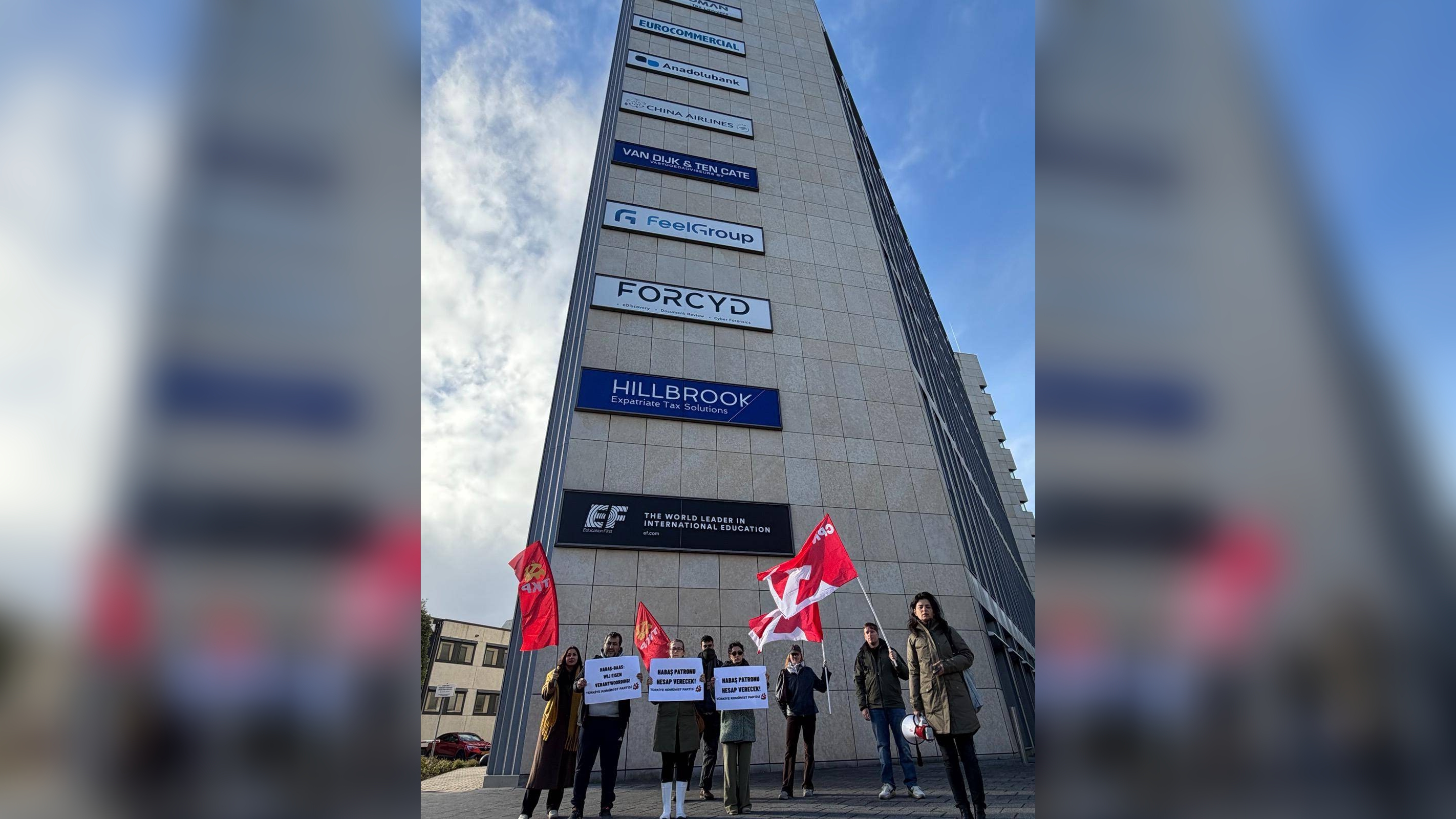
The Netherlands organisation of the Communist Party of Turkey (TKP), together with the Communist Party of the Netherlands (CPN), held a protest on 12 November outside the Amsterdam premises of HABAS International B.V., a company belonging to the Turkish HABAŞ conglomerate.
TKP and CPN protest HABAŞ in Amsterdam after factory disaster killing 19 workers
The action condemned the deaths of 19 workers in an explosion at HABAŞ's iron and steel plant in Aliağa, İzmir, and called for all those responsible to be held accountable.
During the protest, the organisers declared: “We reject a system that puts workers' lives at the mercy of profit calculations.” They called on trade unions, workers' organisations and working people in the Netherlands to demonstrate solidarity with HABAŞ workers and their families. The statement concluded: “Not one more worker should die so that the monopolies can continue accumulating wealth.”
The organisers also explained why they had chosen to protest in Amsterdam. HABAS International B.V. is directly owned by HABAŞ Sınai ve Tıbbi Gazlar İstihsal Endüstrisi A.Ş., according to Dutch company information. The Amsterdam company operates in international trade, including the wholesale trade of ferrous metals and fuels. The protest statement also pointed to the group's banking presence in the Netherlands through Anadolubank Nederland. The communists argued that the wealth generated through workers' labour in Turkey is also used to sustain the group's commercial activities abroad, and that workers' demands must therefore be heard wherever the company operates.
The disaster at the Aliağa steel plant
The protest followed a devastating explosion and fire on 9 November at HABAŞ's iron and steel plant in Aliağa, in the İzmir region of western Turkey. The explosion occurred in the steelworks section during maintenance operations involving an electric arc furnace. A component of the overhead crane structure reportedly became detached, causing the crane and its ladle to fall and triggering the explosion. The precise sequence of events and the technical causes remain subject to investigation.
The disaster initially left 17 workers dead and 15 injured, according to the prosecutor's office. The death toll subsequently rose: one injured worker died in hospital on 11 November, bringing the number of reported fatalities to 19. Several injured workers remained under medical treatment.
The scale of the disaster also brought renewed attention to earlier fatal incidents at the same plant. On 21 October, Hakan Doğan, a subcontracted worker, died after falling from a height of approximately eight metres. On 5 November, 20-year-old Eyüp Eğinli was killed when an industrial vehicle tyre exploded during inflation. According to the Workers' Health and Safety Assembly (İSİG), 21 workers died in three separate incidents at the Aliağa facility between 21 October and 9 November.
A judicial investigation was launched immediately after the explosion. Eleven people, including HABAŞ chairman Mehmet Rüştü Başaran and senior factory and technical personnel, were initially detained. On 12 November, it was reported that nine of the suspects had been remanded in custody, while Başaran and another suspect were placed under house arrest. These are judicial measures during an ongoing investigation, not final determinations of criminal responsibility.
What is HABAŞ?
Established in 1956, HABAŞ is one of Turkey's major industrial conglomerates. Its operations extend well beyond steel production to industrial and medical gases, electricity generation, heavy machinery, natural gas, liquefied petroleum gas, port and maritime services, and other industrial activities. The company describes itself as a leading producer of industrial and medical gases and a major steel producer, with an annual steel production capacity of 4.5 million tonnes. Its investments also include the banking sector.
The Aliağa plant is one of the group's major industrial facilities. The disaster has intensified scrutiny of occupational safety at the factory, particularly in light of the deaths in the weeks preceding the explosion and the employment of workers through subcontractors.
TKP demands accountability and nationalisation
The Amsterdam action forms part of a broader campaign by TKP following the disaster. The Party's İzmir organisation protested in Aliağa on 9 November, visited the factory and hospital, and sought information while expressing solidarity with workers' families. On 10 November, TKP organised another protest outside HABAŞ's headquarters in Kartal, Istanbul.
In its Central Committee statement, titled “This Brutality Must End!”, TKP rejected the description of the disaster as an isolated accident. It argued that the pursuit of profit, harsh working conditions and inadequate safety measures were inseparable from the deaths. The Party also warned that investigations must not restrict responsibility to a few workers, engineers or factory managers while overlooking the decisions of company owners and those responsible for supervision.
TKP's central demand is the immediate nationalisation, without compensation, of all enterprises belonging to HABAŞ. It argues that steel production and other major industries should operate in the interests of society, with workers' health and safety guaranteed and their labour properly remunerated. The Party has also demanded that the wages and rights of workers be protected during any production stoppage, and that the families of those killed and injured workers receive full guarantees.